


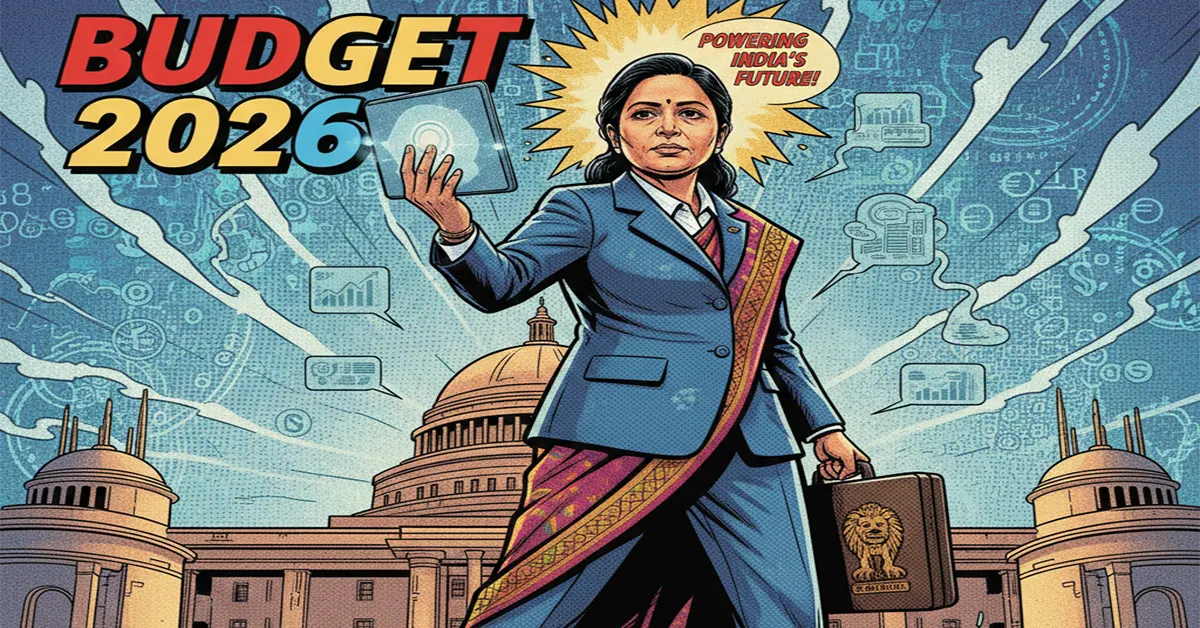

The Union Budget 2026-27 focuses on deep-tech manufacturing and AI infrastructure to boost the digital economy, as presented by the Finance Minister Nirmala Sitharaman on February 1, 2026. It aspires for technological self-reliance and better strategic digital infrastructure, with a focus on semiconductors, data centres, AI tools, and skill development, as well as long-term incentives to entice global tech investment in India.
The shift from India Semiconductor Mission (ISM) 1.0 to 2.0 aims to strengthen India’s position in the semiconductor industry by moving up the value chain. The major goal is to transition from just assembling imported components to producing and holding intellectual property (IP) specific to India. This strategic move intends to reduce the high import costs associated with semiconductors while also increasing India’s impact in the global technology setting, especially in light of ongoing technical competitions.
The government has set aside Rs 1,000 crore for the fiscal year 2026-27 to help with this transition. The funds would go toward industry-led research and the building of training institutes. The money will help with the design and production of Indian IP and the making of semiconductor equipment, which are very important for making chips. India wants to make the semiconductor ecosystem more self-sufficient and strong by putting money into these areas. This would help the country compete better in the global market.
The National Quantum Mission has been given an additional Rs 900 crore in funding, showing that India is serious about moving forward with quantum technology projects. The SHAKTI program would also benefit the biopharmaceutical industry. It will spend Rs 10,000 crore over five years to improve India’s ability to make biologics and biosimilars. Also, setting up Rare Earth Corridors in places like Odisha and Tamil Nadu is an intelligent approach to protect the supply chains for important minerals that are needed to make electric vehicle (EV) batteries and smartphones.
The Electronics Components Manufacturing Scheme (ECMS) has gotten a big upgrade, with the budget going from Rs 22,919 crore to Rs 40,000 crore. The primary objective of this significant financial boost is to leverage twice the projected investment commitments from 2025. This will help add more value to electronics production in the area.
The Indian government has offered a full tax break for international companies that use Indian data centres to provide worldwide cloud services. This is part of an effort to make India a major player in the global AI and cloud infrastructure market. This tax break will last until 2047, but only if services are provided to Indian customers through resellers in India. This strategic move is part of larger national AI missions, such as the Bharat-VISTAAR program, which is an example of continuous funding efforts to use AI technologies in important areas like agriculture and healthcare.
The reason for the 2047 deadline is in keeping with India’s Viksit Bharat 2047 vision, which lays out an ambitious plan for the country’s growth over the next 20 years. This plan guarantees policy consistency that is frequently lacking from tax systems around the world. In addition, this action is considered a tactical move to gain more control over data management. The government wants to keep control of the economy and make sure that foreign cloud services use Indian resellers. This will protect the country’s data security and economic interests while also bringing in global investment in its digital infrastructure.
India is making big changes to its policies to become a global centre for artificial intelligence (AI) and cloud infrastructure. For example, global businesses that use Indian data centres to deliver cloud services to Indian clients would not have to pay taxes on those services until 2047. The goal of this project is to bring in foreign investors and help the growth of AI technologies in the country.
At the same time, the government is still committed to national AI missions, with an emphasis on using AI in different areas, including agriculture and healthcare. One program that stands out is Bharat-VISTAAR, which aims to move AI applications from academic settings to real-world use. Bharat-VISTAAR wants to give farmers a “digital consultant” that makes it easier for them to access complicated agricultural research and useful information through an AI tool that can speak multiple languages.
Also Read: Samsung Galaxy F70 India Series India launch confirmed
AI is also being used in logistics to make things safer and more efficient. For example, non-intrusive AI scanning devices at ports speed up trade and improve national security. This comprehensive strategy demonstrates India’s significant investment in AI as a transformative force for both the economy and security.
The budget acknowledges that creating digital content is becoming more and more significant, especially in the Animation, Visual Effects, Gaming, and Comics (AVGC) sector. One of the main goals is to set up Content Creator Labs in partnership with the Indian Institute of Creative Technologies in Mumbai. The plan is to establish these labs in 15,000 secondary schools and 500 institutions. This program aims to help create a trained workforce that can fill the two million jobs that are expected to be available in this field by 2030. These facilities will help create jobs and support the expansion of the AVGC industry.


