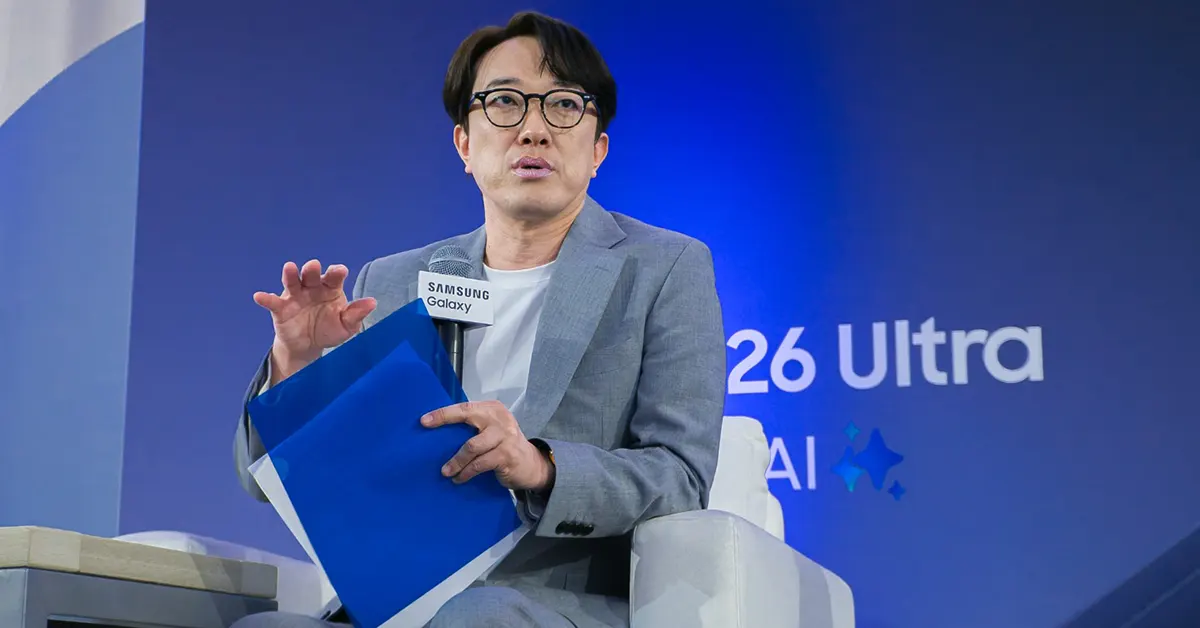
Recently, I had the opportunity to speak with Samsung MX COO Won-Joon Choi and gain his insights. Based on remarks from him and Samsung Southwest Asia chief JB Park, the Galaxy S26 series is being framed as a hardware-first flagship family that also wants AI to do more of the work in the background quietly. That means better cameras, stronger battery life, faster charging, and a new software direction Samsung is calling AI OS.
In This Article
Samsung’s big S26 pitch is balance, not buzz
If there is one clear message from Choi’s address, it is this: Samsung says it studied what buyers still care about most before building the Galaxy S26 lineup. The answer was not mysterious. Performance, camera quality and battery life remain the top buying factors, and Samsung claims the S26 series was designed to balance those fundamentals with newer AI experiences. That is a smart shift in messaging because smartphone buyers may enjoy AI demos, but most still notice bad battery life faster than clever software.
Samsung’s official messaging describes the Galaxy S26 series as its most intuitive Galaxy AI phone yet, with proactive features such as Now Nudge, a more personalised Now Brief, upgraded Circle to Search, and a more conversational Bixby. It also confirms that Gemini and Perplexity are part of the mix, signalling that Samsung is no longer treating AI as a one-assistant world. That openness lines up neatly with Choi’s three stated principles for Galaxy AI: reach, openness and trust.
Read Also: Samsung Galaxy S26 series bets big on agentic AI, privacy and India’s role in innovation
AI OS and agentic AI are Samsung’s next software bet
The phrase Samsung AI OS may sound ambitious, but Samsung’s description is fairly practical. Choi says the company is integrating AI engines and functions at the OS layer so apps and services can deliver more agentic experiences. In simple terms, Samsung wants the phone to move from answering questions to handling intent, planning steps and helping execute tasks across apps.
Samsung says the S26 can complete multi-step actions more seamlessly, and that agent choices include Bixby, Gemini and Perplexity. In the Q and A, Choi also pointed to early partner integrations with Uber, DoorDash and Starbucks, with broader app and language support expected to expand over time. English and Korean appear to be the starting point for the initial wave. Indian languages will soon come into play.
This is where Samsung’s argument gets interesting. Choi openly suggested some utility apps could fade into the background in an agentic AI smartphone future, while content apps like Netflix or Spotify would likely remain. That is a more nuanced take than the usual “AI replaces everything” hype. It also feels closer to what users may actually accept.
Charge better
On charging, Samsung says the Ultra supports fast top-ups with a 60W adapter (sold separately). That aligns with Choi’s remarks that Samsung’s own Samsung 60W charger would be available at launch and that standard-compliant third-party chargers should also work, and more are being built with compatible third-party vendors.
Read Also: Samsung Galaxy Buds 4 Pro Review: Cut Above The Noise
Privacy Display is the headline feature
The standout hardware story is clearly the Galaxy S26 Privacy Display on the Ultra. Samsung says it is the mobile industry’s first built-in privacy display for smartphones, designed to limit side-angle viewing without the usual downsides of a stick-on privacy screen.
That matters because it turns privacy from an accessory into a native feature. Choi also suggested the technology could expand over time to more Galaxy devices, though foldables still present structural challenges. He further said Samsung is studying whether the same approach makes sense for products like Galaxy Book laptops. If Samsung can scale this well, Privacy Display could become one of those features rivals quickly try to imitate. For now, though, Samsung has found a rare smartphone talking point that feels instantly understandable to regular users.