


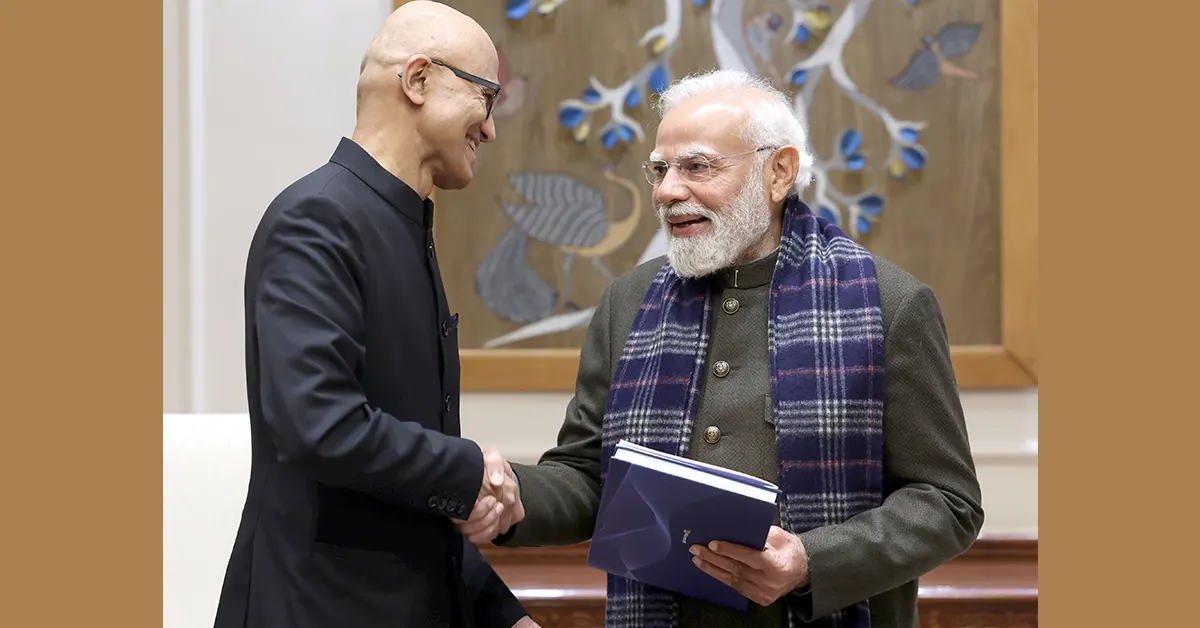
Microsoft India AI investment is no longer a talking point; it now has a dollar figure that is hard to ignore. After meeting Prime Minister Narendra Modi, Microsoft CEO Satya Nadella has committed 17.5 billion US dollars, roughly Rs 1.5 lakh crore, to support what he calls India’s “AI first future.” The money will be spent over four years and is described as Microsoft’s largest investment in Asia, aimed at building infrastructure, skills and sovereign capabilities around artificial intelligence.
In This Article
India gets Microsoft’s biggest Asia bet
During his meeting with PM Modi, Nadella thanked the Prime Minister for an “inspiring conversation on India’s AI opportunity” and publicly announced the plan to invest 17.5 billion dollars in the country. The timing is not accidental. India has a massive internet population, a growing developer base and a government that is pitching AI as a national priority.
Read Also: Lava Play Max 5G with 5000mAh battery launched in India
For Microsoft, this is not a fresh start but a serious scale-up. Earlier this year, the company had already announced a 3 billion dollar investment in India’s AI and cloud infrastructure over two years. The new commitment lifts the total to 20.5 billion dollars by 2029, signalling that India is central to its global AI roadmap rather than just another regional market.
What the 17.5 billion dollars will actually fund
The investment is expected to flow into three big buckets:
-
New and expanded data centres to handle AI and cloud workloads
- Advertisement - -
Sovereign cloud and AI capabilities that respect India’s data rules
-
Skilling initiatives for students, developers and enterprises
Microsoft plans to build and expand hyperscale data centres in cities such as Hyderabad, Chennai and Pune, boosting local compute capacity for AI workloads. This matters because training and running modern AI models need serious hardware, and hosting that capacity inside India can cut latency, improve reliability and support data localisation.
On the sovereign front, Microsoft is talking about infrastructure and services that align with Indian regulations and sector-specific requirements. For Indian banks, healthcare providers or government departments, this pitch of “AI plus control over your data” will be a big part of the story.
Read Also: Poco C85 5G with MediaTek Dimensity CPU debuts in India
Skilling, youth and the AI talent race
Any AI-first future India imagines will fall flat without people who can actually build and manage these systems. Alongside the investment figure, Microsoft is pushing hard on skilling. The company has set a target to train tens of millions of Indians in AI skills by 2030, including students, working professionals and developers.
Expect more:
-
Curriculum tie-ups with universities
-
Certification programs on AI development and safety
-
Enterprise workshops on deploying AI responsibly
-
Support for startups through credits and mentorship
For India’s youth, AI skilling is already turning into the new buzzword on campus. The upside is more opportunities and better pay for those who adapt. The risk is a wider gap between those who get access to quality training and those who are left trying to compete with basic skills.
India in the global tech AI race
This move also has to be seen alongside foreign AI investments India has attracted in recent months. Google has announced a 15 billion dollar plan to build a 1 gigawatt AI hub and data centre campus in Visakhapatnam, pitched as its largest AI facility outside the United States. Amazon, on its part, has outlined plans to invest over 35 billion dollars in India by 2030 to boost AI capabilities, logistics and exports.
Put together, this places India squarely inside a global tech AI race where cloud giants want three things from the country:
-
Huge demand for digital and AI services
-
A massive pool of engineering and data science talent
-
A relatively stable regulatory environment compared with some other large markets
For India, the opportunity is to convert this capital into long-term capacity rather than just short-term headline numbers.
What it could mean for users and businesses
If these plans roll out as promised, Indian consumers may see AI woven more deeply into everyday services. That could mean better language support in Indian languages, more accurate digital public services and smarter features inside familiar apps.
For businesses, especially startups and small enterprises, the headline benefit is access to powerful AI tools and India AI data centres without needing to build their own expensive infrastructure. Lower latency, local hosting and more predictable pricing can make it easier to build products for both India and the rest of the world.
Large enterprises may use this moment to modernise legacy systems, introduce AI-powered analytics and experiment with automation across supply chains, finance and customer service. The flipside is that they will also have to upskill teams, invest in cybersecurity and navigate new compliance questions around AI.
Read Also: Blue Lock: Rivals Codes (December 2025)
Hon’ PM Modi, Nadella and the messaging around AI
PM Modi has framed the meeting and the investment as proof that “when it comes to AI, the world is optimistic about India.” Nadella, in turn, has positioned Microsoft as a long-term partner that wants to help build infrastructure, skills and sovereign capabilities rather than just sell more cloud services.
The political message is clear. India wants to be seen as a responsible, opportunity-rich AI hub. Microsoft wants to be seen as the global tech partner that backs that ambition with money, hardware and training.
A big cheque is a start, not a finish line
Seventeen and a half billion dollars will grab headlines, and probably should. But a large cheque by itself does not guarantee an AI-first future that India can feel in daily life. The real success of this Microsoft India AI investment will depend on three quieter things: whether infrastructure actually reaches beyond a few metro cities, whether skilling programs benefit more than a small urban elite, and whether regulation keeps both innovation and misuse in check. If those pieces fall into place, this will not just be Microsoft’s biggest Asia bet. It could be the moment India stops talking about AI potential and starts living with AI at the population scale.


