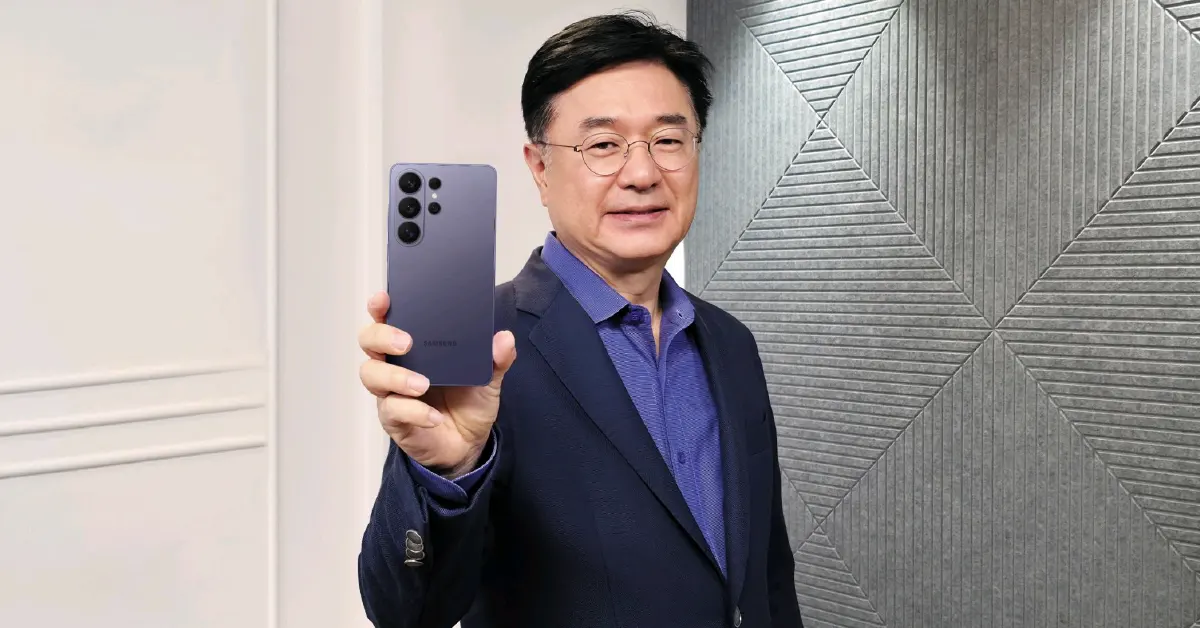
The Samsung Galaxy S26 agentic AI story is not just about another flagship phone getting faster chips and shinier camera tricks. According to Mr JB Park, President and CEO of Samsung Southwest Asia, who was kind enough to tell us his Anti-Ageing secrets (amongst other things), on a serious note, he told Gadget Bridge that the Galaxy S26 series is Samsung’s attempt to make AI less like a feature list and more like an invisible co-pilot. At a roundtable in San Francisco ahead of Unpacked on February 24, 2026, Mr Park framed the Galaxy S26 lineup as a major shift in how Samsung wants users to experience smartphones, with privacy, control and local relevance sitting at the centre of the pitch.
That matters because the smartphone industry is now at an awkward yet fascinating stage. Hardware still matters, obviously. Nobody wants a sluggish premium phone with a great AI pitch deck. But the bigger battle is increasingly about what the phone can do quietly, intelligently and without turning the user into a settings manager. Samsung’s message here is simple. The Galaxy S26 is meant to work harder in the background so people do less in the foreground.
Read Also: Nothing Headphone (a), featuring a 40mm driver with a titanium coating launched
In This Article
Galaxy S26 aims to make AI feel less robotic
Mr Park described the Galaxy S26 series as the start of a new direction built around agentic AI. In plain English, that means the phone is expected to understand context, connect apps and complete tasks with less manual input from the user. Rather than asking people to learn new commands or juggle multiple apps, Samsung is of the idea that the device should understand intent and carry out actions more naturally. And we agree.
That is a timely pitch. AI on smartphones has often felt like a scattered collection of demos looking for a daily habit. Samsung’s approach with the S26 series, at least from this briefing, is to reduce friction and give users a choice of AI agents instead of forcing a one-model future. Mr Park said many users already rely on more than one AI tool, and Samsung wants Galaxy AI to support that kind of flexibility rather than lock people into a single assistant.
This is where the Galaxy S26 Ultra’s privacy display, Galaxy AI user control, and Samsung Knox AI security narrative become important. Samsung knows that the more capable AI becomes, the more people worry about where their data goes, who sees it, and whether convenience quietly becomes surveillance in nicer packaging.
Privacy takes centre stage on Galaxy S26 Ultra
One of the most interesting announcements from the session was the privacy display on the Galaxy S26 Ultra. Samsung says this is not a stick-on privacy filter or a crude afterthought. Instead, it is integrated into the display itself, allowing users to limit side-angle visibility while preserving the normal viewing experience. Mr Park also suggested users can apply privacy to selected parts of the screen and customise when it activates.
If that works well in real life, it could be one of the more practical premium-phone additions in a while. Smartphone privacy is often sold through abstract promises. A built-in privacy display sounds refreshingly tangible.
Samsung also leaned hard on on-device processing and user consent. According to Mr Park, personal context processing keeps sensitive information on the device, while users remain in control over when information is shared with partner AI agents. He also said partner interactions through Samsung apps such as Notes, Calendar, Gallery, Reminder and Clock will include controls over whether data can be used to train models or for targeted advertising. The company’s on-device AI privacy message is clear. AI should help without becoming nosy.
Privacy Alerts are another part of that strategy. Samsung says the feature can notify users when apps try to access sensitive permissions such as precise location, contacts or call logs. In a market where most people tap “allow” faster than they read terms, that kind of nudge could prove genuinely useful.
India is not just a market, but a major development hub
For Indian readers, one of the biggest takeaways from the roundtable is Samsung’s insistence that India is not merely a sales market for the Galaxy S26 series. Mr Park positioned India as a strategic pillar in Samsung’s global innovation ecosystem. He said engineers in Bengaluru and Noida have played meaningful roles in the development of the S26 lineup, especially around AI algorithms, component calibration, camera tuning and localisation across markets.
That is a significant detail, and not just because it sounds good in a keynote room. Samsung also said the Galaxy S26 series will be manufactured at its Noida factory, underlining India’s role in both engineering and production.
Samsung also acknowledged that AI needs local context. Mr Park pointed to India’s multilingual reality, noisy environments, startup ecosystem and different camera usage patterns as areas where localisation matters. That gives weight to keywords like India-made Galaxy S26 and Samsung AI ecosystem India, which are likely to resonate strongly with readers tracking how global tech brands tailor products for Indian consumers.
Read Also: Apple Music Adds AI Transparency Tags For Music Content
The bigger picture
Samsung’s Galaxy S26 pitch, at least from this roundtable, is not really about making the loudest AI claim in the room. It is about making AI useful without making it creepy, powerful without making it complicated, and local without making it feel fragmented. That is a harder trick than it sounds.
The real test, of course, will come after the stage lights dim. Agentic AI is a bold phrase. People will judge the Galaxy S26 series not by how fluently executives describe it, but by whether it actually saves time, protects privacy and feels smarter in everyday use. Still, if Samsung can deliver even half of what it outlined in San Francisco, the Galaxy S26 series may end up being remembered as the moment AI on smartphones finally stopped shouting and started helping. Stay tuned as Gadget Bridge will bring you reviews of all 3 devices launched at Galaxy Unpacked 2026, starting with the Samsung Galaxy 26 Ultra.