Garena Free Fire (GFF) Max is a battle royale game with regular awards and tournaments to keep players interested. If you play GFF, you should be aware of the redeem codes that are released on a daily basis. However, because the battle royale game is banned in India, players from other countries can use theFree Fire Redeem codes daily. If you’re unfamiliar with the codes or don’t know how to get them, we’ve put together a step-by-step guide to help youredeem them. Check out Garena Free Fire Max Redeem Codes for 6 March 2026.
These codes are a great way to get free items in the game. The 12-digit codes contain letters and numbers, as well as an expiration date and time. Because the Garena FF redeem codes cannot be used more than once, you should hurry to the redemption page to claim your free reward before someone else does. To get a free reward, all you have to do is go toreward.ff.garena.com/en, which is the official redemption page. Also, keep an eye on this space for daily updates on Gadget Bridge on GFF Max redemption codes and rewards.
The Samsung Galaxy S26 agentic AI story is not just about another flagship phone getting faster chips and shinier camera tricks. According to Mr JB Park, President and CEO of Samsung Southwest Asia, who was kind enough to tell us his Anti-Ageing secrets (amongst other things), on a serious note, he told Gadget Bridge that the Galaxy S26 series is Samsung’s attempt to make AI less like a feature list and more like an invisible co-pilot. At a roundtable in San Francisco ahead of Unpacked on February 24, 2026, Mr Park framed the Galaxy S26 lineup as a major shift in how Samsung wants users to experience smartphones, with privacy, control and local relevance sitting at the centre of the pitch.
That matters because the smartphone industry is now at an awkward yet fascinating stage. Hardware still matters, obviously. Nobody wants a sluggish premium phone with a great AI pitch deck. But the bigger battle is increasingly about what the phone can do quietly, intelligently and without turning the user into a settings manager. Samsung’s message here is simple. The Galaxy S26 is meant to work harder in the background so people do less in the foreground.
Mr Park described the Galaxy S26 series as the start of a new direction built around agentic AI. In plain English, that means the phone is expected to understand context, connect apps and complete tasks with less manual input from the user. Rather than asking people to learn new commands or juggle multiple apps, Samsung is of the idea that the device should understand intent and carry out actions more naturally. And we agree.
That is a timely pitch. AI on smartphones has often felt like a scattered collection of demos looking for a daily habit. Samsung’s approach with the S26 series, at least from this briefing, is to reduce friction and give users a choice of AI agents instead of forcing a one-model future. Mr Park said many users already rely on more than one AI tool, and Samsung wants Galaxy AI to support that kind of flexibility rather than lock people into a single assistant.
This is where the Galaxy S26 Ultra’s privacy display, Galaxy AI user control, and Samsung Knox AI security narrative become important. Samsung knows that the more capable AI becomes, the more people worry about where their data goes, who sees it, and whether convenience quietly becomes surveillance in nicer packaging.
Privacy takes centre stage on Galaxy S26 Ultra
One of the most interesting announcements from the session was the privacy display on the Galaxy S26 Ultra. Samsung says this is not a stick-on privacy filter or a crude afterthought. Instead, it is integrated into the display itself, allowing users to limit side-angle visibility while preserving the normal viewing experience. Mr Park also suggested users can apply privacy to selected parts of the screen and customise when it activates.
If that works well in real life, it could be one of the more practical premium-phone additions in a while. Smartphone privacy is often sold through abstract promises. A built-in privacy display sounds refreshingly tangible.
Samsung also leaned hard on on-device processing and user consent. According to Mr Park, personal context processing keeps sensitive information on the device, while users remain in control over when information is shared with partner AI agents. He also said partner interactions through Samsung apps such as Notes, Calendar, Gallery, Reminder and Clock will include controls over whether data can be used to train models or for targeted advertising. The company’s on-device AI privacy message is clear. AI should help without becoming nosy.
Privacy Alerts are another part of that strategy. Samsung says the feature can notify users when apps try to access sensitive permissions such as precise location, contacts or call logs. In a market where most people tap “allow” faster than they read terms, that kind of nudge could prove genuinely useful.
India is not just a market, but a major development hub
For Indian readers, one of the biggest takeaways from the roundtable is Samsung’s insistence that India is not merely a sales market for the Galaxy S26 series. Mr Park positioned India as a strategic pillar in Samsung’s global innovation ecosystem. He said engineers in Bengaluru and Noida have played meaningful roles in the development of the S26 lineup, especially around AI algorithms, component calibration, camera tuning and localisation across markets.
That is a significant detail, and not just because it sounds good in a keynote room. Samsung also said the Galaxy S26 series will be manufactured at its Noida factory, underlining India’s role in both engineering and production.
Samsung also acknowledged that AI needs local context. Mr Park pointed to India’s multilingual reality, noisy environments, startup ecosystem and different camera usage patterns as areas where localisation matters. That gives weight to keywords like India-made Galaxy S26 and Samsung AI ecosystem India, which are likely to resonate strongly with readers tracking how global tech brands tailor products for Indian consumers.
Samsung’s Galaxy S26 pitch, at least from this roundtable, is not really about making the loudest AI claim in the room. It is about making AI useful without making it creepy, powerful without making it complicated, and local without making it feel fragmented. That is a harder trick than it sounds.
The real test, of course, will come after the stage lights dim. Agentic AI is a bold phrase. People will judge the Galaxy S26 series not by how fluently executives describe it, but by whether it actually saves time, protects privacy and feels smarter in everyday use. Still, if Samsung can deliver even half of what it outlined in San Francisco, the Galaxy S26 series may end up being remembered as the moment AI on smartphones finally stopped shouting and started helping. Stay tuned as Gadget Bridge will bring you reviews of all 3 devices launched at Galaxy Unpacked 2026, starting with the Samsung Galaxy 26 Ultra.
Being one of the most popular contemporary anime, One Piece enjoys a lot of popularity on Roblox as well. One Fruit Simulator is one of our favourite games based on the anime. It puts you on the journey to become the Pirate King and throws different kinds of battles along the way. To give you the edge in these battles, the game offers some special codes that can be redeemed for useful items. Here are all the One Fruit Simulator codes available in March 2026.
Hit the Menu button in the bottom left corner of the screen.
Tap the Heart icon.
Enter your YouTube Channel ID and a working code in their respective text fields.
Hit Redeem.
Frequently Asked Questions (FAQs)
Why is my code not working?
If you can’t get your code to work, check it for typos and make sure its letters are in uppercase.
How do I redeem a code in this game?
Launch One Fruit Simulator, hit the Menu icon, tap the Heart icon, enter your YouTube Channel ID, type the code, and hit ‘Redeem’.
How do I find my YouTube Channel ID?
Go to YouTube on your PC or mobile browser, tap your profile picture, and navigate to Settings>Advanced Settings. This is where you will find your YouTube Channel ID. Alternatively, click this link to go directly to YouTube Advanced Settings.
Why am I not able to redeem my code in this game?
If your code has expired, it can no longer be redeemed in Roblox.
Where can I find the newest Roblox codes?
Keep checking the Gadget Bridge home page for the latest Roblox code drops.
One Fruit Simulator is not the only One Piece adaptation on Roblox. Superfans of the anime can also check out titles like King Legacy and Blox Fruits on the platforms. While you’re here, take a look at the latest Basketball Zero codes as well. If you have any questions, let us know in the comments!
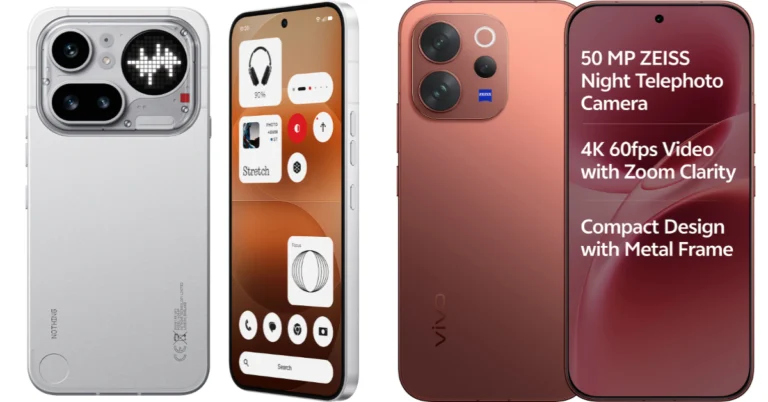
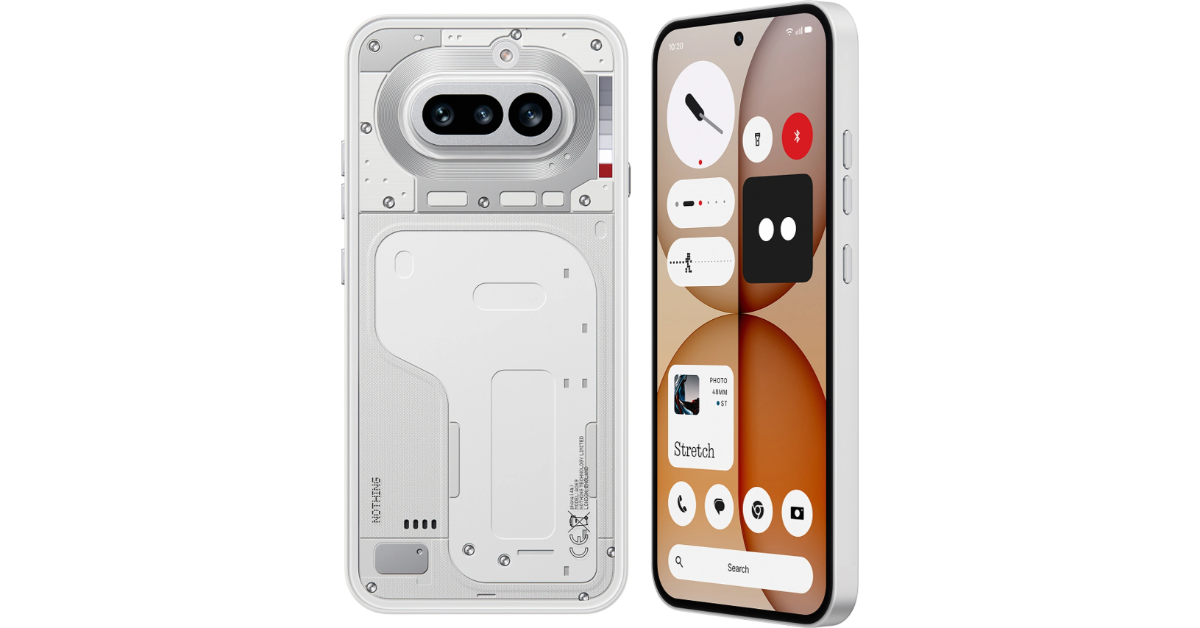
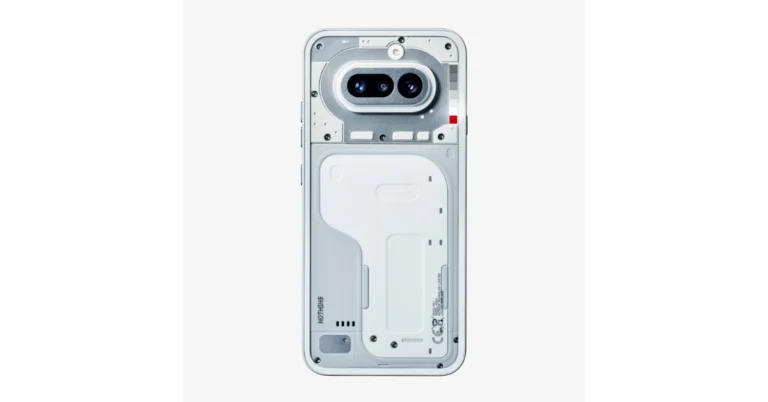
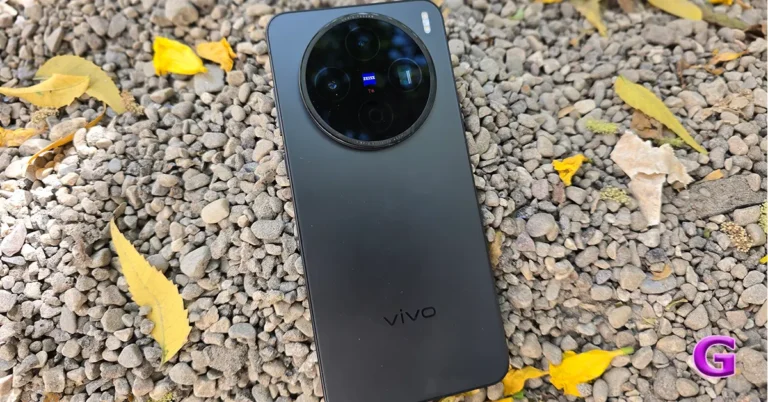
The Nothing Phone 4a Pro recently launched in India, although it isn’t for sale yet. We compared the Android phone against the Vivo V70 before it went on sale. Both phones are new to the mid-range market in 2026. Let’s find out which of the two devices offers better value for money.
The Nothing Phone 4a Pro has a wonderful 6.83-inch display with a 144Hz refresh rate and a peak brightness of 5,000 nits, which is perhaps the best in its price category. The Vivo V70, on the other hand, is better at taking pictures since it has ZEISS optics and Sony sensors. It has better colour science, works better at night, and has a better 50MP selfie camera.
The Phone 4a Pro has a metal unibody and a new Glyph Bar with changeable mini-LEDs that are 40% brighter, which serve as a useful notification light system. This feature makes it a useful notification light system. The V70’s sturdy construction is certified IP68/IP69 for water and pressure resistance, and it has a 3D ultrasonic fingerprint sensor that is quicker and more reliable than many other optical sensors on the market.
The 4a Pro runs on Nothing OS 4.1, which is recognised for its clean, bloat-free Android experience. Now it has Gemini Live AI capabilities that make it even better. The Vivo V70, on the other hand, has a big 6,500 mAh BlueVolt battery that beats the Nothing Phone and supports 90W fast charging, which lets you charge it quickly.
The Nothing Phone 4a Pro is a great choice for tech enthusiasts because of its distinctive appearance, fast gaming screen, and advanced software, all at a good price. On the other hand, the Vivo V70 is a better pick, even if it costs more. It has a longer battery life, charges quicker, has a better front camera, and is more water-resistant.
The game adaptation of Kuroko’s Basketball is worth a shot if you’re a fan of the anime. It incorporates pieces of the anime’s storyline into its gameplay and fuses it with competitive matches where you can flaunt your skills. To help you get ahead of your competitors, the game offers some special codes that can be redeemed for useful items. Here are all the Basketball Zero codes that are up for grabs in March 2026.
Hit the Codes button at the bottom of the homepage.
Enter or paste the code in the text field.
Hit Redeem.
Frequently Asked Questions (FAQs)
Why is my code not working?
If you can’t get your code to work, check it for typos and make sure its letters are in uppercase.
How do I get free cash in this game?
Use codes FRIDAYUPD, 30FRIDAYUPD, and 1HRFRIDAYUPD to get free cash in Basketball Zero.
How do I redeem a code in this game?
You need to join the Current community and like Basketball Zero’s Roblox page in order to redeem a code. Once that’s done, launch the game, hit the Codes button, enter the code in the text field, and hit ‘Redeem’.
Why am I not able to redeem my code?
If your code has expired, it can no longer be redeemed in Roblox.
Where can I find the newest Roblox codes?
Keep checking the Gadget Bridge home page for the latest Roblox code drops.
Fans of Basketball Zero must also check out other sports-based Roblox games like Endzone Strike and NFL Universe Football. While you’re here, take a look at the latest Roblox Fisch codes as well. If you have any questions, let us know in the comments!
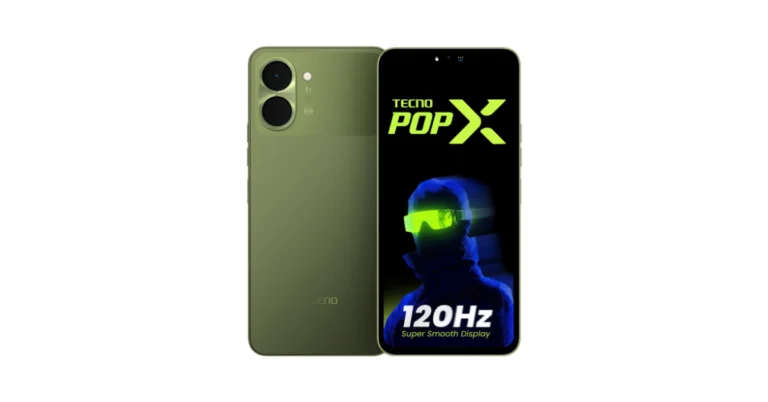
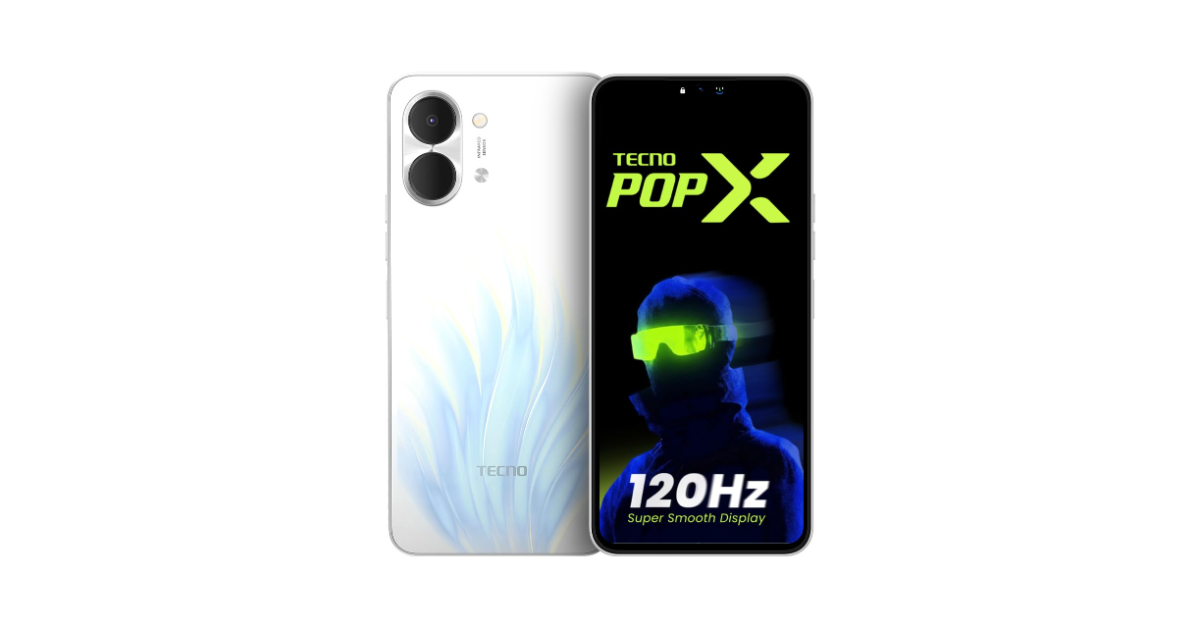
The Tecno Pop X has been released in India as an affordable smartphone with a 5,000mAh battery for prolonged use, a 13-megapixel back camera, and an 8-megapixel front camera. It has a 120Hz refresh rate LCD screen for fluid graphics and is IP64 certified for dust and water protection. Sales in India begin on March 6, and the phone allows calls between nearby users without a cellular network connection.
In This Article
Price in India, Availability
The Tecno Pop X is priced at Rs 8,499 in India.
The smartphone has 4GB of RAM and 64GB of storage capacity.
Available colours include Chilly Green and Flare White.
The gadget will be available via Amazon and other retail channels beginning March 6.
As part of its special launch deal, the company is offering the Tecno Pop X smartphone at a considerable discount of Rs 7,749. This discount is available to consumers who purchase the phone using only HDFC Bank cards, making it an appealing offer for those wanting to get this device.
Specifications and Features
The Tecno Pop X has a 6.75-inch HD+ LCD display with a resolution of 720×1,600 pixels. It has a 120Hz refresh rate and a pixel density of 260 pixels per inch (ppi), which improves the visual experience for consumers. Furthermore, the Pop X has an IP64 classification, which indicates its resistance to dust and light splashes of water, increasing its endurance for daily usage.
The smartphone runs on the Android 15 platform and is complemented with the HiOS 15 user interface, which offers a user-friendly experience.
The Pop X, a dual SIM smartphone, is powered by a 12nm octa-core Unisoc T7250 CPU, which ensures efficient performance. It has 4GB of LPDDR4x RAM, which allows for multitasking, and 64GB of eMMC storage for files and media.
The Tecno Pop X has a 13-megapixel back camera with an f/1.85 aperture, despite the fact that its rear panel seems to have two sensors. The gadget is equipped with an 8-megapixel front-facing camera for taking selfies.
The Tecno Pop X smartphone comes with a number of features designed to improve user ease and connectivity. It has a side-mounted fingerprint scanner for secure access, which improves its usability. The gadget is powered by a powerful 5,000mAh battery that can be charged at a rate of 15W, with a 10W adapter included in the box. The Pop X offers a wide range of connectivity options, including 4G LTE networks, Wi-Fi, Bluetooth version 5.2, GPS, and a USB Type-C port for convenient data transfer and charging. In addition, the smartphone has an infrared (IR) transmitter, which allows users to manage home appliances directly from the device. It also keeps a 3.5mm headphone connector.
Amazon Quiz 6 March 2026: The New Daily Quiz is now available. Customers from different parts of the country are participating in the daily quiz. The quiz starts at midnight today and will be live until 11:59 PM tonight. By successfully answering every question, participants in the quiz have the chance to win wonderful rewards. Up to Rs 500 Amazon Pay Balance is up for grabs for participants today.
One wrong answer could eliminate you from the quiz. You have a chance to win up to Rs 500 Amazon Pay Balance if you successfully answer every question. Users of the app only have the opportunity to take the quiz. Check Out the 6 March 2026 Quiz.
In This Article
Are you not able to find Amazon FunZone? Click below and participate.
We have written an explainer above; you can refer to that.
When are the winners of the Quiz and contest announced or declared?
The announcement of today’s quiz winner will take place Tomorrow. As for the Special Quiz and “Spin & Win” Contest, the winners will be declared once the Quiz Contest comes to an end. To find out who the lucky winner is, you can refer to the Winners List or visit the Amazon Winners tab in the Amazon App.
How to participate in the Daily Amazon Quiz?
That is very easy, just got to the Amazon app and scroll to the bottom of the page and you will find the Quiz section. Click on it (usually it is called the fun zone) and you can enter the Amazon Today Quiz Contest.
Are there any other quizzes or contests running on Amazon daily?
Yes, there are many running daily. These range from spinning the wheel to answering the questions correctly. All are located in the Fun Zone.
What are the criteria for selecting a winner in the Daily Amazon Quiz?
When a qualified player submits correct answers to all the questions, they will automatically be entered into a lucky draw. This draw will include all participants who answered all the questions correctly. Amazon randomly selects the final winners from the pool of eligible participants who gave the right answers.
Which Types of Questions are asked within the Amazon Daily Quiz?
These are very simple and straightforward questions. These are mainly related to general knowledge.
Where should I look for Amazon Daily Quiz answers?
You can bookmark our website www.gadgetbridge.com as we will help you every day with the Amazon Daily Quiz. We bring you fresh answers every day for the Amazon Daily Quiz and Contest.
What time does Amazon announce previous winners?
The previous winner’s name will be announced today at 12 PM (noon).
Are you looking for today’s Wordle answer for March 6, 2026? The problem is difficult to solve, so if you need assistance, we’ve included hints and the clue to today’s Wordle Quiz. Below, we have made it simple for everyone to understand how to get to the Wordle Answer today.
In This Article
Hints and Answers for Today’s Wordle March 6
Before answering directly, please check the Wordle Hints first.
Hint 1: Today’s Wordle answer includes a vowel. Hint 2: The answer for today has no repeating letter. Hint 3: Meaning- unpleasantly sticky or messy
What word does today’s Wordle begin with?
Do you need help with today’s Wordle answer’s initial letter?
The first letter in today’s Wordle is “G”
Today’s Wordle Answer
The answer to Wordle #1721 on March 6, 2026, is — GUNKY
Wordle: A Five-Letter Word Guessing Game • The game allows six guesses of a five-letter word. • Provide feedback on the guessed letters’ placement in the puzzle. • The New York Times purchased the game in 2022. • Created by Josh Wardle for his partner, narrowing down 12,000 English words to 2,500. • Named after the word “word.”
How To Play Wordle?
Wordle is a New York Times word puzzle game that allows users to guess a five-letter word in six attempts. The letters are highlighted in Yellow and Green, indicating whether the word is present in the answer or not, and Green letters indicate the correct guess.
Select a powerful starting word: Avoid using unusual words, as they frequently do not match common letters. A good opening word has plenty of benefits.
Repeating letters: Don’t be afraid of repeating letters; they appear frequently in words. The answer may contain one or two repeated letters.
Use the Wordlebot: The NYT’s Wordlebot analyses and compares replies to itself. This challenge can assist you in enhancing your guessing skills and highlighting areas for development.
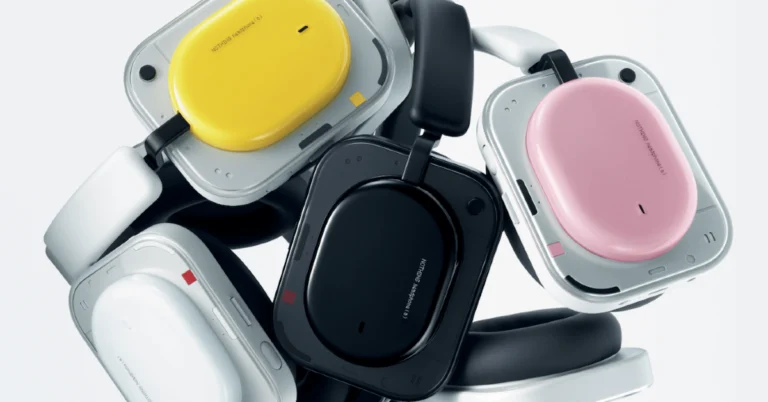
The Nothing Headphone (a) has been released across the world, adding to the brand’s set of over-ear audio products. This model has adaptive active noise cancellation (ANC) and breathable memory foam ear cushions for comfort. It has Nothing’s roller and paddle controls that allow for user customisation. The battery lasts a long time—up to 135 hours.
In This Article
Pricing and Availability
The Nothing Headphone (a) costs £149 in the UK (about Rs 18,200), $199 in the US (also around Rs 18,200), and €159 in Europe (about Rs 17,000).
There have been no price or availability announcements for India yet.
Pre-orders for the headphone (a) have commenced and may be made today via Nothing’s official website and select retail partners. The open sales for the standard variations, which include black, white, and pink, will begin on March 13.
Additionally, a limited-edition yellow colour option will be available for purchase beginning April 6.
Specs and Features
The Nothing Headphone (a) is available in four different colours: yellow, pink, black, and white, appealing to a wide range of aesthetic options. Weighing just 310 grams, its lightweight form improves portability and comfort during usage. The headphones have ear cushions made of memory foam for extended listening sessions. They also have an IP52 classification, which means they are resistant to water, dirt, and dust, assuring their longevity and suitability for a wide range of environments and conditions.
It retains the tactile features of the headphone (1).
Roller, paddle, and button are integrated right into the ear cups.
The integrated controls enable precise adjustments to volume, navigation of media, and switching between ANC modes.
Users can operate smoothly without any friction.
Channel Hop allows users to move across different apps and functions on their phones without requiring direct interaction. This feature is triggered with a special button. In addition, a new camera shutter mode has been added, which allows the button to operate as a remote trigger. Users can enable hands-free photos or start video recordings on their linked devices with a simple push of the button.
Headphone (a) is designed to provide better audio clarity, featuring certified Hi-Resolution Audio Wireless technology and the LDAC codec that preserves detail in sound reproduction. It comes with a 40mm driver with a titanium coating, which increases its durability. The headset is meant to provide a robust sound experience without distortion, accurately reproducing the audio as intended by the artist.
Headphone (a) have Adaptive Active Noise Cancellation with three settings (low, mid, and high) to minimise ambient noise.
With the Nothing X app, users can personalise their listening experience, which includes an 8-band Advanced EQ (equaliser) for precise sound adjustments.
The app enables the creation and sharing of customised sound profiles within the Nothing Community.
A real-time bass enhancement algorithm improves low frequencies, resulting in powerful bass while keeping clarity in mid and high tones.
Transparency Mode is intended to let ambient sound in, hence boosting awareness of the surroundings. It has Hybrid Active Noise Cancellation (ANC) with dual feedforward and feedback microphones. Advanced AI technology optimises noise cancellation in real time based on the surroundings and the headphones’ fit. A three-microphone AI algorithm, trained on over 28 million noise scenarios, further enhances voice quality by providing clear voice isolation. This technology provides excellent communication even in crowded areas.
Artificial intelligence is quietly reshaping the music industry. Now, Apple Music AI transparency tags are stepping into the conversation. The streaming platform has introduced a new metadata framework designed to label AI-created elements across music releases, marking what it calls a first step toward clearer disclosure of synthetic content.
The announcement was shared with music industry partners in a newsletter on March 4, 2026. The idea is simple on the surface. Labels and distributors can now tag songs, artwork, lyrics, and videos that contain AI-generated elements when delivering content to Apple Music.
However, there is a notable twist. Apple Music is not actively detecting AI music itself. Instead, it is relying on music distributors and record labels to declare it.
In This Article
Apple Music Introduces AI Transparency Tags
The newly launched tagging system focuses on four major creative components within a music release. Each element can receive a specific label if artificial intelligence played a meaningful role in its creation.
Artwork tag for album artwork generated partly by AI
Track tag for AI-created portions of sound recordings
Composition tag for AI-generated lyrics or musical structure
Music video tag for visuals created with AI assistance
The artwork label applies at the album level and highlights when AI generates a material portion of cover art or motion graphics. The track tag operates at the song level and flags AI-generated elements within the recording itself.
Meanwhile, the composition tag identifies AI involvement in songwriting, including lyrics or musical arrangement. The music video tag covers any visual content that accompanies an album or is distributed independently.
Multiple tags can be applied to a single release when necessary. This allows labels to provide more granular disclosure around how AI tools were used during production.
Responsibility Falls On Labels And Distributors
One of the most interesting aspects of this move is where the responsibility lies.
Apple Music has made it clear that labels and distributors will determine what qualifies as AI-generated content. The system works similarly to genre classification or metadata credits already used across the music industry.
In other words, Apple Music is not verifying whether AI was used. It is trusting content providers to disclose it accurately.
The company believes proper tagging is the first step toward building better industry standards. With clearer data, the music ecosystem could eventually develop policies around licensing, royalties, and ethical AI use.
Still, the absence of platform-level detection has raised questions across the industry.
How Deezer Is Taking A Different Approach
While Apple Music is relying on self-reporting, another streaming platform has taken a more technical route.
The music streaming service Deezer has spent the past year building an internal AI detection system that analyses tracks to identify synthetic content automatically.
The scale of AI music uploads has grown dramatically. According to Deezer, tens of thousands of fully AI-generated songs are being uploaded every day. At one point, the company reported roughly 50,000 such tracks arriving daily, representing around a third of total uploads.
More recent estimates suggest the number has climbed even higher.
Deezer says it has already detected millions of AI-generated songs across its catalogue. Its detection system can reportedly identify music produced using generative AI tools such as Suno and Udio.
Another concern has emerged alongside this growth. A large share of AI-generated tracks appears linked to streaming fraud rather than artistic experimentation.
In some cases, platforms have reported that up to 85 per cent of streams on AI-created tracks were fraudulent attempts to generate royalties.
Elsewhere in the streaming world, Spotify is approaching AI from a different angle. Instead of focusing primarily on detection, the company is investing in Spotify artist-first AI tools that aim to help musicians use artificial intelligence responsibly.
Spotify has established a generative AI research lab that collaborates with artists, producers, and songwriters. The goal is to build AI tools that prioritize consent, attribution, and fair compensation.
Music executives have echoed similar views. Many argue that licensing agreements and artist approvals should remain central to AI innovation in the music business.
A First Step, But Not The Final Word
Apple Music’s transparency framework signals that the streaming industry is taking AI disclosure seriously. Still, the system currently depends on voluntary reporting from labels and distributors.
That means its effectiveness will ultimately depend on how consistently the industry adopts these tags.
From a listener’s perspective, transparency around AI-created music could soon become as common as genre labels or production credits. The bigger question is whether platforms will eventually move beyond disclosure and begin verifying AI content independently.
For now, Apple Music has opened the door to transparency. Whether it leads to stronger oversight remains the next chapter in the evolving story of AI in music.
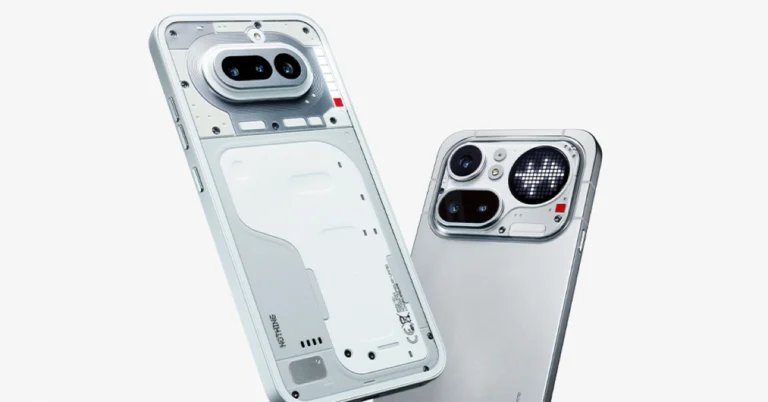
Nothing has brought the Phone 4a and Phone 4a Pro to India, showcasing its most advanced smartphones for 2026. The Phone 4a has a Glyph Bar, and the Pro variant has a design that is only partly see-through.
In This Article
Price in India, Availability
In India, you can get the Nothing Phone 4a in three different versions: 8GB + 128GB for Rs 31,999, 8GB + 256GB for Rs 34,999, and 12GB + 256GB for Rs 37,999. The Nothing Phone 4a Pro, on the other hand, costs more. The 8GB + 128GB version costs Rs 39,999; the 8GB + 256GB version costs Rs 42,999; and the 12GB + 256GB version is priced at Rs 45,999.
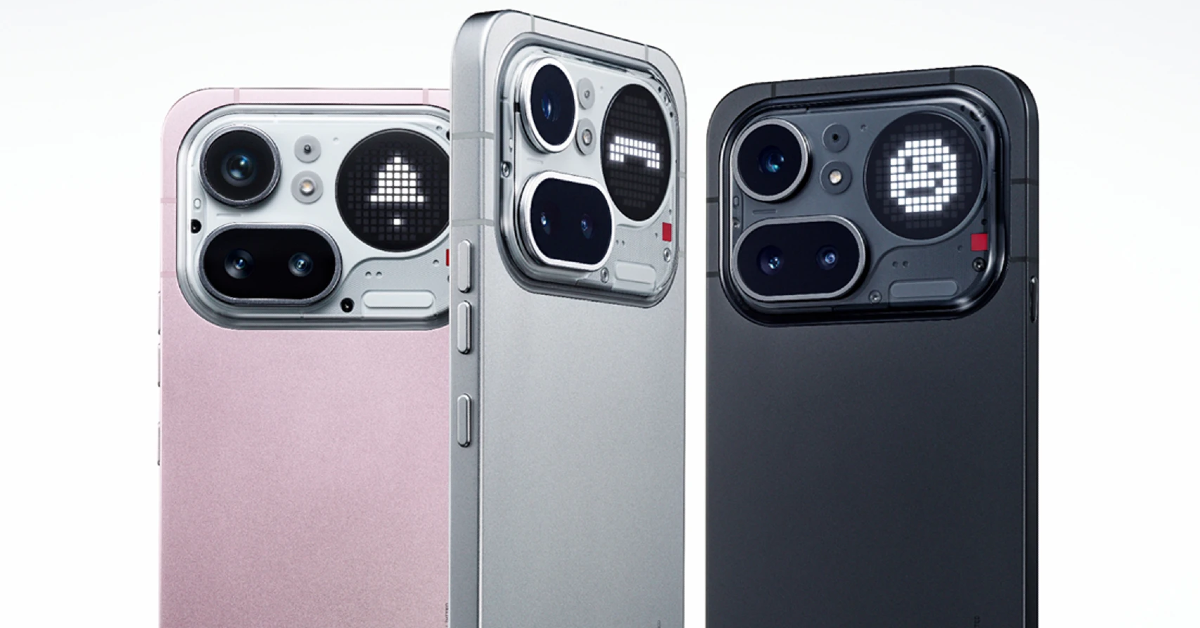
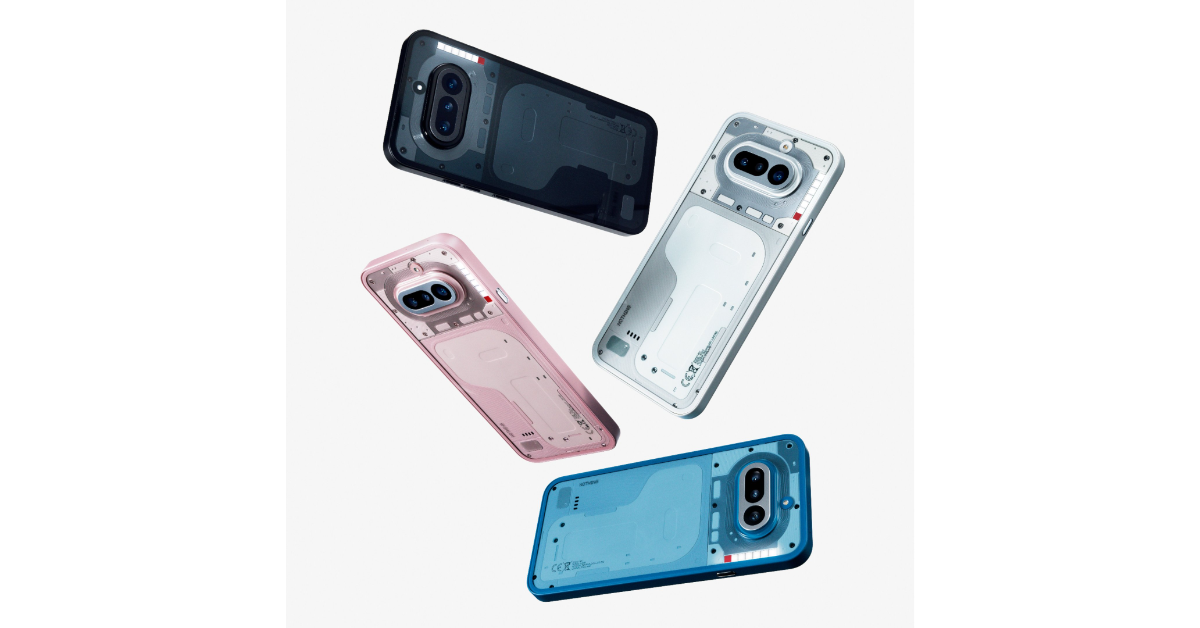
There are four colours to choose from for the Nothing Phone 4a: black, blue, pink, and white. The Phone 4a Pro will only be available in black, pink, and silver.
On March 13 and March 27, the gadgets will be available for purchase in India via Flipkart.
Nothing Phone 4a Pro Specs
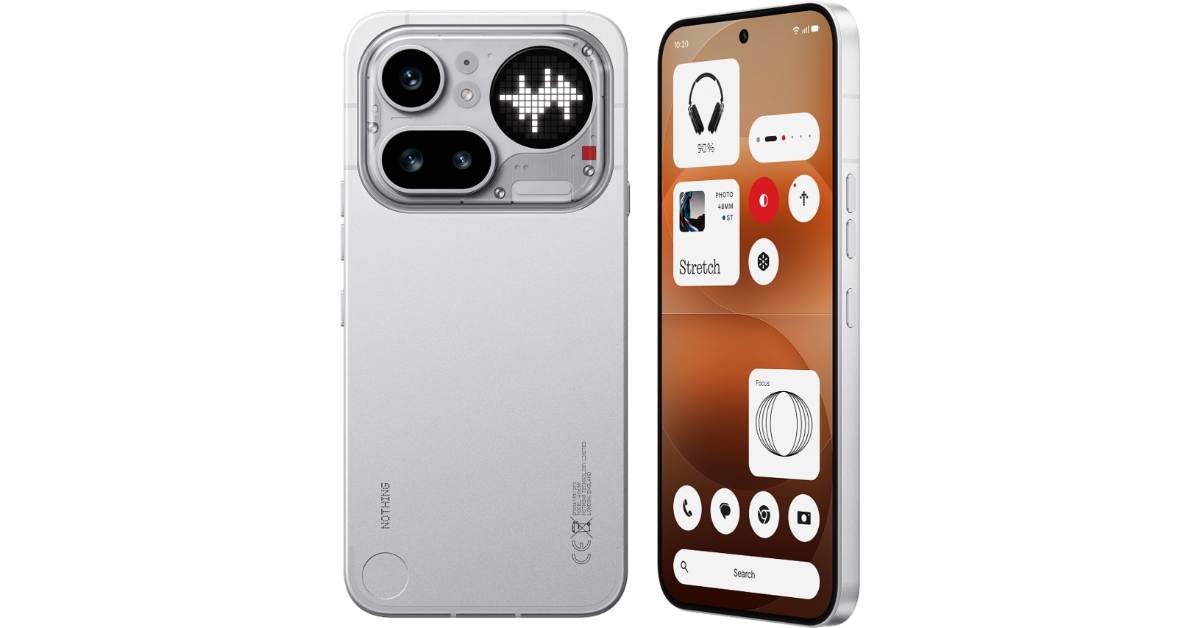
The Nothing Phone 4a Pro has a unique physical appearance, especially on the top part of its rear panel, which makes it seem more contemporary. The 4a Pro also has a strong metal shell and a triple back camera setup that includes the Glyph Matrix feature that was originally seen in its predecessor, the Phone (3). The camera’s unique layout has one sensor at the top and two at the bottom.
The gadget has two cameras: a primary camera with 50MP resolution and a periscope camera with 50MP resolution that can zoom in 3.5 times. It has an 8MP ultra-wide camera that lets you take pictures of wider settings. The Phone 4a Pro has a 32 MP camera on the front, which is great for taking high-quality selfies.
The Nothing Phone 4a Pro has a big 6.83-inch 1.5K flexible AMOLED screen with a refresh rate of 144 Hz, which makes videos and other visual content seem smoother. It also has a peak brightness of 5000 nits, which makes it easy to see even in strong light. Gorilla Glass 7i protects the gadget and makes it more resistant to scratches and impacts, which makes it more durable overall.
The Qualcomm Snapdragon 7 Gen 4 chipset powers the Nothing Phone 4a Pro. It came out with Nothing OS 4.1, which is based on Android 16. People who use this gadget may expect to get three years of Android upgrades and six years of security patches, which means that support will last a long time.
The phone has a big 5,400 mAh battery, so you can use it for a long time. It has superior 50W fast charging, which lets users swiftly charge the smartphone. The smartphone is also certified IP65, which means it can handle dust and water, so it may be used in various settings.
Nothing Phone 4a Specs
The Nothing Phone 4a has a big 6.78-inch LTPS AMOLED screen that can change its refresh rate between 30 Hz and 120 Hz to make the experience better for the user. This display stands out because it can reach a peak brightness of 4,500 nits, which makes it easy to see even in strong light. Its normal brightness level is 800 nits. Gorilla Glass 7i protection also makes the screen more durable by making it scratch- and damage-resistant. The Nothing Phone 4a still has an IP64 classification, which means it can only protect against a little bit of dust and water.
The newest Snapdragon 7s Gen 4 chipset powers the gadget. The Phone 4a’s new Glyph Bar has 63 mini-LEDs that can brighten up to 3,500 nits.
The phone has three cameras on the back: a 50MP Samsung GN9 main camera with optical image stabilisation (OIS), a 50MP Samsung JN5 periscope telephoto lens with 3.5x optical zoom, and an 8MP Sony IMX355 ultra-wide-angle lens. The front camera of the Samsung KD1 is 32MP and can take selfies and make video calls.
The Phone 4a will have a 5,400mAh battery in India; however, in other parts of the world, it will have a 5,080mAh battery. The gadget can charge quickly at 50W, which means it can be fully charged in just 64 minutes.
The gadget has an optical fingerprint sensor built into the display, which makes it safer and easier to operate. It also has two high-definition microphones and two stereo speakers, which make calls and multimedia activities sound better.
Garena Free Fire (GFF) Max is a battle royale game with regular awards and tournaments to keep players interested. If you play GFF, you should be aware of the redeem codes that are released on a daily basis. However, because the battle royale game is banned in India, players from other countries can use theFree Fire Redeem codes daily. If you’re unfamiliar with the codes or don’t know how to get them, we’ve put together a step-by-step guide to help youredeem them. Check out Garena Free Fire Max Redeem Codes for 5 March 2026.
These codes are a great way to get free items in the game. The 12-digit codes contain letters and numbers, as well as an expiration date and time. Because the Garena FF redeem codes cannot be used more than once, you should hurry to the redemption page to claim your free reward before someone else does. To get a free reward, all you have to do is go toreward.ff.garena.com/en, which is the official redemption page. Also, keep an eye on this space for daily updates on Gadget Bridge on GFF Max redemption codes and rewards.
The Nothing Phone 4a series is all set to launch in India and globally today. The Carl Pei-led smartphone manufacturer will be hosting a launch event to unveil two phones: a basic Phone 4a and Phone 4a Pro. The company recently showcased the Nothing Phone 4a only at the recent Mobile World Congress 2026. The device will be made available in four colour options.
In This Article
How to watch the livestream?
The Nothing Phone 4a and Phone 4a Pro are scheduled to launch globally today. The company will be hosting a launch event at Central Saint Martins, London, which will begin at 3.30 PM IST. You can also watch the presentation online on the company’s official YouTube channel. Check out the embedded link below.
Expected price in India and specifications
According to leaks, the Nothing Phone 4a would be released in India with a starting price of Rs 31,999 for the 8GB + 128GB model. There will be more than just this base model of the phone. There will also be an 8GB + 256GB option and a 12GB + 256GB model. Also, the Nothing Phone 4a Pro is estimated to start at around Rs 40,000 in India.
On March 7 at 6 PM IST, the UK-based tech company will hold a special drop event for the Nothing Phone 4a. Before the phone is officially market-released in India, customers will be able to buy it. The new Nothing Store at 660/1, 100 Feet Road, 1st Stage, Indiranagar, Bengaluru, will host the event.
Nothing will be offering a special deal for the first 100 customers who buy the Phone 4a. This deal will include an engraved version of the phone. These first purchasers will also get a free set of Nothing Ear A true wireless stereo (TWS) headphones. Also, during this special drop event, users will be able to get the CMF Buds 2 Plus TWS at a special discounted price of Rs 999.
In the country, you may buy the phone and its Pro version via Flipkart.
Nothing has teased a silhouette of a new smartphone with a Glyph Matrix display, which is probably the Nothing Phone 4a Pro. The model is different from the basic Phone 4a, which is supposed to have a Glyph Bar design. The Glyph Matrix, which first appeared on the Nothing Phone 3, improves user notifications by using a grid of micro-LEDs for customisable alerts. This functionality means users don’t have to check their screens as often. It lets users create animations, glanceable widgets, and interactive Glyph toys, as well as unique icons for apps and contacts.
The smartphone company also showcased the Nothing Phone 4a at the Mobile World Congress (MWC) 2026 in Barcelona, Spain. You may choose from four colours: black, blue, pink, and white. The Nothing Phone 4a will include a triple back camera system, which will improve it at taking pictures. It will also include a new Glyph Bar interface with seven LEDs, which are probably meant to provide notifications or alerts in a distinctive way. The handset will use an unknown Qualcomm Snapdragon chipset.
Apple has released the MacBook Neo in India, calling it their most affordable notebook. It has a 13-inch Liquid Retina display and comes in four colours: Blush, Citrus, Indigo, and Silver. Apple’s A18 Pro CPU, also found in the iPhone 16 Pro, powers the laptop. It has a great battery life, boasting up to 16 hours of video streaming. Other features include a Magic Keyboard, a multitouch trackpad, and Touch ID for biometric authentication.
In This Article
Price in India, availability
In India, the basic model of the MacBook Neo (with 8GB of RAM and 256GB of storage) costs Rs 69,900.
The one with 512GB of storage costs Rs 79,900.
The beginning price for retail in the US is $599 (about Rs 55,200), and for education, it’s $499 (about Rs 46,000).
You may choose between Blush, Citrus, Indigo, and Silver colours.
The MacBook Neo has a 13-inch Liquid Retina IPS display with a resolution of 2,408×1,506 pixels, resulting in a pixel density of 219 pixels per inch (ppi). This feature makes the images seem crisp and bright. It also has a 1080p FaceTime HD webcam, which makes video conferencing of high quality possible. The gadget has two microphones that work together in two modes: Voice Isolation and Wide Spectrum. These modes improve the quality of audio during calls and recordings. The MacBook Neo has a dual-speaker setup that supports Dolby Atmos and Spatial Audio, which adds to the visual and audio experience by providing immersive sound quality.
The MacBook Neo has the A18 Pro processor, which is also used in the iPhone 16 Pro. This configuration makes it quite powerful. It has 8GB of unified memory and lets you choose between a 256GB or 512GB SSD for storage. The MacBook Neo can’t change its RAM settings, which sets it apart from the MacBook Air. The MacBook Air and this gadget both run on the newest version of macOS, called Tahoe. The 512GB variant also has Touch ID, making it easier for users to access and secure their devices. It also comes with Apple’s Magic Keyboard.
The MacBook Neo has a 36.5Wh battery that can be charged with the supplied 20W USB Type-C adapter. The device comes with a 1.5m USB Type-C charging cable, allowing you to connect it to other devices. Apple says that the battery may last up to 11 hours when surfing the web and an astonishing 16 hours while streaming video on a full charge.
The MacBook Neo has enhanced connectivity options, including Wi-Fi 6E, which is the sixth generation of Wi-Fi technology that makes wireless internet access quicker and more dependable. It also has Bluetooth 6, which makes it easier to communicate wirelessly with devices that support it. The gadget has a USB 3.0 Type-C connector that supports DisplayPort 1.4 natively, so users may connect to external displays with resolutions up to 4K. There is also a USB 2.0 Type-C connector, and both of these ports can be used to charge devices. Lastly, the left side of the laptop has a headphone jack that makes it easy to connect audio devices.
Vivo has introduced the X200T as a new addition to its X-series, well-known for its excellent camera technology. This model is aimed at competing directly with gaming-centric smartphones. It combines the famous ZEISS optics with the powerful MediaTek Dimensity 9400+ chipset and a large 6,200mAh battery, ensuring high performance without compromises. We used this phone as our main device for the past two weeks, and here is our detailed review of the Vivo X200T.
In This Article
Design and Display
The Vivo X200T is a new version of the standard X200. It has a sleek, contemporary industrial look with flat edges instead of the old aggressive curves. The Stellar Black colour variation that we have uses Fluorite AG (Anti-Glare) glass. This glass feels silky and satin-like to the touch, with a very smooth feel and better grip than glossy options.
The colour has a deep, inky look that ranges from charcoal in bright sunshine to pitch-black in low-light settings. The Stellar Black variant has a distinctive black-on-black texture pattern that creates depth with its contrasting materials. The aluminium frame is anodised with a space-grey matte finish, creating a seamless transition from the front glass to the back panel.
Furthermore, this design is functional since the matte texture is designed to resist greasy fingerprints and smudges, allowing for a clean look without the need for a case.
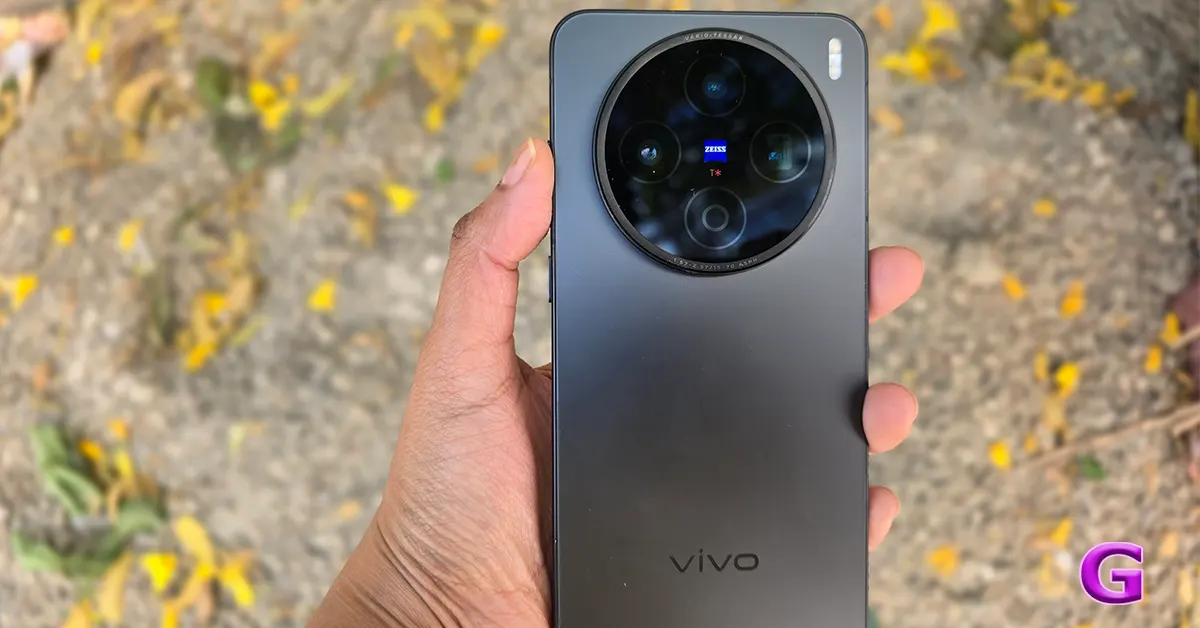
The distinctive back camera housing features a large, round island that houses the cameras, a signature design element of Vivo’s X-series. The metal ring surrounding the camera module enhances its appearance and reflects light, giving the device a luxury, jewelry-like aesthetic. The blue ZEISS logo at the center of the module signifies high quality and professional-grade optics.
The X200T smartphone is water-resistant, with both IP68 and IP69 classifications. The IP68 grade indicates the capacity to survive immersion in water, while the IP69 classification denotes resistance to high-pressure, high-temperature water jets. Furthermore, the gadget has strengthened silicone gaskets for all ports and the SIM tray, which ensures long-term water resistance.
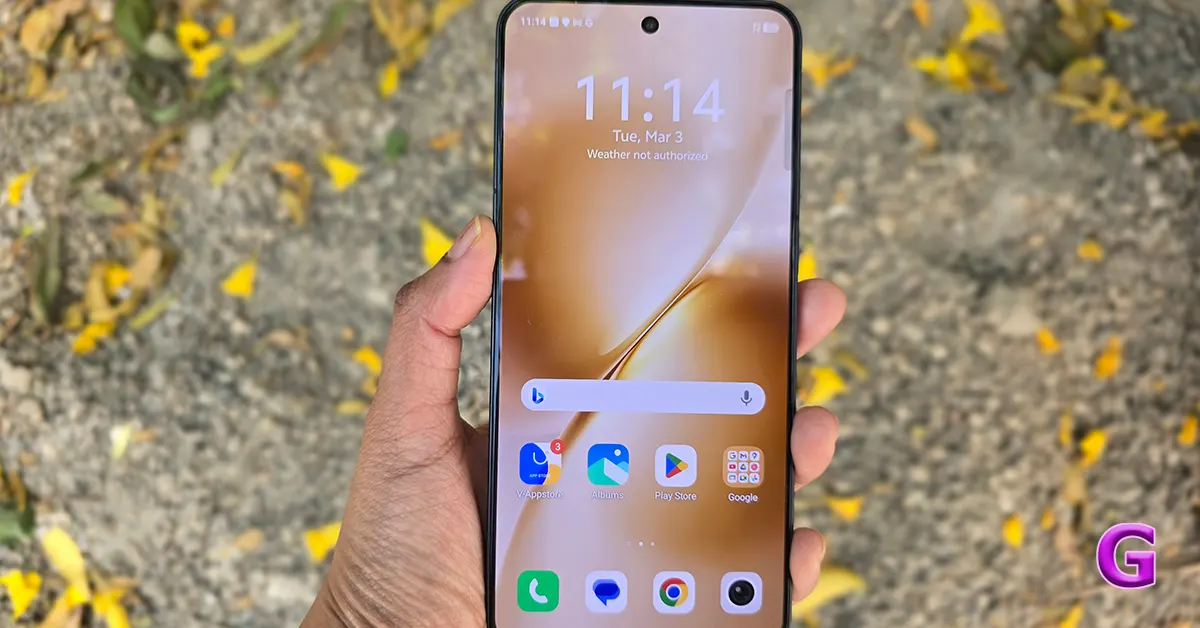
The X200T has a 6.67-inch flat AMOLED display, in contrast to the quad-curved screens seen in the Pro versions. This flat-screen design has ultra-thin, symmetrical bezels on all four sides, resulting in an almost borderless look and an amazing screen-to-body ratio of 94.3%. The gadget has SCHOTT Xensation Core glass on the front, which is highly resistant to drops and scratches. Furthermore, the display has a single, centred punch-hole cutout at the top that houses a 32MP selfie camera, reducing interference to the overall look.
Also, the smartphone is quite thin at 7.99 mm and weighs between 203 g and 205 g. The combination of these features makes the gadget feel solid in your hand without being too big, even though the device has a huge battery that is built inside it.
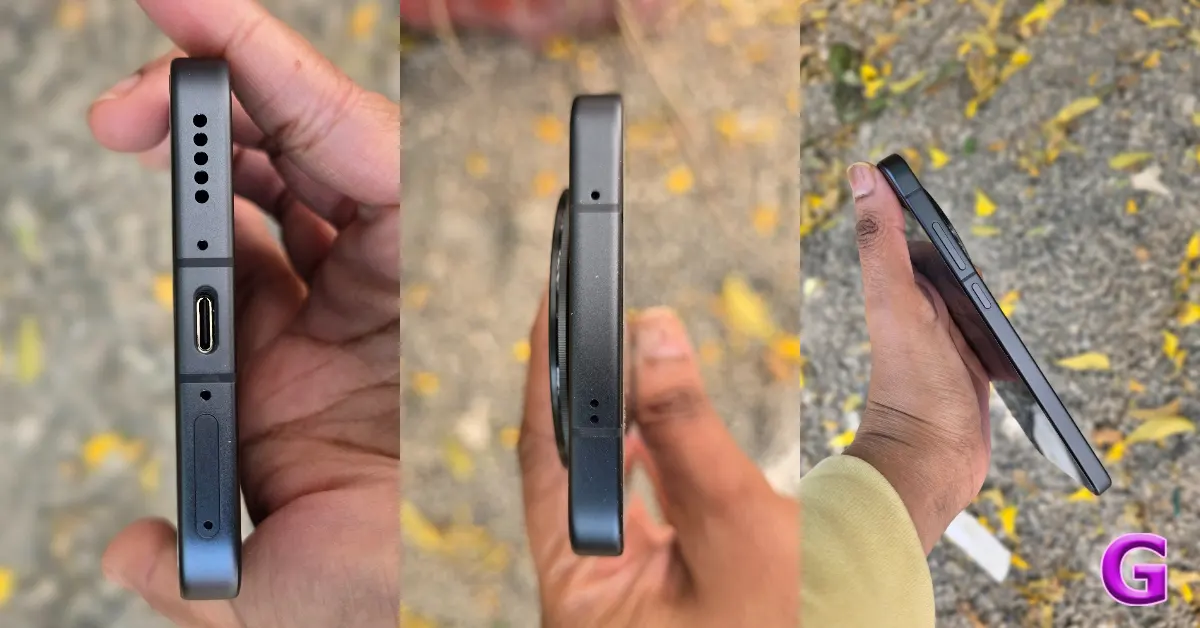
The device’s control centre is on the right. There is a power button that is easy for both right- and left-handed users to reach and provides a strong tactile response. The volume rocker is located above this. It is a long, single button that matches the frame colour in the Stellar Black version and has a matte texture.
The bottom edge of the frame features a USB-C connection that supports 90W FlashCharge and OTG, a dual-slot SIM tray for Nano-SIMs and eSIMs, a major speaker grille with carefully drilled holes, and a primary microphone pinhole near the SIM tray.
There are two important hidden features on the top of the device. One is an infrared (IR) blaster that lets the X200T work as a universal remote through the Smart Remote app. The other is a secondary microphone that improves noise cancellation during calls and records stereo audio for 4K video.
Also, for unlocking the phone, there are ultrasonic fingerprint sensors, which are 3D units built into the display. They work even when your fingers are wet or greasy, which goes well with the phone’s IP69 water resistance.
The X200T performs well outdoors, reaching up to 5,000 nits for HDR highlights and 1,600 nits in High Brightness Mode. This ensures good visibility even in strong sunlight. The Schott Xensation Core glass reduces glare, although the panel lacks the matte finish common in high-end gaming screens.
The Professional mode gets the colours right for the P3 Wide Colour Gamut, exhibiting natural colours without feeling like neon lights. The Q10 PLUS light-emitting material cuts down on blue light by a lot, making it easier on the eyes. High-frequency PWM dimming also helps with eye strain when you use the smartphone for a long time.
The AMOLED display has deep blacks and an infinite contrast ratio, so dark scenes mix well with the bezel in low light. The screen also features very low brightness settings that make it comfortable to use at night.
The X200T is like a tiny theatre for viewing videos. The panel has a resolution of 1.5K (2800 x 1260) and a pixel density of 460 PPI, which makes the visuals very clear. The display supports HDR10+ on platforms such as YouTube, Netflix, and Amazon Prime, enhancing bright highlights against natural shadows. Its flat-screen design reduces colour distortion and light reflections at the panel edges. Unlike the Pro model, it features an LTPS screen limited to 60Hz or 120Hz refresh rates. Nonetheless, its large 6200 mAh battery compensates for this limitation.
The X200T smartphone has great sound quality. Its high-grade aluminium body lets it play music at a loud enough level for small settings without distorting it. The speaker has balanced audio output from both the top and bottom speakers, which helps keep the sound from shifting in landscape mode. The sound profile has powerful mids and highs, with clear vocals and sharp high frequencies. This makes the device great for classical music and podcasts. The bass is not as strong as it might be since the phone is so thin, but it sounds fuller than other phones. However, the handset can’t compete with bigger phones for deep bass. The soundstage is wider than normal, which helps with stereo separation in movies and games. The gadget also supports Hi-Res Audio and low-latency tuning, so there is no delay in sound during real-time gaming activities. This makes it easier to hear footsteps in competitive games.
Performance and Cameras
The MediaTek Dimensity 9400 Plus chipset, manufactured with a 3nm process, drives the device. It features an All-Big-Core design praised for its efficiency, with the Cortex-X925 core clocked at 3.73 GHz for fast app launches. The Immortalis-G925 GPU is optimized for demanding gaming, delivering around 60 FPS at high settings in popular games.
The X200T smartphone is designed for those who often use multiple applications at one time without closing them all. The mobile phone has 12GB of LPDDR5X Ultra RAM. It employs Memory Fusion 4.0 technology to allocate up to 12GB of virtual RAM from storage, enabling the device to keep 35–40 apps open simultaneously without needing refreshes. Additionally, it features UFS 4.1 storage technology, which significantly speeds up installation and gallery loading. The device can transfer large 4K video files at nearly double the speed of previous UFS 3.1 models.
The Vivo X200T distinguishes itself in the smartphone market due to its exceptional gaming performance, marking a significant shift from the usual emphasis on photography features seen in X-series devices. The gadget is powered by MediaTek’s flagship chip, which provides improved processing power specifically designed for high-intensity gaming. This optimisation allows the X200T to compete well with other game-centric smartphones, such as those from the iQOO, Realme GT series, and Xiaomi, which are acknowledged for their gaming features and performance.
As previously stated, the Dimensity 9400+ mobile processor excels in high-intensity gaming, scoring more than 3 million points on AnTuTu benchmarks. It supports 120 FPS natively in BGMI, ensuring a consistent 115-120 FPS even in demanding settings with multiple squads and effects. Genshin Impact maintains a steady 60 FPS on high settings, outperforming many 2025 flagships by sustaining this frame rate for over an hour thanks to its efficient 3nm design. Furthermore, the Game Space software includes Frame Interpolation technology, which allows a 60 FPS game to seem to run at 90 or 120 FPS by using a separate chip to predict and insert extra frames without overwhelming the main GPU.
The Bypass Charging option provides direct power to the motherboard while bypassing the battery, dramatically lowering overheating during games and increasing battery life.
The X200T smartphone’s thermal management is enhanced by its thicker 7.99 mm chassis. This design feature enables a 4.5K liquid cooling vapor chamber that effectively prevents throttling during extended gaming sessions of over an hour.
Geekbench 6 Scores:
Single Core Score- 1,515
Multi-Core Score- 5,780
The X200T runs Android 16, but the upgrade to OriginOS 6 adds a liquid glass look with smooth, visible blur effects and animations. This is quite different from prior versions of Vivo software. The Dimensity 9400+ improves the device’s performance by keeping the user interface at a 120Hz refresh rate. This means the screen can switch between apps instantly, even when many are open, thanks to Atomic Design. The lock screen customisation features in the 2026 update are a big improvement. Users can now change the clock, widgets, and Always-On Display settings more easily than in previous versions.
The X200T performs smoothly without disrupting regular use, showing no stutters or delays. Apps such as Instagram, WhatsApp, and Chrome launch approximately 20% faster than on the previous X100 series, improving overall app start times. It features OriginOS 6 Fluidity, enabled by a dual rendering engine, which maintains UI animations at a consistent 120Hz even during fast downloads. The device includes an AI-powered NPU for agentic AI functions, allowing features like AI note summarisation and real-time live call translation. These features operate locally on the device for quick, near-instant responses.
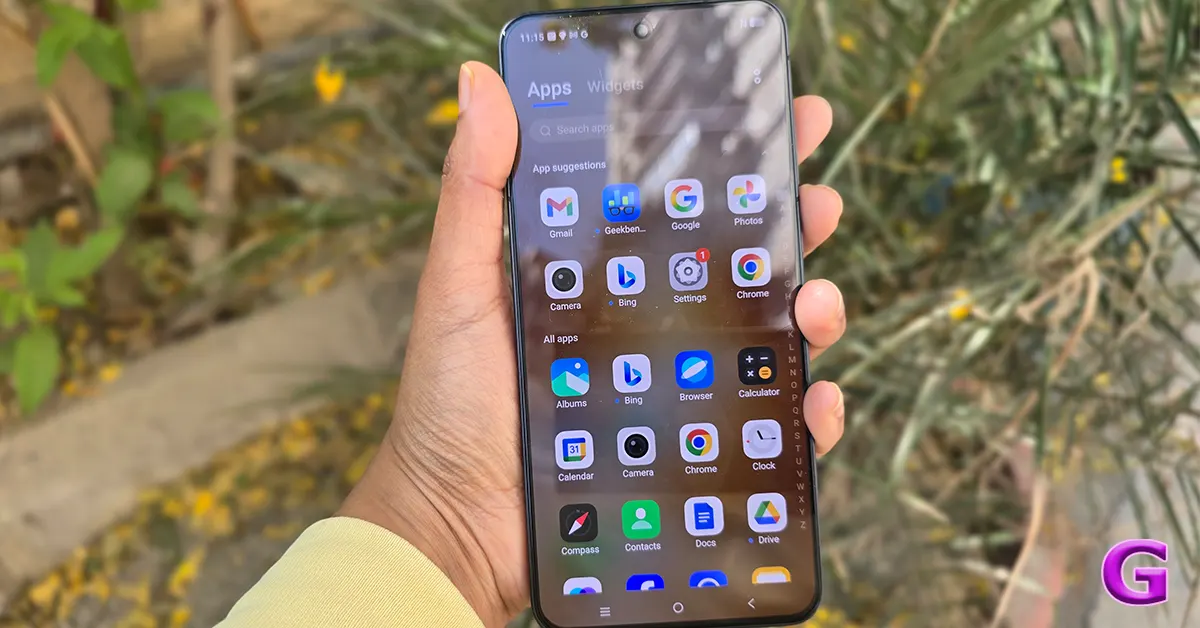
Vivo has made several big improvements that make the user experience better by getting rid of clutter, but it doesn’t get as clean as the Google Pixel. You can still use some third-party apps that come with the phone, like Facebook, Netflix, and LinkedIn, but most can be deleted. Additionally, users can now disable the “Hot Apps” and “Hot Games” folders that were previously mandatory. This makes the home screen seem cleaner. Vivo’s own applications, such as iManager, EasyShare, and Vivo.com, can’t be removed, but they are less intrusive and only send notifications when used.
The 2026 flagship has “On-Device AI”, which gives the Vivo phone many advanced features. For example, AI Erase 3.0 lets you quickly remove people or things from Zeiss photographs. Live Call Translation lets you translate voice calls in English, Hindi, and ten other regional Indian languages in real time. The AI Note Summariser can make a bulleted summary from a 10-minute voice recording in only a few seconds.
Vivo has announced a competitive update strategy for its X200T model, which aligns with big brands like Samsung and Google. The policy covers five years of major Android upgrades, assuring that consumers get updates for Android versions 17 to 21. Additionally, the gadget will receive seven years of security upgrades, with fixes offered monthly or quarterly until 2033.
The Vivo X200T has three rear cameras: a 50MP ZEISS Super Telephoto Camera (IMX882) with 3x to 10x optimised zoom and 100x HyperZoom, which is improved with Multi-Focal HD Portrait, the ZEISS Portrait Lens Package, and better motion freeze; a 50MP ZEISS Main Camera (IMX921) with optical image stabilisation and ZEISS T* coating, plus vivo Camera-Bionic Spectrum Technology 2.0 for professional-grade stabilisation; and a 50MP ZEISS Ultra Wide-Angle Camera for group shots and architecture. The front camera is also a 32MP selfie camera with a KD1 sensor, which makes it easy to take high-quality selfies.
primary vs portrait
The primary sensor accurately captures colors in bright light without the oversaturation common in many AI-enhanced images, maintaining a professional and balanced appearance. The ZEISS T Coating effectively reduces haze during direct sunlight shooting. The X200T excels in nighttime photography thanks to its large f/1.57 aperture and CIPA 4.5 stabilization. It captures light efficiently, preserving deep blacks and shadow details without turning the sky gray.
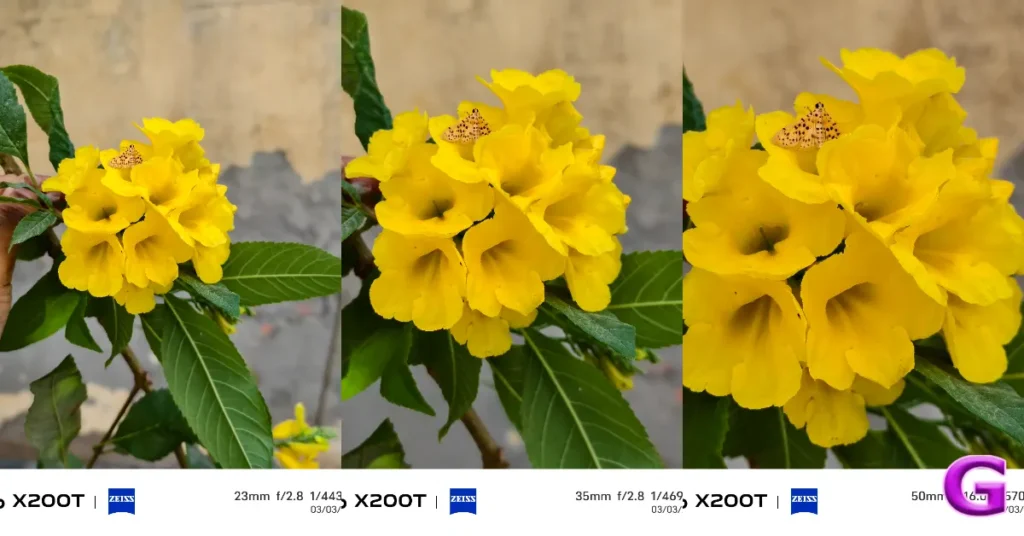
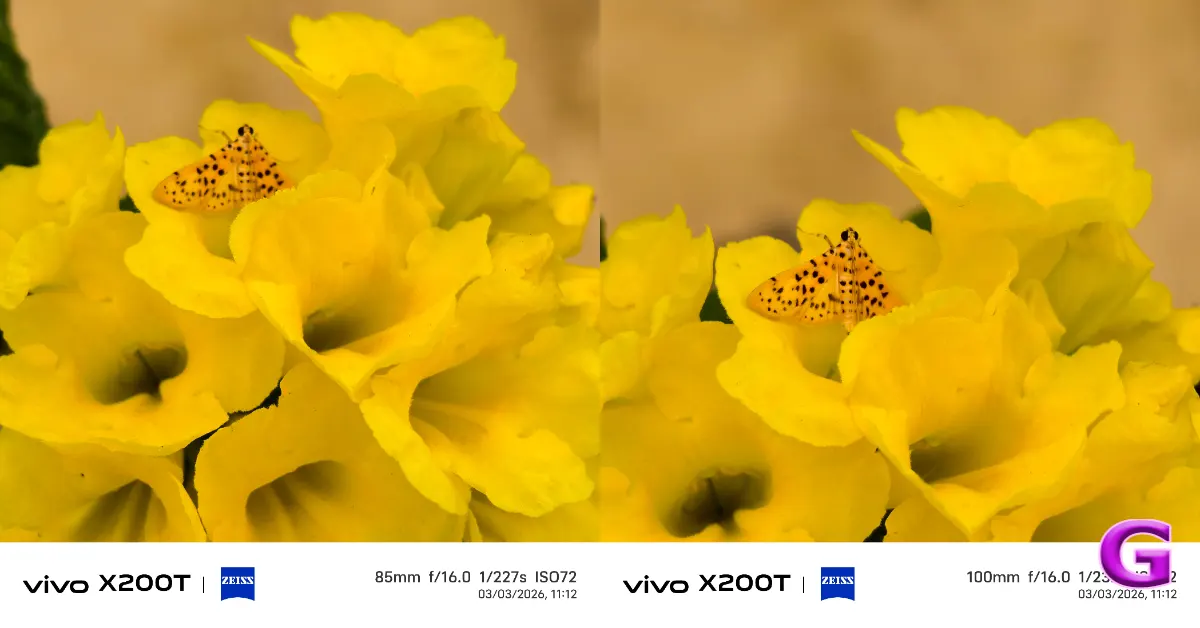
The telephoto camera (50MP Sony IMX882/LYT-600) features a 70mm periscope lens that enables 3x optical zoom, its standout feature. It can achieve up to 100x zoom via HyperZoom, though the sensor performs best between 3x and 10x, providing photos that are suitable for professional purposes. The telephoto macro offers up to 20x magnification, allowing close-up shots of objects like jewelry or insects from just 10 cm away. This functionality results in a more natural bokeh effect compared to standard wide-angle macro lenses.
UW Vs Primary
The ultra-wide camera features a 50MP Samsung JN1 sensor and a 119-degree wide viewing angle, enabling you to capture expansive images. Notably, its colour profile is designed to match the main sensor’s, eliminating issues like colour shift when switching between sensors. When it comes to performance, the ultra-wide camera works best in bright light, giving you clear pictures. However, in very low light, it may be a little soft in the corners, particularly compared to the primary sensor.
The ZEISS Natural Portrait setting on the selfie camera ensures selfies look natural, which is often an issue with many other selfie cameras. This setting preserves the natural texture and details of the skin, including facial hair, so the person appears more like themselves. The camera also captures video quite effectively, with the front camera supporting 4K quality at 60 frames per second (fps). This enhancement makes the camera particularly suitable for high-resolution vlogging, representing a significant advancement for those aiming to create quality content in 2026.
closeup
The Vivo X200T features a significant upgrade in its battery technology, utilising a high-density silicon-carbon battery with a capacity of 6,200 mAh instead of a standard lithium-ion battery. This update has a big effect on how people use their phones every day. It lets them do things like browse social media, handle their email, and take light photography for about 16 hours a day, and by the end of the day, they still have around 40–45% of their battery life left.
When it comes to media consumption, the gadget is great for streaming video. When set to 50% brightness, it can play YouTube videos for around 17 to 20 hours straight. The Vivo X200T performs well for gamers; during a lengthy, intense hour of gaming with titles like BGMI or Genshin Impact, the battery only decreases by about 10–12%.
The phone also comes with a 90W FlashCharge adaptor, which lets you charge the phone quickly. The charger takes around 20 minutes to charge from 0% to 50%, and it takes about 55 to 58 minutes to charge from 0% to 100%. However, the charging speed slows down after 80% to protect the silicon-carbon cells’ longevity.
Verdict
The MediaTek Dimensity 9400+ processor powers the Vivo X200T. This means the handset can run all games in 2026 at their highest settings, making it one of the best phones on the market. The mobile has a class-leading ZEISS 3-lens camera system that appears to be the ideal option for less than Rs 60,000. The smartphone has a great 6200mAh BlueVolt battery, which makes X200T the best in its class for battery life. The phone runs Android 16 and comes with a promise of five years of OS upgrades, which means it will be usable for a long time. Pricing is competitive, with the device available for Rs 59,999 for the 12GB RAM and 256GB storage variant and Rs 69,999 for the 12GB RAM and 512GB storage model.
Amazon Quiz 5 March 2026: The New Daily Quiz is now available. Customers from different parts of the country are participating in the daily quiz. The quiz starts at midnight today and will be live until 11:59 PM tonight. By successfully answering every question, participants in the quiz have the chance to win wonderful rewards. Up to Rs 500 Amazon Pay Balance is up for grabs for participants today.
One wrong answer could eliminate you from the quiz. You have a chance to win up to Rs 500 Amazon Pay Balance if you successfully answer every question. Users of the app only have the opportunity to take the quiz. Check Out the 5 March 2026 Quiz.
In This Article
Are you not able to find Amazon FunZone? Click below and participate.
We have written an explainer above; you can refer to that.
When are the winners of the Quiz and contest announced or declared?
The announcement of today’s quiz winner will take place Tomorrow. As for the Special Quiz and “Spin & Win” Contest, the winners will be declared once the Quiz Contest comes to an end. To find out who the lucky winner is, you can refer to the Winners List or visit the Amazon Winners tab in the Amazon App.
How to participate in the Daily Amazon Quiz?
That is very easy, just got to the Amazon app and scroll to the bottom of the page and you will find the Quiz section. Click on it (usually it is called the fun zone) and you can enter the Amazon Today Quiz Contest.
Are there any other quizzes or contests running on Amazon daily?
Yes, there are many running daily. These range from spinning the wheel to answering the questions correctly. All are located in the Fun Zone.
What are the criteria for selecting a winner in the Daily Amazon Quiz?
When a qualified player submits correct answers to all the questions, they will automatically be entered into a lucky draw. This draw will include all participants who answered all the questions correctly. Amazon randomly selects the final winners from the pool of eligible participants who gave the right answers.
Which Types of Questions are asked within the Amazon Daily Quiz?
These are very simple and straightforward questions. These are mainly related to general knowledge.
Where should I look for Amazon Daily Quiz answers?
You can bookmark our website www.gadgetbridge.com as we will help you every day with the Amazon Daily Quiz. We bring you fresh answers every day for the Amazon Daily Quiz and Contest.
What time does Amazon announce previous winners?
The previous winner’s name will be announced today at 12 PM (noon).
Are you looking for today’s Wordle answer for March 5, 2026? The problem is difficult to solve, so if you need assistance, we’ve included hints and the clue to today’s Wordle Quiz. Below, we have made it simple for everyone to understand how to get to the Wordle Answer today.
In This Article
Hints and Answers for Today’s Wordle March 5
Before answering directly, please check the Wordle Hints first.
Hint 1: Today’s Wordle answer includes a vowel. Hint 2: The answer for today has a repeating letter. Hint 3: Meaning- the act of stealing
What word does today’s Wordle begin with?
Do you need help with today’s Wordle answer’s initial letter?
The first letter in today’s Wordle is “S”
Today’s Wordle Answer
The answer to Wordle #1720 on March 5, 2026, is — SHEEP
Wordle: A Five-Letter Word Guessing Game • The game allows six guesses of a five-letter word. • Provide feedback on the guessed letters’ placement in the puzzle. • The New York Times purchased the game in 2022. • Created by Josh Wardle for his partner, narrowing down 12,000 English words to 2,500. • Named after the word “word.”
How To Play Wordle?
Wordle is a New York Times word puzzle game that allows users to guess a five-letter word in six attempts. The letters are highlighted in Yellow and Green, indicating whether the word is present in the answer or not, and Green letters indicate the correct guess.
Select a powerful starting word: Avoid using unusual words, as they frequently do not match common letters. A good opening word has plenty of benefits.
Repeating letters: Don’t be afraid of repeating letters; they appear frequently in words. The answer may contain one or two repeated letters.
Use the Wordlebot: The NYT’s Wordlebot analyses and compares replies to itself. This challenge can assist you in enhancing your guessing skills and highlighting areas for development.
Hey, old-timer, do you have that itch to log back into World of Warcraft that you have been feeling after not playing the game in a long time? You are not alone; we have plenty of vets who feel the urge when a new expansion is released. Regardless of whether you were a Wrath of Lich King raider or dipped out during Dragonflight, it feels like you are exploring Azeroth anew when you come back. The game has been transformed, and the systems have become smoother, new stories have been created, and the communities are discussing on forums.
Being a person who has come back several times since vanilla, I will guide you through the process of shaking off the rust: how to regain access to your account and what to do to get up to date in the lore. Next, we will head to the most recent chapter, Midnight, which will be released on March 2, 2026, in which Void horrors will be battling Light forces in a book that everyone is buzzing about. We will prepare you to battle without the fuss.
In This Article
Shaking Off the Rust: Why Now’s the Perfect Time to Return
Returning to WoW after a lapse is something different—it feels like meeting an old guild member with a lot of nostalgia but with shiny new tricks. The player base is flourishing, and millions of them are logging in for events and patches. In case farming rep in Northrend or avoiding fel in Legion is your last memory, you will enjoy the quality-of-life improvements, such as faster queueing and customizable UIs. Begin by updating your client through Battle.net—grab any free trials or returning player bonuses for additional mounts or bags. Turn the subs back on, or in case of tightness, use tokens; it is worth it for that first flight across the known areas.
Reclaiming Your Characters: First Steps Back In
Check your mains, log in and see that your gear may be outdated, but your achievements and mounts are there to stay. Join active realms with the help of the character services, e.g., changing race or realm. Old quests will rejuvenate the mechanics; low-level areas such as Elwynn or Durotar will help you get used to it. In case the inventory is a mess, be organised using addons such as Bagnon. To make the jump easier, a WoW boost can bring alts to level in a short amount of time, allowing you to explore the waters without the exhausting effort.
Catching Up on Lore: Bridging the Gap
The story of WoW is decades long, but you do not have to know all of it; pay attention to major arcs. Since the Alliance-Horde strains of vanilla to the world-redefining Cataclysm, every expansion was based on threats such as the Lich King or Sargeras. More recent ones, such as Shadowlands, delved into death realms, while Dragonflight revived dragonflights. Skim with in-game recaps or Wowhead recaps; YouTube lore videos by Nobbel87 are gold to watch when you need a quick catch. In case plot holes bother you, community discords dissect everything.
Quick lore hits: Burning Crusade shattered Outland, Wrath froze Northrend against the undead, Legion invaded with demons.
Tip: Watch “Warbringers” cinematics for emotional hooks like Sylvanas’ arc.
Rep and Zone Refresh: Building Your Foundation
Reputation grinds haven’t vanished, but they’re streamlined—old factions like Cenarion Expedition offer mounts via dailies. Hit classic zones for rep if needed, but prioritise current hubs for relevant buffs. Exploration tech like dragonriding (from DF) speeds travel, but in older content, ground mounts rule. Farm rep for enchants or tabards; it’s meditative after a break. If time’s short, WoW carry handle rep farms, unlocking vendors without the tedium.
Gearing Up Again: From Rustbucket to Raid-Ready
Your old gear’s probably vendor trash now—start fresh with world quests or dungeons for quick ilvl bumps. Use the Group Finder for pugs; it’s more forgiving than vanilla LFG spam. Craft or buy basics on the AH—enchants and gems make a difference. Simulate specs on Icy Veins for rotations; classes evolved with talent trees. Join a casual guild via forums for tips—nothing beats vet advice on addons like Deadly Boss Mods.
Questing Comeback: Rediscovering the World
Quests are WoW’s heart—jump into chains you missed, like the Dragon Isles in DF for catch-up. Levelling’s faster now, with heirlooms speeding XP. Explore zones like Storm Peaks for nostalgia or new biomes for variety. Track progress with addons like Questie; it’s gaming tech that maps everything. For overwhelmed returns, WoW boost service levels you to cap, freeing time for fun stuff.
Zone picks: Northrend for epic scales, Pandaria for serene vibes.
Pro move: Mix solo quests with group finder for balanced play.
Midnight Beckons: What’s Waiting in the New Expansion
Midnight drops March 2, 2026, pulling you into a Void/Light war where shadows corrupt the Veil, threatening Azeroth’s reality. The story picks up from Dragonflight’s aftermath, with Xal’atath scheming cosmic horrors. Heroes ally with elves and Lightforged to purge threats in zones like Harandar’s dream veils or Voidstorm’s corrupted spires. It’s a fresh start—perfect for returnees, with catch-up mechanics letting you jump in without full prior knowledge.
Midnight Overview: New Features After The War Within
After The War Within’s underground Nerub’ar saga and Xal’atath’s emergence, Midnight (March 2, 2026; early access Feb 27) unleashes a surface-level Void invasion on Quel’Thalas. Xal’atath targets the Sunwell to extinguish its Light, uniting elven tribes in a desperate defence. Rebuilt Silvermoon City anchors the hub, with the pre-expansion novel Blood Ties (Nov 2025) priming Alleria, Turalyon, and Arator’s Void expedition. Level to 90 amid reality-warping incursions—perfect for returnees with catch-up tools.
Player Housing: Buy Horde/Alliance houses in Neighbourhood zones. 3D placement tool for grid/freeform object sizing, dye system for colours, and hundreds of décor items to collect and customise interiors.
New DH Spec: Devourer: Pre-patch unlock; mid-range DPS blending ranged/melee Void/Cosmic damage (no prereqs). Core kit: Reap (scythe consuming soul fragments), Voidblade/Hungering Slash (melee combo with retreat), Soul Immolation (self-damage aura generating Fury/fragments), Consume (filler summoning fragments), Collapsing Star (Fury finisher), Void Ray (piercing beam), Void Metamorphosis (harvested transformation).
New/Returning Players: Exile’s Reach to Dragonflight; Arathi tour with Jaina/Thrall; TWW catch-up quests.
Void/Light Saga: The Core Conflict Unveiled
The plot revolves around polarity—Light and Void clashing in reality-warping ways. Alleria Windrunner leads the charge against corrupted forces, with cameos from Turalyon and Arator. Quests explore fractured realms, uncovering secrets like Xal’atath’s crown. Start with the intro chain in Silvermoon, branching into rep grinds for faction buffs. No need for deep lore dives; in-game cinematics fill gaps. If catching up feels daunting, WoW boosting services guide you through story quests.
Zones of Wonder: Exploring the New Frontiers
Midnight’s maps blend elven elegance with Void horror. Harandar’s veils hide dream puzzles and rare blooms for crafting. Voidstorm’s tower ascent leads to raids, with corrupted nodes for gathering. Quel’Danas revamps the Sunwell for endgame hubs, full of dailies defending against incursions. Flying unlocks early, but polarity mechanics flip safe zones—wrong side means damage. Rep with Lightforged or Void Elves grants portals and buffs.
Harandar highlights: Veil-jumping for hidden quests, rep for dream mounts.
Voidstorm vibes: Tower climbs with environmental hazards, elite farms for essence.
Quel’Danas endgame: Daily defences for rep gear, tying into raid attunements.
WoW Midnight boost speeds zone clears, unlocking reps without the slog.
Reputation Roads: Factions and Rewards
Rep grinds tie into the narrative—align with Light for radiant buffs or Void for shadow edges. Dailies in Silvermoon pay 1k-2k gold, plus tokens for polarity enchants. Factions like the Redeemed offer mounts like cosmic steeds or void-touched hawks. Start neutral, build through quests; polarity choices lock paths but swap via items. For fast progress, Midnight boosting farms rep, hitting exalted in days.
Starting Fresh: From Login to Level Cap
New characters spawn at 1, but returnees get heirlooms for 50% XP boosts. Level through Outland revamps or DF zones for variety, hitting 80 fast. Gear via world quests (ilvl 500 starters) or vaults. Classes gain polarity talents—enhance specs with Light bursts or Void drains. Economy favours gatherers; AH flips void mats for quick gold. If rusty, World of Warcraft carry levels while explaining mechanics.
Levelling path: 1-60 in classic zones, 60-80 in Midnight for story immersion.
Gear tips: Craft polarity rings for early stats.
Midnight boost handles the grind, landing you raid-ready.
Re-Entry Real Talk: Tips to Stick the Landing
Ease in with dailies for rhythm, join discords for guilds, and set goals like AOTC in Voidspire. Avoid burnout—play 2-3 hours daily. Tech like addons (DBM for alerts) makes returns seamless. Midnight’s welcoming for vets; its Void/Light duality echoes classic conflicts. You’re back—let’s
Apple has announced a refreshed Studio Display and an all-new Studio Display XDR, and yes, the Studio Display XDR price will be the first thing many creators will check right after “does it do proper HDR?”. The pitch is simple: a cleaner one-cable desk setup for Macs, plus a higher-end option that brings mini-LED backlighting, higher brightness, and faster motion handling to Apple’s 27-inch 5K display family.
Pre-orders open March 4, with availability starting March 11 in select markets and regions.
This update splits the range into two clear choices:
Studio Display: the familiar 27-inch 5K Retina monitor, upgraded where people actually notice it day-to-day.
Studio Display XDR: a new pro-grade option designed for HDR workflows, colour-critical work, and smoother motion.
Both models aim to reduce desk clutter by doubling down on Thunderbolt 5 monitor connectivity, while keeping the “plug in one cable and get display plus charging” convenience Mac users tend to love.
Studio Display: familiar, but finally faster on the port side
The refreshed Studio Display keeps the headline basics that made the original popular:
27-inch 5K display with 5120×2880 resolution
600 nits brightness
P3 wide colour and 1 billion colours
Where it moves forward is on the “work-from-anywhere” and “clean setup” bits:
12MP Centre Stage Desk View support for video calls and overhead-style demos
A three-mic array tuned for clearer voice pickup
A six-speaker system with Spatial Audio, with deeper bass than the previous generation
Thunderbolt 5 plus extra USB-C ports for accessories, storage, and charging
In plain English: it’s still your crisp, everyday pro-friendly 5K screen, but it behaves more like a modern docking monitor without needing an extra hub.
Studio Display XDR: mini-LED, real HDR punch, and smoother motion
The new Studio Display XDR is the bigger story, mainly because it shifts Apple’s pro display strategy into a smaller, brighter, more modern form factor. It also positions itself as a Pro Display XDR replacement for many creators who wanted XDR-level performance without the old “separate stand, separate decisions” drama.
Key highlights include:
Mini-LED Retina XDR and serious brightness
Mini-LED Retina XDR backlight with 2,304 local dimming zones
Up to 1000 nits SDR brightness
Up to 2000 nits peak HDR brightness
1,000,000:1 contrast ratio
That matters for HDR editing, lighting-heavy photography, and motion projects where shadow detail and highlight control are not “nice-to-have,” they are the job.
120Hz with Adaptive Sync for creators (and yes, gamers too)
A 5K pro display is not usually where you go looking for gaming talk, but higher refresh rates help far beyond games.
120Hz Adaptive Sync support
Variable refresh range that can adjust between 47Hz and 120Hz
For editors, it can mean smoother timeline scrubbing and playback. For animators and 3D artists, it can mean a more responsive feel while moving around complex scenes. For anyone who occasionally unwinds with a controller, it can mean less judder and lower perceived latency.
Wider colour support for mixed workflows
Studio Display XDR adds Adobe RGB alongside P3, a detail that print and design professionals will actually care about. If your day includes switching between digital-first colour and print-ready work, having both in a reference display reduces the “looks great here, looks odd everywhere else” problem.
Thunderbolt 5: why it matters on a monitor
Thunderbolt 5 is not just a spec flex. The practical benefits are simple:
More bandwidth for high-resolution displays and high-speed drives
Better hub-style behaviour for a single-cable workstation
More flexible multi-display setups and daisy-chaining possibilities
If your desk has a MacBook, a couple of SSDs, and enough accessories to qualify as a small electronics store, Thunderbolt 5 can reduce the cable chaos.
Pricing and availability (US and India)
Studio Display starts at Rs 1,89,900 in India.
Studio Display XDR starts at Rs 3,99,900 in India.
US pricing starts at $1,599 for Studio Display and $3,299 for Studio Display XDR (regional pricing varies).
Both offer standard or nano-texture glass options, plus different stand and mount configurations.
Pre-orders begin March 4, with sales and deliveries starting March 11.
Who should buy which
Pick Studio Display if you want a premium 5K screen for office work, editing, coding, and everyday creative projects, plus modern connectivity and better call hardware.
Pick Studio Display XDR if your work involves HDR grading, colour-critical output, print design, 3D rendering, or if you simply want the brightest and most responsive 27-inch 5K Apple display with mini-LED and 120Hz.
This launch feels like Apple finally decided that “pro display” should not automatically mean “giant screen, giant price, giant compromises.” Studio Display XDR sounds like the monitor for people who live in timelines, layers, and colour charts, while the regular Studio Display remains the cleaner, calmer choice for everyone else who just wants a beautiful 5K workspace without turning their desk into a cable documentary.
Are you looking for today’s Wordle answer for March 4, 2026? The problem is difficult to solve, so if you need assistance, we’ve included hints and the clue to today’s Wordle Quiz. Below, we have made it simple for everyone to understand how to get to the Wordle Answer today.
In This Article
Hints and Answers for Today’s Wordle March 4
Before answering directly, please check the Wordle Hints first.
Hint 1: Today’s Wordle answer includes a vowel. Hint 2: The answer for today has no repeating letters. Hint 3: Meaning- the act of stealing
What word does today’s Wordle begin with?
Do you need help with today’s Wordle answer’s initial letter?
The first letter in today’s Wordle is “T”
Today’s Wordle Answer
The answer to Wordle #1719 on March 4, 2026, is — THEFT
Wordle: A Five-Letter Word Guessing Game • The game allows six guesses of a five-letter word. • Provide feedback on the guessed letters’ placement in the puzzle. • The New York Times purchased the game in 2022. • Created by Josh Wardle for his partner, narrowing down 12,000 English words to 2,500. • Named after the word “word.”
How To Play Wordle?
Wordle is a New York Times word puzzle game that allows users to guess a five-letter word in six attempts. The letters are highlighted in Yellow and Green, indicating whether the word is present in the answer or not, and Green letters indicate the correct guess.
Select a powerful starting word: Avoid using unusual words, as they frequently do not match common letters. A good opening word has plenty of benefits.
Repeating letters: Don’t be afraid of repeating letters; they appear frequently in words. The answer may contain one or two repeated letters.
Use the Wordlebot: The NYT’s Wordlebot analyses and compares replies to itself. This challenge can assist you in enhancing your guessing skills and highlighting areas for development.
Good fishing games are hard to come by, but Fisch on Roblox is one of the rare ones that capture the fishing experience quite well. In this game, you can explore different islands to catch a variety of fish. Of course, you will need good gear and bait to attract the fish you want. The game offers some special codes that can get you these items. Here are all the Roblox Fisch codes available in March 2026.
For more fun and relaxing games, check out Farm a Fish and Catch and Tame. While you’re here, take a look at the latest Anime Last Stand codes. If you have any questions, let us know in the comments!
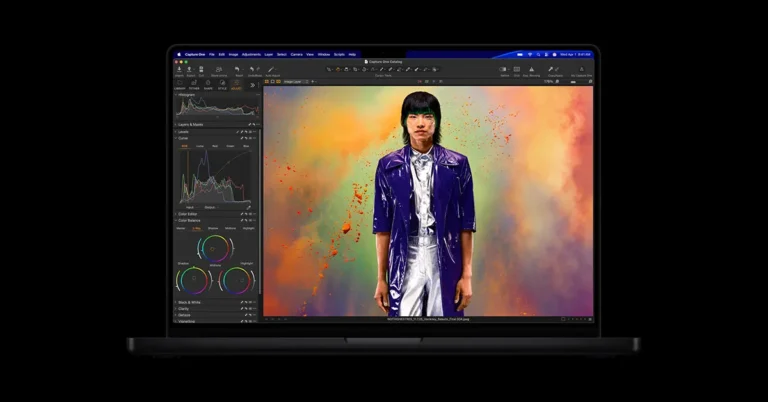
If your workflow involves juggling timelines, code, RAW photos, or a suspicious number of browser tabs, the new MacBook Pro M5 lineup is being pitched as the upgrade that keeps it all moving fast, even when you are offline. Apple has unveiled refreshed 14-inch and 16-inch MacBook Pro models powered by the new M5 Pro and M5 Max chips, with a heavy emphasis on on-device AI, higher memory bandwidth, and noticeably faster storage.
Pre-orders open March 4, with availability starting March 11. The laptops come in space black and silver, and they ship with macOS Tahoe.
Apple’s headline changes are split into three buckets that matter to working pros.
More base storage, less immediate upgrading guilt M5 Pro models start at 1TB storage, while M5 Max models start at 2TB. Apple is also touting 2x faster SSD performance versus the previous generation, with read and write speeds claimed up to 14.5GB/s.
A big push for on-device AI M5 Pro and M5 Max add a GPU design that includes a Neural Accelerator inside each core, alongside higher unified memory bandwidth. In Apple’s framing, this is about making AI tasks feel instant and local, including faster LLM prompt processing and AI-assisted creative work. Consider this the “do it on the laptop, not on a server” era getting louder.
New networking silicon The MacBook Pro adds an Apple-designed N1 wireless chip, enabling Wi-Fi 7 MacBook support and Bluetooth 6, aiming for faster and more reliable wireless connections.
M5 Pro performance vs M5 Max AI goals
Both chips are designed for heavy workloads, but the intent is different.
M5 Pro performance is positioned for people who live in complex, multi-app pipelines, like developers compiling and testing at scale, photographers crunching large libraries, and creators running layered edits. It supports up to 64GB unified memory and up to 307GB/s memory bandwidth.
M5 Max AI is aimed at those who regularly hit the ceiling, like engineers simulating, 3D artists pushing scenes in real time, or AI developers experimenting locally. It supports up to 128GB unified memory and up to 614GB/s memory bandwidth, which is the kind of spec that quietly changes what “portable workstation” means.
Apple is also claiming notable uplifts in ray tracing gaming and pro apps, including examples like Maxon Redshift and DaVinci Resolve Studio. Real-world gains will still depend on your exact apps and projects, but the message is clear: the ceiling moved up again.
Ports, display, camera, and the day-to-day stuff
Specs are fun, but ports and screens pay the bills.
Thunderbolt 5 ports are included, alongside HDMI (up to 8K), an SDXC card slot, and MagSafe 3.
A Liquid Retina XDR display returns with a nano-texture option.
A 12MP Centre Stage camera, studio-quality mics, and a six-speaker system target hybrid work and content creation.
Apple claims up to 24 hours of battery life, plus fast charging up to 50 per cent in 30 minutes using a 96W or higher USB-C adapter.
macOS Tahoe features that matter to pros
The new MacBook Pro ships with macOS Tahoe features like a refreshed Spotlight that supports quicker actions, stronger Shortcuts with intelligent actions, and Live Translation integrated into core communication apps. Apple Intelligence features are also part of the story, with a focus on privacy and on-device processing where possible.
India pricing and availability
In India, pricing starts at:
14-inch MacBook Pro with M5 Pro: Rs 2,49,900 (education Rs 2,32,900)
16-inch MacBook Pro with M5 Pro: Rs 2,99,900 (education Rs 2,77,900)
14-inch MacBook Pro with M5 Max: Rs 3,99,900 (education Rs 3,66,900)
16-inch MacBook Pro with M5 Max: Rs 4,29,900 (education Rs 3,94,900)
Pre-orders begin March 4, and availability starts March 11.
The smartest part of this refresh is not just raw speed, it’s the shift toward serious on-device AI plus faster storage and bigger base SSDs. If you are already happy with an M4 Pro or M4 Max, this may feel like a “nice” upgrade. If you are on Intel or early Apple silicon, it looks less like temptation and more like a practical productivity intervention.
Apple has unveiled the MacBook Air M5, upgrading its best-selling laptop with a newer chip aimed at faster everyday performance and smoother on-device AI workflows. The refresh also tackles a long-running pain point for buyers by doubling the base storage to 512GB, while adding Wi-Fi 7 MacBook Air connectivity and Bluetooth 6 for people who live in coffee shops, campus networks, and airport lounges.
The new MacBook Air comes in 13-inch MacBook Air and 15-inch MacBook Air sizes, keeps the familiar thin, fanless aluminium build, and arrives in sky blue, midnight, starlight, and silver. Pre-orders begin March 4, with availability starting March 11.
This update is not about reinventing the Air. It is about making the popular bits feel quicker and more future-ready, especially as AI features become part of everyday apps.
Key upgrades include:
M5 performance and graphics with a 10-core CPU and up to a 10-core GPU, plus a Neural Accelerator built into each core for AI-heavy tasks
MacBook Air 512GB starting storage as standard, with configurations up to 4TB
Wi-Fi 7 MacBook Air support and Bluetooth 6 via Apple’s N1 wireless chip
Support for up to two external displays, plus two Thunderbolt 4 ports
A 12MP Centre Stage camera with Desk View for video calls and remote learning
Performance and on-device AI get the spotlight
Apple is positioning M5 as a noticeable step up for everything from multi-tab browsing to creative work like editing photos, rendering 3D scenes, or enhancing video. The headline is AI. With a neural-focused design, the MacBook Air M5 is pitched as a better fit for workloads that run locally, including Apple Intelligence features and on-device LLM tasks in some professional settings.
Gaming and 3D creators also get attention here, with mentions of upgraded graphics capabilities, including ray-tracing support, which can help with lighting and realism in supported titles and workflows.
Storage finally starts where many people wanted it
The MacBook Air 512GB base storage change is arguably the most buyer-friendly headline. It means fewer users have to pay extra on day one just to avoid constant storage juggling. Apple also claims faster SSD performance, which matters for anyone moving large files, launching heavier apps, or importing big photo and video libraries.
macOS Tahoe features and Apple Intelligence additions
The new MacBook Air ships with macOS Tahoe features that focus on personalisation and continuity across devices, including a refreshed design language and deeper system intelligence. Apple Intelligence highlights include Live Translation in Messages, smarter organisation in Reminders, and more powerful Shortcuts actions designed to automate multi-step tasks. Add continuity tools like iPhone Mirroring and call handoff, and the Air remains a strong “one laptop, many roles” device for students, creators, and business users.
Battery life, display, and the stuff you notice every day
Apple says battery life remains up to 18 hours, with fast charging support. The Liquid Retina display continues at 13.6 inches or 15.3 inches with up to 500 nits brightness and 1 billion colours. The audio setup leans into Spatial Audio and Dolby Atmos support, while the three-mic array is aimed at clearer voice pickup during calls.
The new models go on pre-order on March 4 and start shipping on March 11.
India pricing shared by the company:
13-inch model starts at Rs 1,19,900 (education pricing Rs 1,08,900)
15-inch model starts at Rs 1,44,900 (education pricing Rs 1,33,900)
In the US, prices start at $1,099 for the 13-inch and $1,299 for the 15-inch, with the base storage now set at 512GB.
The MacBook Air M5 upgrade feels like the kind of refresh buyers actually notice, not because it looks different, but because it fixes the everyday annoyances. Starting at 512GB and adding Wi-Fi 7 is the practical kind of “new” that ages well, especially when your laptop is expected to juggle work, entertainment, and AI tricks without breaking a sweat.
‘Flagship killer’ is a phrase that gets thrown around a lot these days, but Motorola’s newest offering certainly makes a compelling case for it. Motorola Signature packs the Snapdragon 8 Gen 5 chipset under its hood. This processor is positioned just below its ‘Elite’ counterpart. Additionally, the smartphone flaunts a 6.8-inch LTPO AMOLED display with a 165Hz refresh rate and 6,200 nits of peak brightness, a triple camera setup comprising 50MP sensors, a 5,200mAh Si/C battery with fast wireless charging support, NFC, IP68/69 protection, and other premium features. At a time when flagship smartphones cost upwards of Rs 70,000, Motorola’s disruptor is retailing for Rs 54,649 on Amazon. We used the smartphone for a week to find out how well it holds up against its flagship counterparts. Here is our review of the Motorola Signature.
Before we talk about the Signature’s design, let’s take a look at what you get inside its retail box.
Smartphone
90W power adapter
USB-C to USB-C cable
SIM ejector
Sealing tapes
Quick start guide
Thank you card
The Signature follows Motorola’s standard design language. However, instead of an elevated section for the camera array, it gets a two-step panel. The 3 camera sensors, along with the LED flash, are placed on a square metal plate. The back panel has a fabric texture. It keeps fingerprints and smudges at bay. We used the Patone Carbon colour variant for this review. It showed a great resistance to stains.
The aluminium frame houses the volume rocker and the side key on its right edge. The SIM tray, primary microphone, and speaker grille are positioned at the bottom. Up top lie the noise-cancelling microphone and the secondary speaker. The left edge houses the special AI button. The smartphone is comfortably sleek, measuring just 7mm along its edges. It weighs just 186g. Its in-hand feel is quite premium. Furthermore, it is compliant with MIL-STD-810H durability standards. The IP68/69 protection makes it immersible up to 1.2 metres in water for 30 minutes.
The 6.8-inch curved LTPO AMOLED display has a 165Hz refresh rate and can hit a peak brightness of 6,200 nits. It can hold its own in bright outdoor conditions, maintaining legibility with ease. The touch response is as smooth as it gets. The under-display ultrasonic fingerprint scanner is significantly faster than its optical counterparts.
The viewing experience offered by the 1.5K AMOLED display is tasteful and highly enjoyable. We streamed titles across OTT apps like Netflix, Prime Video, and JioHostar during the review period. The smartphone relayed impeccable details and punchy colours. The deep blacks on the AMOLED panel brought out spectacular contrast. The dual speaker setup produced a well-rounded audio output with a pronounced low end.
Motorola Signature Review: Performance and Cameras
At the heart of the Motorola Signature lies the Snapdragon 8 Gen 5 SoC. The smartphone comes in 3 RAM (LPDDR5X) and storage (UFS 4.1) variants:
12GB + 256GB: Rs 59,999
16GB + 512GB: Rs 64,999
16GB + 1TB: Rs 69,999
We ran a couple of benchmark tests on the device. Here’s how it performed.
The Motorola Signature crushes routine tasks with ease. During the review period, we did not come across a single lag while carrying out everyday tasks like calling, instant messaging, web browsing, navigation, and media streaming. It didn’t feel like the smartphone needed to get out of second gear. Everything felt snappy and quick. The UFS 4.1 storage configuration ensured that apps did not take any time to load, while the LPDDR5X RAM managed them smartly in the background. The haptic motor produced a fine vibrational feedback.
Motorola’s flagship killer has something in it for gamers as well. The smartphone can run titles like BGMI and Call of Duty Mobile at high graphics and fps settings. The controls are smooth, and there are no frame drops to be seen. The 6,002mm² vapour chamber does a decent job of managing the internal temperature, but it is not the best in its class. The smartphone warms up after 25 minutes of continuous gameplay, but it can carry on for another 15 minutes without throttling.
Software duties on this smartphone are handled by Android 16 skinned with Motorola’s Hello UI. Motorola has promised 7 major OS upgrades for this phone, which is on par with Samsung’s coverage. There is no bloatware to be seen on the device. The software experience is as clean as it gets.
No one does gesture controls better than Motorola. Twisting your wrist with the phone in your hand launches the Camera app. Repeating this gesture flips the camera. Turning on the torch requires just two karate chop motions. Double-tapping the top third of the back panel triggers Moto AI by default, but it can be customised to carry out a bunch of other actions. However, what takes the cake for us is the new AI Key. Double-pressing this button gives you a summary of your unread notifications. A long-press triggers Moto AI.
The Moto AI suite has a bunch of useful AI features. Its Image Studio can generate pictures based on your prompts. Playlist Studio creates an AI playlist in your preferred music streaming app. The Remember This tool saves screenshots as memories. You can use it to save important stuff on the fly and set reminders. You also get Google’s Gemini AI assistant along with Copilot and Perplexity on this device.
The 5,200mAh Si/C battery pack on this device isn’t the largest one in this segment, but it keeps any kind of battery anxiety at bay. It can last an entire day, even on heavy usage. We ended an average day with ~30% left in the tank. The 90W power adapter provided in the box takes just over 40 minutes to fully charge the device. There is support for 50W wireless charging as well – something that not all ‘flagship killers’ can flaunt.
The Motorola Signature has 4 50MP camera sensors – three on the back panel and one nestled inside the punch-hole cutout on the display. The rear camera array comprises a primary shooter, an ultrawide lens, and a telephoto lens with 3x optical zoom.
The 50MP primary shooter takes impressive pictures with balanced, yet vibrant colours. The images are packed with details and showcase tasteful contrast and dynamic range. Even in limited lighting conditions, this camera is able to illuminate the subject and get rid of the grain.
Night Mode: Primary v Ultrawide
There is a slight tonal shift in the colour palette of the image taken with the 3x telephoto lens. The images are still very detailed, but the colours feel a tad washed. With that being said, the average user will find a lot of use for this camera. The 50MP ultrawide lens takes good pictures with immaculate details and tasteful sharpness. Similar to the telephoto lens, there is a visible shift in the colour tone, but the results are very good overall. In limited lighting conditions, this lens does a decent job of lighting up the scene, but some noise manages to creep into the final results.
1x v 3x6x v 10x
Portraits taken by the Motorola Signature are vibrant and well-focused. The native camera app offers 4 different focal length options – 24mm, 35mm, 50mm, and 85mm. The smartphone does a good job of separating the subject from the background, but we were left wanting a stronger background blur. The 50MP front-facing camera takes clear selfies with vibrant colours and minimal tone and texture correction.
The Motorola Signature is easily one of the finest smartphones in the Rs 60,000 price bracket. It is a very easy smartphone to recommend, especially to someone who wants the perfect trifecta of performance, a clean software experience, and good cameras. The Signature puts up a great display on all three aspects. We also like that Motorola has not traded off ‘enthusiast’ features like NFC, wireless charging, and LTPO technology for the display. If you don’t want to break the bank on a flagship, this is the next best phone you can get.
Samsung Electronics presented its exhibition at Mobile World Congress (MWC) 2026 in Barcelona, highlighting the Galaxy S26 series and its Agentic AI vision. The exhibition emphasises better ecosystem experiences across the Galaxy S series and wearables, as well as AI-driven network technologies that demonstrate Samsung’s connectivity leadership. Building on the success of Galaxy Unpacked, the expo seeks to provide personalised and easy user experiences.
Samsung is demonstrating its next-generation leadership by focusing on breakthrough technology such as the Galaxy XR and Galaxy TriFold. The company’s commitment to privacy, security, sustainability, and ethical development is shown by innovations like Samsung Knox. Samsung is also boosting satellite connectivity for its Galaxy smartphones, including the Galaxy S26 series. Its AI vision includes pioneering software-driven networks, such as the CognitiV Network Operations Suite, which uses AI to automate network management. Furthermore, Samsung intends to launch an edge AI solution that combines numerous network functions into a single server, pushing real-time AI services for organisations.
“MWC is an opportunity to show not only where Galaxy AI is today, but where it’s going next,” said TM Roh, Chief Executive Officer, President and Head of Device eXperience (DX) Division at Samsung Electronics. “From the Galaxy S26 series to emerging form factors like Galaxy XR and TriFold, we’re pushing the boundaries of what mobile technology can be — while keeping the user experience at the centre of every innovation.”
The Samsung Galaxy S26 Ultra has a 6.9-inch Dynamic AMOLED 2X display that stands out. It boasts a refresh rate of 120 Hz and a resolution of 3,120 × 1,440 pixels. The display has 10-bit colour output, which makes colours more accurate. It uses Corning Gorilla Armor 2 to protect the screen. The Snapdragon 8 Elite Gen 5 processor powers the Galaxy series smartphones. It comes with OneUI 8.5, which is based on Android 16, and can be set up with up to 16GB of RAM and 1TB of storage.
Samsung has added new Galaxy AI functions to the Galaxy S26 Ultra.
It includes a privacy display, which limits visibility beyond a 30-degree angle.
Assist suggests actions depending on the information presented on the screen.
Call Screen can handle unknown callers and provide live transcriptions of discussions.
Creative Studio contains tools for creating content.
The Bixby Device Agent enables you to change device settings using voice commands.
Privacy Alerts alert consumers about data access through applications.
AI noise reduction is accessible in certain third-party apps.
The Samsung Galaxy S26 Ultra has four rear cameras: a 200-megapixel wide-angle primary sensor (f/1.4, optical image stabilisation), a 50-megapixel periscope telephoto camera (f/2.9, 5x optical zoom), a 50-megapixel ultra-wide-angle lens (f/1.9), and a 10-megapixel telephoto camera (f/2.4, 3x optical zoom). It enables 8K video recording, HDR10+ capture, and Super Steady Video. The front is a 12-megapixel wide-angle selfie camera that can shoot 4K video.
The smartphone has a 5,000mAh battery that can be charged with 60W wired (up from 45W) and 25W wireless chargers. It also works with Qi2 technology for quicker and easier charging.
Galaxy S26 and Galaxy S26+ Specs and Features
The Galaxy S26 sports a 6.3-inch full-HD+ Dynamic AMOLED 2X display (1,080×2,340 pixels) that can refresh at up to 120 Hz. The Galaxy S26+ has a bigger 6.7-inch display (1,440×3,120 pixels) that can also refresh at 120Hz. Both smartphones come with Corning Gorilla Armor 2 protection.
With Samsung’s One UI 8.5 and Android 16, both phones use Samsung’s 2nm Exynos 2600 processor with a prime core that runs at 3.9GHz. They come with 256GB or 512GB of storage and 12GB of RAM.
The S26 and S26+ include three cameras on the back: a 50 MP wide-angle camera with f/1.8 aperture and OIS, a 10 MP telephoto camera with f/2.4 aperture, OIS, and 3x optical zoom, and a 12 MP ultra-wide camera with f/2.2 aperture and a 120-degree field of view. With an f/2.2 aperture, the front camera is a 12 MP wide-angle camera. The back cameras can capture 8K video at 24 or 30 frames per second and 4K video at 30 or 60 frames per second.
The Galaxy S26 has a 4,300 mAh battery, whereas the S26+ has a bigger 4,900 mAh battery. This means that the S26+ may be used for a longer period of time. Also, the charging speeds are different: the S26 can charge at 25W wired, while the S26+ can charge at 45W wired, which is faster.