


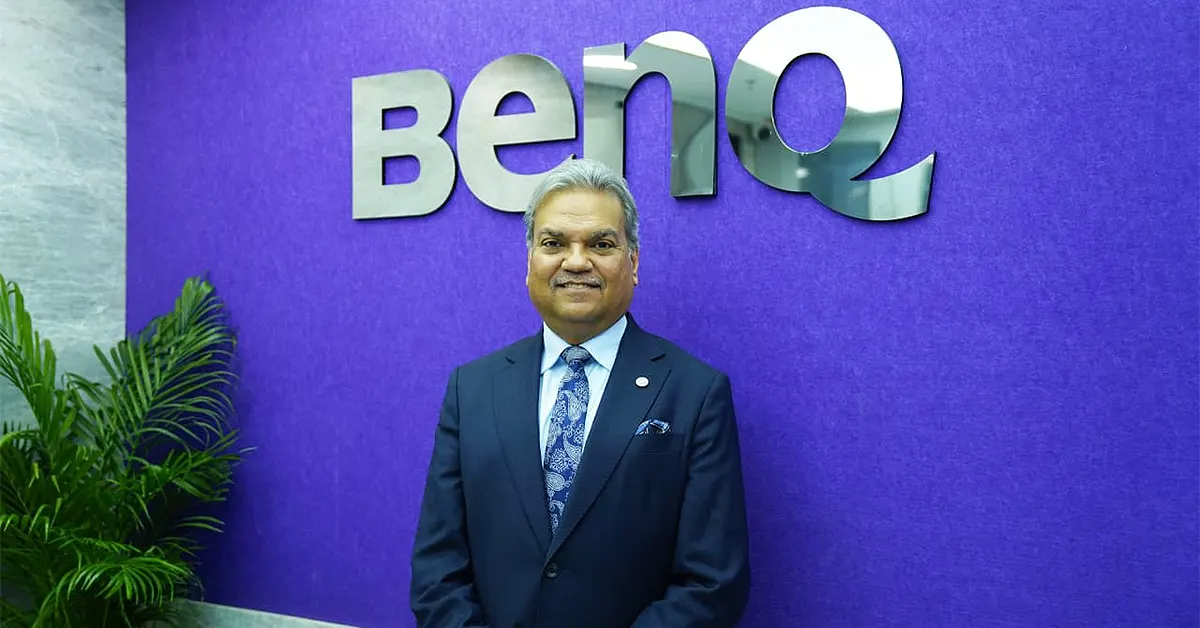
Twenty-five years is a long time to stay relevant in the display industry, especially in India, where the market evolves fast enough to leave most multinationals dizzy. BenQ has not just survived those 25 years. It is now having what could be its best year on record. With a 40 to 50 per cent growth projection and a 1,000 crore revenue target within arm’s reach, the brand that once lived primarily in conference rooms and classrooms is quietly and confidently coming for your living room. We sat down with Rajeev Singh, Managing Director of BenQ India and South Asia, for a wide-ranging conversation on growth, segments, AI that actually works, and the quiet death of the casual gaming monitor.
Q How is business performing for BenQ in India right now?
A It is doing extremely well, and especially this year. We are looking at a growth of 40 to 50 per cent over last year, which is pretty significant. We are completing 25 years in India this December, and we hope to cross the 1,000 crore mark in this calendar year. That alone would represent over 40 per cent growth from where we were last year.
Q How is that growth distributed across your main product segments?
A Monitors have been our biggest contributor for years, at close to 40 per cent of total revenue. This year, monitors will continue to grow well, around 25 to 30 per cent, but because our overall growth rate is higher, their share will settle at around 35 per cent. The segment stepping up to become our largest contributor is the interactive flat panel, which is growing even faster and should account for about 40 per cent this year. The remaining 25 per cent comes from projectors.
Read Also: Apple’s Clever New AirPods Pro 3 Commercial Dança Uses Zero Music to Flex ANC Power
Q What is actually driving this growth in interactive flat panels? The product has been around for a while.
A It has, and the market went through a difficult phase where more than 100 brands were selling interactive flat panels. The customer was confused; prices are significant, starting from around 75,000 rupees and going well above 2 lakh, and quality varied wildly. Over the last two to three years, customers have started figuring out that many of these brands were not delivering on quality or service. So they are moving away from buying from anyone and everyone, and gravitating toward brands they can actually trust. That consolidation is working strongly in our favour. Our customer base is very satisfied because our products genuinely meet or exceed what they expected.
Q Is it fair to say brand value and after-sales support are the main differentiators?
A Brand image is what sits at the top, yes, but brand image is really the sum of everything that comes before it. The first thing is what the product actually delivers in real use. Then it is the build quality and failure rate. Then it is our ability to service when something goes wrong. And then it is the training we provide, because teachers who are buying these boards are not always immediately comfortable with this kind of technology. The entire ecosystem of support we have built around our customers has been genuinely appreciated. It just takes time for people to see the evidence and then understand the difference. Once they do, they know.
Q Has penetration for smart boards expanded beyond the metros?
A Very much so. Demand now runs strongly up to Tier 4 cities. People at every level understand how these boards have made teaching far more interactive and effective. And with AI now entering the picture, it has gotten even more interesting. Our new RP series comes with a 10 TOPS NPU for on-device AI processing. A lot of AI features can now run directly on the board itself, which makes them very fast and very usable. Teachers are already using AI to create full lessons on the board, save them on the board, and then deliver them directly from it. It has become a completely self-contained teaching device.
Q Is there also a government push contributing to this?
A Yes, though that is an entirely separate segment. In the last quarter alone, we covered more than 10,000 to 12,000 government school classrooms. That includes over 5,000 classrooms in Delhi schools, around 3,000 in Punjab, and about 1,500 in Assam. Right now, we are working on projects in Uttar Pradesh and Himachal Pradesh as well. Every quarter, there are government projects in the pipeline, and they are contributing meaningfully to our numbers.
Q Shifting to monitors. What does the roadmap look like for 2026 and into early 2027? And is there any plan for more value-oriented, lower-priced monitors? I looked through your portfolio and could not find anything entry-level.
A BenQ has fully transformed into the premium space, and that is a deliberate decision. But premium for us does not mean overpriced. It means the overall value the customer gets is better than anything else available. We are the only brand with monitors specifically designed for programmers and coders. We have a complete lineup built for the Mac ecosystem. We have monitors for E-sports players, which is a separate segment from immersive gaming entirely. We are not in casual gaming at all. The immersive side is about triple-A titles, rich open worlds, and high-fidelity visuals. And we now have monitors for graphic designers, and a dedicated range for content creators, the growing segment of people producing for YouTube and Instagram and monetising their work. The next 10 months will bring fresh additions and innovations across all of these segments.
Q On projectors, is the home now the primary focus?
A Absolutely. The home is where the future of projectors is being written, not the conference room or the classroom. A big driver is Gen Z. They are living in shared or rented accommodation, they change cities and jobs frequently, and they are not looking to settle into a traditional home for many years. They want a large-screen experience without the permanence and weight of a television. A portable projector fits perfectly into that lifestyle. You can carry it anywhere; you do not need a special surface, it has everything built in, and it can give you up to 150 inches in any environment. We genuinely believe the home projector segment will be three to four times bigger within the next two to three years.
Q I actually just heard this exact dilemma from my younger brother. He is a Supreme Court lawyer in his mid-thirties, just moved into his own place, and asked me whether he should get a projector instead of a television.
A That is exactly it. You have hit the nail. That is the customer we are talking about. They want the large screen. They want the immersive sensory experience. And projection technology has advanced to a point where it genuinely delivers on that promise for everyday use.
Q What about the laser TV and ultra short-throw category?
A That is a very strong segment, and it is already selling well in India. The technology works beautifully even with ambient light on, because the screen is engineered to absorb light coming from above and reflect only what the projector throws from below. So with every light in the room on, you still get something close to TV-level brightness. It sits right where your television used to sit, on the same wall unit, in the same living room. It is not a compromise. It is a genuine large-screen television replacement.
Q How important is built-in audio within a projector?
A For portable projectors, built-in sound is critical because the whole point is an all-in-one solution. If you have to carry a separate speaker, it defeats the purpose. For installed home cinema projectors and laser TV setups, a dedicated audio system is the right approach. A soundbar pairs naturally with the laser TV. A full surround sound setup is what you want for a proper cinema experience with an installed projector. Different products, different users, different sound strategies.
Read Also: Top 10 smartphones priced under Rs 40,000 (June 2026)
Q Is BenQ thinking about entering the audio segment? A soundbar, perhaps?
A No, and deliberately so. Audio requires a completely different kind of expertise. We want to stay focused on the visual experience, which is what we do best. Where we are expanding our ecosystem is in areas adjacent to our core, like conferencing. Around the interactive flat panel, we now offer PTZ cameras, wireless presentation solutions, and other accessories. You can configure a complete conference room using only BenQ products. But audio and video, despite going hand in hand for the consumer, are very different disciplines from a product development standpoint. Even Samsung and LG, pioneers in video for decades, do not have anything truly outstanding in audio. That expertise simply does not transfer across.
Q What technology should consumers be most excited about from BenQ in the months ahead?
A AI that is genuinely useful, not AI for the sake of a marketing bullet point. On our home cinema projectors, we have now built in a camera that looks at the projected image in real time and performs frame-by-frame calibration based on whatever surface you are projecting onto and whatever the ambient conditions are. Earlier, proper calibration required a specialist and was a complicated process. Now it is entirely automatic and can enhance picture quality two to three times. On our portable projectors, you simply place the unit anywhere, switch it on, and it reads the surface and corrects the image on its own. Nothing to configure. These are the kinds of features that make you genuinely stop and think, wow, this actually works.
Q Is this AI development happening in-house?
A The technology and the know-how are ours. We source certain components externally, of course, but the application of AI to enhance the visual experience is something we are doing ourselves.
Q How much of the research driving these innovations is happening in India?
A The core R&D happens outside India, but a significant amount of consumer research that shapes product design originates here. The best example is our programmer monitor range. That entire concept was developed from consumer research done in India, within the developer and programming community. We launched it in India first, and it became a big success, and those monitors are now sold across the world. Something built entirely on insights from Indian consumers has become the global benchmark for that category. That is something we are genuinely proud of.