



Key Takeaways
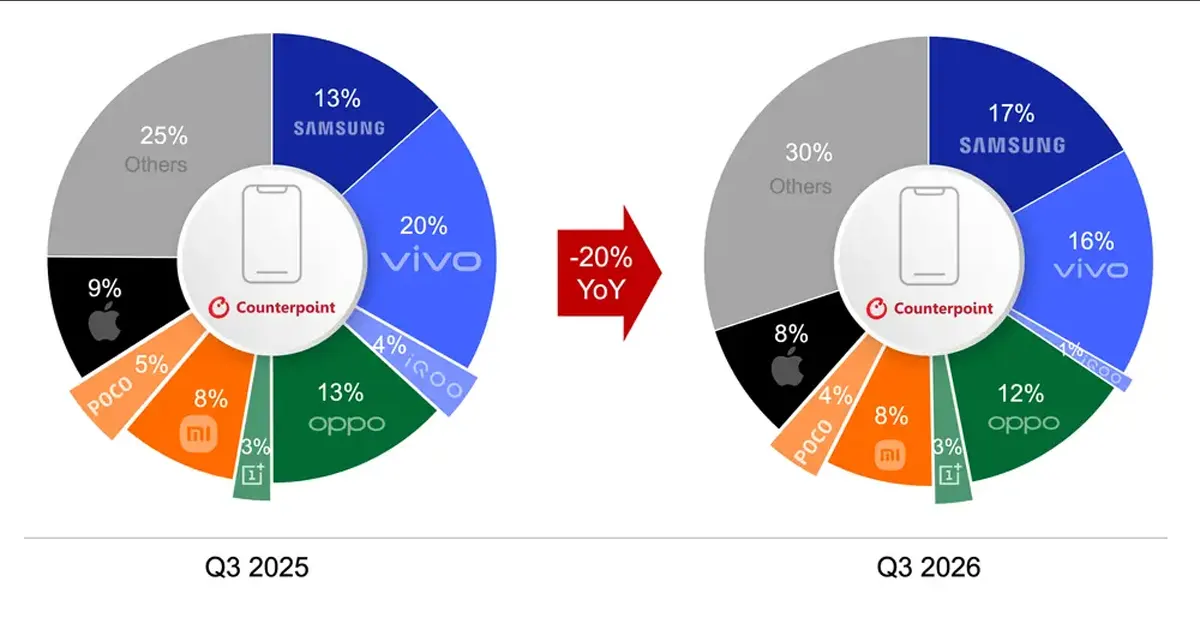
- Samsung topped the India smartphone market in Q3 2026 with a 17% share, becoming the only brand in the top five to grow during a 20% year-on-year market decline.
- Record-high memory prices increased manufacturing costs and drove up average selling prices, causing the mass market under INR 20,000 to take a severe hit.
- Samsung secured the top spot through measured price adjustments, the popularity of the Galaxy A series, and strong traction for its new foldable form factor.
Samsung tops India smartphone market for the first time in nine quarters, and it did so in the ugliest quarter the industry has seen in about a decade. According to Counterpoint Research’s Monthly India Smartphone Tracker, shipments in Q3 2026 (July–September) fell 20% year on year. Samsung grabbed a 17% share and was the only brand in the top five to actually grow. Think of it as winning a race where most of the field stopped to tie their shoelaces.
In This Article
Why India’s smartphone shipments fell in Q3 2026
The villain is memory. Record-high memory prices have pushed up what it costs to build a phone, and brands have passed much of that on to buyers. Earlier Counterpoint data showed average prices in India climbing 16% in the first half of 2026, with the average selling price touching a record $318 in Q2. Phones under INR 10,000 took the harshest beating, with average hikes of around 32%.
Shoppers responded the way shoppers do. They held on to old phones longer, delayed upgrades and got far pickier. Brands, meanwhile, played defence. Instead of stuffing the channel with stock ahead of the festive season, they kept inventory lean and protected margins.
Read Also: Apple’s First Foldable iPhone Has Apps Waiting. Here Is What You Can Actually Use on Day One
Research Analyst Shubham Singh described the quarter as a realignment, with a memory-led cost squeeze landing on top of soft demand. The traditional mass-market volume engine, especially below INR 15,000, took the biggest hit. Sub-INR 20,000 shipments dropped 47%, partly because rising prices simply shoved models into higher price bands.
How Samsung reclaimed the top spot
Samsung’s win was less about fireworks and more about restraint. Counterpoint credits the Galaxy A series for driving volumes, backed by a balanced online and offline strategy. The firm also points to Samsung’s relatively measured price hikes and early handling of rising memory costs.
That “measured” label deserves some context. Samsung has revised Galaxy prices in India repeatedly this year, so the claim is relative rather than absolute. Rivals simply moved harder or faster. For comparison, OnePlus kept its average H1 increase to about 8% by locking in memory supply early.
Samsung’s eighth-generation foldables also got a mention. Its new passport-style form factor, a first for the lineup, reportedly gained traction with buyers. That matters because the premium end is where the market’s growth is expected to come from.
Q3 2026 India smartphone market share by brand
- Samsung ranked first with 17%, led by the Galaxy A series.
- vivo (excluding iQOO) was a close second at 16%. The Y series kept volumes moving, the T series struggled, and the new S series was introduced to fill the gap between the Y and V lines.
- OPPO held third with 12%, powered by triple-digit growth in the above-INR 20,000 segment.
- Xiaomi (including POCO) also took 12% for fourth place and led the INR 10,001–20,000 band.
Apple, Google and the underdogs
Apple is having a good start to the festive stretch. Initial iPhone 18 Pro series sales in India ran nearly 20% above where the iPhone 17 Pro series began, and demand for the iPhone 17 lineup stays healthy even as Apple adjusts pricing.
Google grew more than 50% year on year, helped by more promotions and wider mainline retail presence. The Pixel 11 series, with Tensor G6 and Gemini Intelligence, gives it an AI-first pitch.
Ai+ Smartphone was the fastest-growing brand of the quarter, with shipments up 306%. Indian brands as a group rose from a 2% share to 7%, mostly in lower price tiers. Transsion’s itel grew 88% on its sub-INR 15,000 4G phones. On the silicon side, MediaTek still leads with 45%, but UNISOC is bouncing back as brands trim costs at the low end.
That 4G revival is worth watching. Counterpoint has noted that cheaper 4G models are returning because older components, such as LPDDR4x memory and LCD panels, help brands hold price points. In plain terms, some budget phones are getting a quiet spec downgrade.
What happens next for smartphone prices in India
Research Director Tarun Pathak expects the Indian smartphone market to shrink around 13% in 2026. Another round of price hikes is likely once the festive sale season wraps up, and the post-festive slowdown will add to the strain. Memory prices are also not expected to cool before 2028, according to earlier Counterpoint commentary.
Entering 2027, growth should tilt toward premium and upper-mid segments, while the mass market stays squeezed. No-cost EMIs, exchange offers and retailer-led promotions will carry more weight as conversion tools. If you have been eyeing a new phone, festive sale pricing may be the friendliest it gets for a while.


