


A phone can look powerful on paper and still reveal its limits when live video, touch controls, brightness, and network behaviour arrive together. Live game streams make this visible quickly. The screen is not only displaying a feed. It is translating motion, timing, and input into something that must feel clear in the hand.
Mobile video quality is more than sharpness. A stream can begin at high resolution, then feel less polished if it pauses, takes too long to start, or changes quality too often. A study on video streaming QoE over mobile networks found that initial buffering latency, stalling times, and stalling ratio can strongly affect perceived video experience. That matters for live game streaming because the viewer is reading movement and reacting through touch while the video continues.
In This Article
Where Live Play Shows the Phone’s Real Behaviour
This is where live casino formats become a useful, realistic way to understand the phone screen as a complete system. The 7signs online casino platform includes a live casino area with visible categories, such as roulette, blackjack, game shows, baccarat and dice, poker, and international tables, so the phone has to present several types of motion and detail within the same viewing context.
Roulette asks the display to keep a moving wheel, table layout, numbers, and touch areas readable. Blackjack places cards, dealer movement, and decision buttons into a compact frame. Game show formats add brighter studios, faster visual changes, and larger motion across the screen. The useful point is not whether the phone has the highest benchmark score. It is whether the screen remains readable, the feed feels close to real time, and the touch layer stays comfortable during short moments of attention. Viewed that way, 7signs online casino becomes a practical example of how live game streams can reveal the relationship between video delivery, display clarity, and control response.
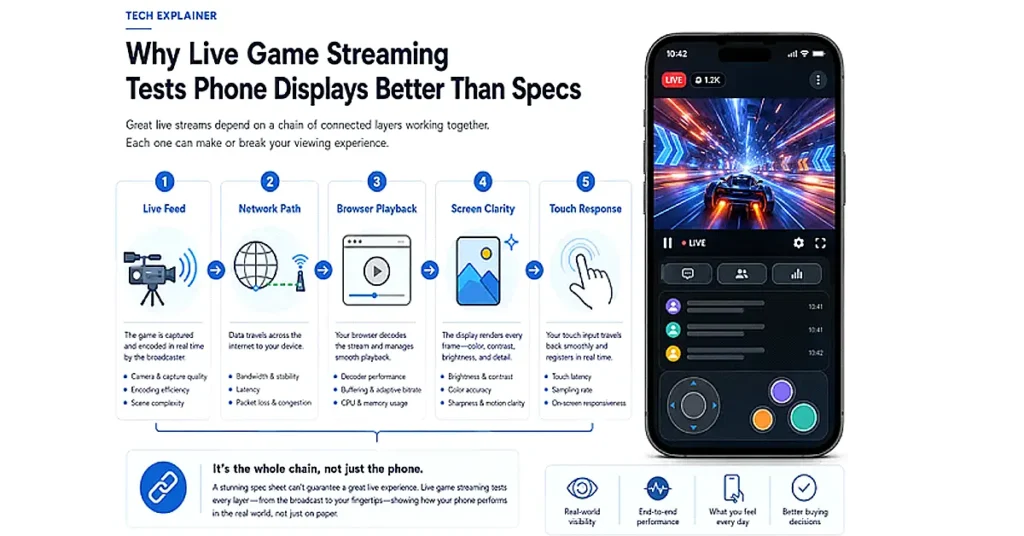
A simple way to read that relationship is to follow the stream from capture to touch. This infographic shows what the viewer notices when a phone handles live video well.
Latency Is Felt Before It Is Measured
Latency is often discussed as a number, but on a phone, it becomes a feeling. A slight delay between a visible event and a touch response can make the stream feel distant, even if the picture looks sharp. A small drop in image quality can also be more noticeable on a compact screen because every icon, card, number, and animation competes for limited space.
This is why live streams are more revealing than ordinary video clips. A movie can tolerate a few hidden compromises because the viewer is mainly watching. Live play adds expectation. The screen needs to keep the image legible while the browser handles incoming segments, bitrate changes, and user input. If the stream adjusts quality, the viewer sees that adjustment in real time. If the phone warms up, brightness and smoothness may shift.
Speed tests still help, especially when a stream feels inconsistent. Do take note that speed alone does not explain everything, but it can show whether the network has enough headroom before looking at browser performance, phone temperature, or display settings.
Display Specs Need Real Context
Spec sheets are still useful. Refresh rate, peak brightness, resolution, touch sampling, and chipset performance all affect how live content feels. The problem is that specs often appear separately, while live streaming forces them to work together. A high-refresh panel cannot rescue a stream that arrives unevenly. Strong brightness cannot fix a cramped visual design.
The more practical question is how the phone behaves over the entire short session. Does the stream become clear quickly? Does the image stay readable when motion increases? Does the screen remain comfortable to view under normal lighting? Do controls sit naturally under the thumb without covering the action? These everyday signals often say more than one headline number. In practice, the best screen is the one that disappears from attention while the stream stays legible and responsive.
For readers comparing phones, the best lesson is to look beyond the brightest demo clip. Live content reveals the everyday balance between clarity, speed, and control, and research into adaptive low-latency live streaming reinforces how video quality, latency, and playback stability work together at the end of the chain.
What This Means When Choosing a Phone
When comparing phones, treat live streaming as a practical comfort test, not a spec contest. A strong device should keep motion readable, brightness steady, controls responsive, and heat controlled during a normal session. The best clue is how little you have to think about the screen. If the phone lets the live feed stay clear while your hand stays relaxed, the display is doing its real job. That is the quiet benchmark now.


