


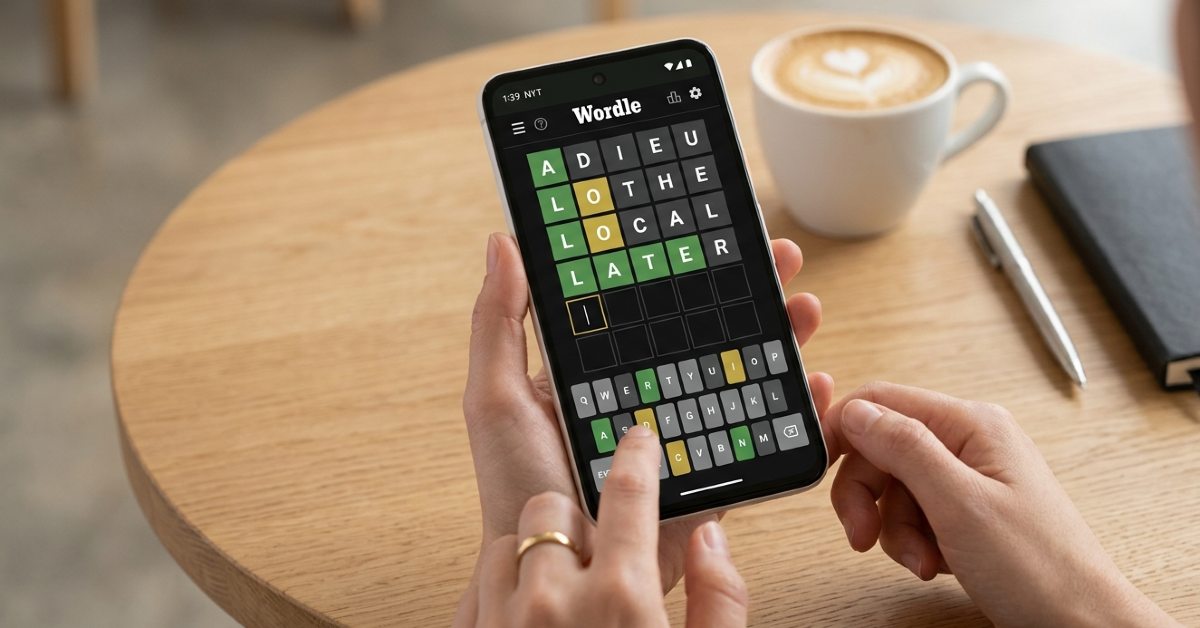

NYT has released a difficult new Wordle #1810 June 3 2026 that breaks the midweek puzzle routine. The Wordle today is a word that is familiar in regular English but has an extremely hard phonetic arrangement. And it’s causing long-term winning streaks for gamers throughout the globe to crumble. Yesterday’s puzzle was a difficult one, and today’s challenge makes it much more difficult by drastically lowering the quantity of vowels, hence creating a restricting environment for players.
The difficulty of solving the Wordle answer for June 3, 2026 is less about esoteric terminology and more about a specific consonant trigraph at the end of the word. Players that like to use vowel-heavy starting words such as ADIEU, AUDIO, RAISE might have considerable difficulties and a sequence of unfortunate grey tiles. It’s really easy to screw yourself over into a pattern of single-consonant guesses by your 4th or 5th guess and ruin the high-streak records. Our guide is very extensive and strategic to help players keep track of their statistics and minimise random guessing to provide a clear path to winning gameplay.
In This Article
Is today’s Wordle #1810 difficult?
The early morning statistics show that the global average solving rate for Puzzle #1810 has surged to more than 4.3 out of 6 tries, suggesting a tough board for casual players. The added difficulty doesn’t come from an absence of letters but from something called trigraph clustering. It’s a matter of the terminal -TCH combination occupying three of the five spaces in the word. This leaves very little room for the other letters to be arranged.
Once a solver finds the green trailing framework with -TCH, they are faced with a board that becomes fragmented, and a dangerous cycle of guessing starts. A common way for players to distinguish between similar words (such as NOTCH, BOTCH, HATCH, MATCH, WATCH, and FETCH) is to try alternative beginning consonants or to alternate vowels. Rather than making random guesses, it is best to use rows 3 or 4 to add a strategic diagnostic word such as ‘BLAME’ or ‘PRICK’ that may be used to check multiple possible beginning frames at once. This will increase the possibilities of completing the challenge in an efficient manner.
Tip for solving today’s Wordle
Today’s Wordle offers a unique brain teaser, with a distinctive consonant cluster, especially a terminal trigraph. This trigraph demands that the players use their minds differently because it is so distinct from the usual reading patterns, so like, strong consonant clusters are paired with leading vowel clusters. Today’s solution focuses on one short vowel, making it more difficult for players to solve the puzzle since its structure interferes with the subconscious ways of forming words.
A good strategy to solve this problem in a reasonable amount of time is to intentionally slow down the inputs and pay attention to words that have a low vowel density. This will assist you in avoiding the cognitive block and keep your performance metrics above the global average. The answer has a hard consonant trigraph (-TCH) with a vowel in the middle, which is the last part of the term. This rhyming family is competitive and includes BOTCH , HATCH , MATCH, FETCH, HITCH, and DITCH. Being a part of this family is a significant risk and high reward. Players who focus too early on the solution might quickly get into an unproductive cycle of guessing, making it harder to tackle today’s challenge.
Hints and Answers for Today’s Wordle June 3, 2026
Wordle Hints 1 Vowel Configuration: 1 vowel, with ‘O’ sitting in the second position.
Wordle Hints 2 Consonants: 4 Unique Consonants (N, T, C, H)
Wordle Hints 3 Repeat Letters: None, all 5 tiles are unique.
Wordle Hints 4 Starting Letter: N
Wordle Hints 5 Ending Letter: H
Wordle Hints 6 Meaning: A V-shaped nick, indentation, or incision on a surface.
Today’s Wordle Answer #1810
Today’s Wordle Answer is NOTCH
Etymology of NOTCH
The history of the term “notch” is fascinating and rare, which accounts for its complicated linguistic evolution. It came into Middle English as “noche”, from the Old French word “osche”, meaning a nick or a cut. This change to the modern English “notch” was an uncommon process known as metanalysis, or false splitting. This happened over centuries of spoken use when the word “an osche” was misheard and redivided by English speakers as “a noche”. So the ‘n’ at the end of ‘noche’ merged forever with the beginning of the word. Thus, we get the modern word “notch”. It is an interesting aspect to go into, especially in terms of how the phonetic use has changed over time , as seen by the changes on Wednesday’s board. This structural change is a captivating component of language history.
Previous Wordle Answers
How To Play Wordle:
• Players have six attempts to guess a hidden five-letter word.
• Feedback is provided through colour changes to tiles after each guess:
– Green indicates a correct letter in the correct position.
– Yellow indicates a correct letter in the wrong position.
– Grey indicates a letter that is not in the word.
Tips and tricks to solve the puzzle
• Choose a strong starting word that contains common letters rather than unusual ones.
• Repeating letters are common in words; don’t hesitate to use them in guesses.
• Utilise WordleBot, which analyses guesses and identifies areas for improvement to enhance your skills.


