



Key Takeaways
- Nvidia has officially unveiled the RTX Spark AI superchip at Computex 2026, representing a significant shift in personal computing by entering the consumer PC processor segment with a full system-on-chip design.
- Nvidia CEO Jensen Huang described the RTX Spark as reinventing the PC, shifting from launching apps to asking the PC to do work, backed by a partnership with Microsoft for on-device AI agents that handle tasks locally.
- With support for up to 128GB of unified memory, the RTX Spark can run large AI models entirely on-device, eliminating the need for cloud dependency and meeting Microsoft's Copilot+ requirements with its integrated NPU.
The Nvidia RTX Spark AI superchip was officially unveiled at Computex 2026 in Taipei, and it might just be the most significant shift in personal computing since Windows itself arrived on the scene. This is not a new graphics card. It is not an incremental processor update. NVIDIA has walked straight into Intel’s and Qualcomm‘s living room, sat down on the couch, and announced it lives there now.
In This Article
What Exactly Is the Nvidia RTX Spark?
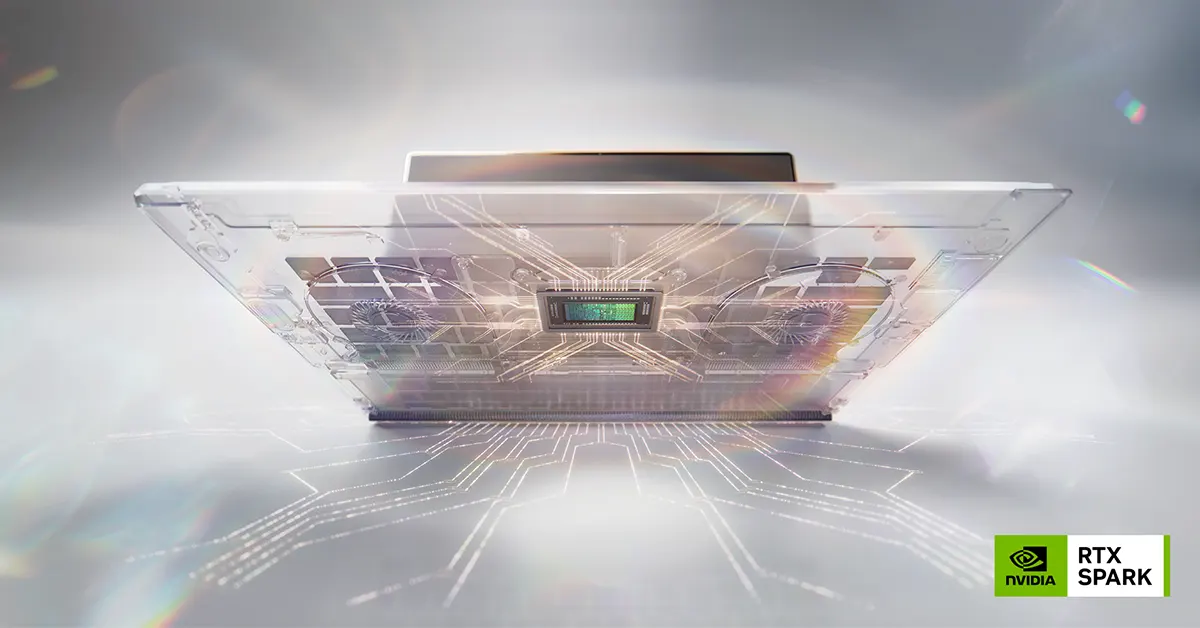
RTX Spark is a new Windows PC platform built around a Grace Blackwell superchip, marking Nvidia’s entry into the consumer PC processor segment with a full system-on-chip design rather than just a discrete GPU. Think of it as the more sociable, Windows-friendly sibling of the DGX Spark, Nvidia’s $3,999 AI mini-desktop that ran on Linux and appealed mainly to researchers in lab coats.
The chip is manufactured on the TSMC 3nm EUV foundry node and its CPU complex is based on Nvidia’s Grace microarchitecture, co-developed with MediaTek. It features 20 cores in a mix of performance and efficiency configurations. The GPU is based on the Blackwell graphics architecture with 48 streaming multiprocessors delivering 6,144 CUDA cores and up to 1 petaflop of FP4 AI performance, a spec sheet that is broadly comparable to the desktop GeForce RTX 5070 graphics card. The chip also features an LPDDR5X memory interface with 300 GB/s of bandwidth, and the CPU and GPU are connected through NVLink C2C, a high-speed interconnect that eliminates the bottlenecks that typically hobble conventional processor designs.
Read Also: How to Fix the 007 First Light Crashing Error on PC
128GB of Memory and the End of Cloud Dependency
The chip supports up to 128GB of unified memory, making it capable of running up to 200 billion parameter AI models entirely on-device. There is also a low-power NPU on the silicon that meets Microsoft’s Copilot+ requirements. That is a genuinely staggering number for a laptop chip. For context, most smartphones ship with somewhere between 8GB and 16GB. The RTX Spark can hold the equivalent of several large AI models entirely in memory, meaning there is no waiting for a cloud server to do the heavy lifting.
Unified memory configurations will range from 16GB all the way up to 128GB, and the chip can draw power ranging from single-digit watts to 80W. That kind of power efficiency across such a wide performance range is the part that will matter most to anyone who has ever been disappointed by a laptop dying mid-flight.
AI Agents, Not Just AI Features
NVIDIA CEO Jensen Huang put it plainly at the Computex 2026 keynote: “The PC is being reinvented. For forty years, you launched apps. Click. Type. With RTX Spark and Microsoft Windows, you ask, and the PC does the work.”
That vision is backed by real infrastructure. NVIDIA and Microsoft are partnering to deliver a robust, secure Windows platform for on-device agents, built on new OS security primitives and Nvidia OpenShell. These agents are designed to work across applications locally, handling tasks like file searches, code assistance, and workflow automation without sending your data off to a remote server somewhere.
RTX Spark brings together 30 years of Nvidia innovation, including CUDA, RTX, DLSS, FP4, TensorRT, OptiX, Reflex, and G-SYNC, into slim Windows laptops with all-day battery life and small, ultra-efficient desktop PCs. The result is a platform that can run 120-billion-parameter large language models with up to 1 million tokens of context, entirely offline, on a device you can slip into a backpack.
Gaming and Creative Performance
NVIDIA has been careful not to let this become purely an AI story. RTX Spark systems are claimed to be capable of rendering 90GB-plus 3D scenes, editing 12K video, and generating 4K AI video. On the gaming side, AAA titles are expected to run at 1440p above 100 FPS with DLSS and Reflex doing their usual magic. Microsoft has confirmed that Xbox experiences are coming to RTX Spark systems, and developers, including Riot Games, Remedy Entertainment, and NetEase, are already preparing optimised titles for the platform.
The Laptops and Desktops Coming This Fall
Confirmed first-wave models include the ASUS ProArt P14 and P16, Dell XPS 16, HP OmniBook X14 and Ultra 16, Lenovo Yoga Pro 9N, Microsoft Surface Laptop Ultra, and MSI Prestige N16 Flip AI. Acer and GIGABYTE have also been confirmed with systems in development to follow later. NVIDIA partners are already working on more than 30 laptops and more than 10 compact desktops, making this a remarkably broad launch ecosystem for a brand-new processor architecture.
These laptops are engineered to be as slim as 14 millimetres and as light as 3 pounds, available in 14 to 16-inch sizes, featuring a precision-machined aluminium chassis that blends durability with a clean, modern design. Colour-accurate tandem OLED displays with Nvidia G-SYNC technology complete the package for creative work and immersive gaming. NVIDIA has not confirmed pricing yet, but the first systems are expected to target premium price points, with more affordable configurations arriving later as the RTX Spark family expands.
Read Also: Acer Predator Atlas 8 with a new Intel Arc G3 Extreme processor launched
A New Challenger in the PC Chip Wars
Having dominated the data centre AI chip market and become the world’s most valuable company in the process, Nvidia is now expanding its reach into chips that serve as the main processor for personal computers. This puts it in direct competition with Intel, AMD, Qualcomm, and Apple, all of whom have long carved up this market among themselves. The RTX Spark goes head-to-head with AMD’s Ryzen AI Max and Qualcomm’s Snapdragon X2, and the rivalry could not have arrived at a more interesting moment for the industry.
If the RTX Spark delivers even half of what Nvidia is promising, the laptop you buy later this year could be the most capable personal computer that has ever existed at that price point. Whether Nvidia can translate its data centre dominance into living-room relevance remains the big question, but one thing is certain: the personal computing landscape just became a lot more interesting than it has been in years.


