

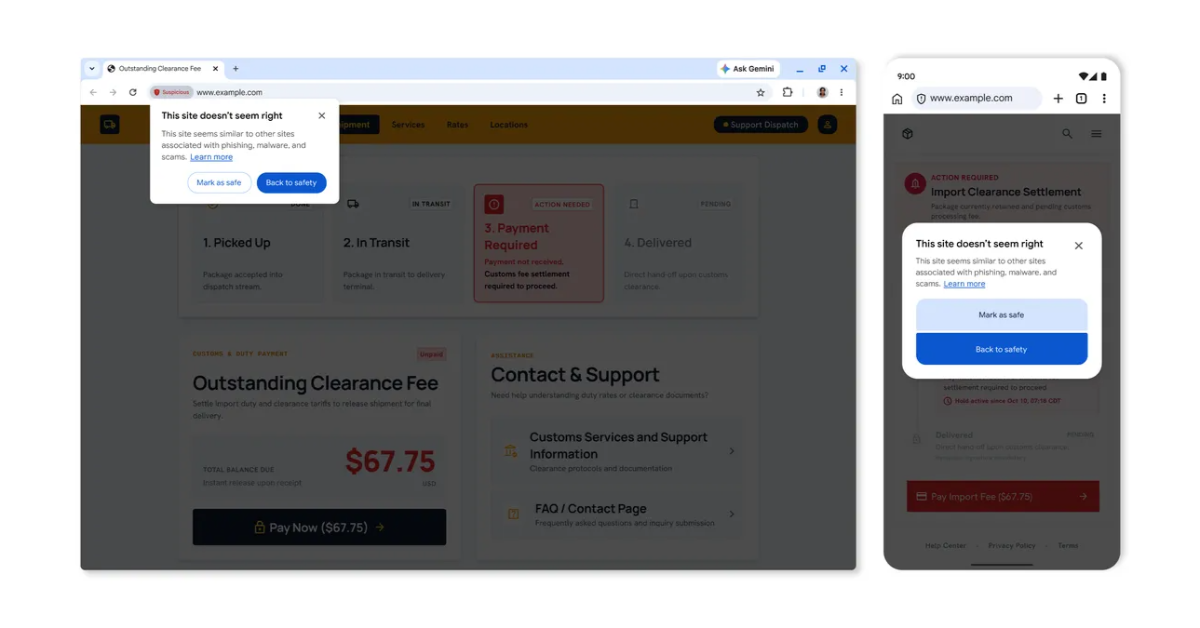

Google Chrome will employ Gemini AI to alert users about suspicious websites and online frauds and social engineering as they become more widespread. This technology improves Chrome’s fraud prevention by improving warnings on websites, detecting scams in real-time, and safeguarding users with Enhanced Protection against ClickFix attacks. Those who turn on Enhanced Protection in Chrome’s Safe Browsing settings also get improved safeguards against threats like fake antivirus notifications and deceptive browser updates.
To help consumers be more aware of possible online threats, the firm has introduced a two-level taxonomy for site warnings in Chrome’s Enhanced Protection mode. The first layer, “Suspicious sites,” is for websites that behave like malicious sites but are labelled with a lower confidence level of user risk. The second category is called “Dangerous sites,” which means a high risk with a strong confidence assessment and demands rapid user action.
To aid in identification, warnings utilise different formats, specialised iconography, different colours, and clear text, so that users may quickly and readily recognise the nature of the threat. The customised warning user interface is expected to improve preventive measures, thereby enhancing overall user safety while surfing the internet. Full-page red interstitial warnings are still used for sites identified as harmful, giving a continuous high-level warning for users encountering serious online threats.
Chrome is bringing on-device Gemini integration for enhanced protection for users to combat tech support frauds. This feature has been reported to be useful in recognising such frauds and has validated the use of Large Language Model (LLM) aided detection approaches. The plan going forward is to develop into a more complex server-side form of Gemini that will provide protection against a wider variety of scams, such as fake antivirus and fake browser upgrades.
Also Read: Apple Music gets a fresh brand identity with a new black-and-white logo and app icon
The new approach assesses web page content against several variables including brand representation, the intent behind the page, and scores which assess the possibility of scams. This comprehensive data about possible risks is paired with Safe Browsing’s evaluation of the website, which includes domain reputation and other security signals to determine the authenticity of the site. Moreover, Chrome ensures the user’s privacy, as it restricts the data transfer to the server. Page text is analysed only in instances where there is a high confidence level of scam indicators, ensuring that any content sent is handled temporarily and without logging or retention.
Also Read: Here are today’s active Garena Free Fire MAX Redeem Codes, October 22, 2026
ClickFix is a form of social engineering that tricks people into running malicious commands masquerading as fixes. It tells the user to copy commands that are different from the commands that are shown on the screen, frequently using Living Off the Land Binaries (LOLBins) like PowerShell or cmd.exe, which are genuine tools. So these trusted tools have been misused by attackers to do bad things like download malware and avoid detection by security software. Chrome’s answer to the issue is to identify copied suspicious commands for users with Enhanced Protection; any ClickFix script discovered will have personal data stripped and will be sent to Safe Browsing for review. Chrome will notify you if the commands appear harmful. This keeps users safe without delaying necessary development activities.


