


Key Takeaways
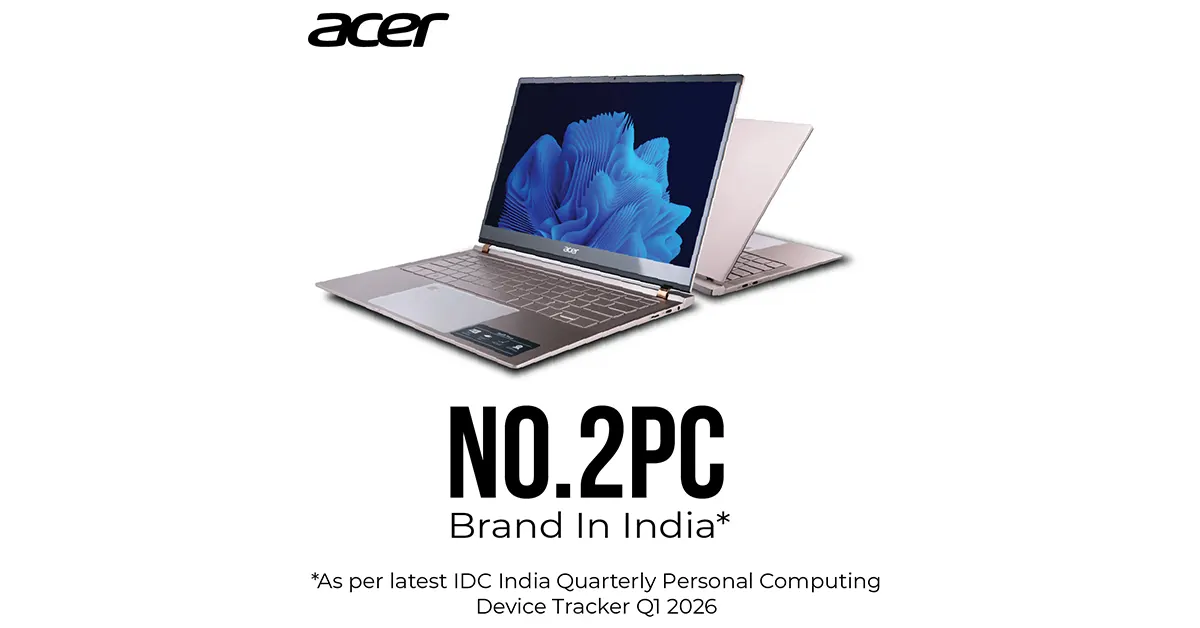
- Acer India secured the No. 2 position in the traditional PC market for Q1 2026, capturing 21.3% market share, a significant jump from fourth place with 15.4% in Q1 2025.
- Acer's growth was largely driven by dominant performance in the education and government segments, ranking No. 1 with 62.1% share in education and No. 1 overall in government deployments.
- Key factors contributing to Acer's success include expanded omnichannel retail, investment in AI-focused computing, focus on 'Make in India' manufacturing, and competitive pricing.
Acer India has pulled off one of the more striking market share climbs in recent Indian PC history. The company has officially secured the No 2 position in India’s traditional PC market for Q1 2026, according to the latest IDC India Quarterly Personal Computing Device Tracker, capturing a 21.3% overall market share. To put that in perspective, Acer sat in fourth place in Q1 2025 with a 15.4% share. That’s a jump of roughly six percentage points and two full positions in just twelve months, and not a small feat in a market as competitive as India’s.
In This Article
A Remarkable Rise Through the Rankings
India’s traditional PC segment, which covers desktops, notebooks, and workstations, has been on a sustained growth trajectory. The market hit a record 15.9 million units shipped in 2025, growing 10.2% year-over-year, and the momentum has clearly carried into 2026. Acer, which had been quietly but steadily building its presence in India in recent years, appears to have timed its push extremely well.
Read Also: Redmi A7 Pro 5G Review: Is it a good deal at Rs 15,000?
The company’s Acer India PC market share growth was fuelled in large part by dominant performance in two segments that most consumer-focused brands barely register: education and government. These are bulk-order, institutional verticals that reward reliability, price competitiveness, and distribution muscle over flashy marketing. Acer has clearly put the groundwork in, and the results show it.
Dominant in Classrooms and Government Offices
In the education segment covering desktops, notebooks, and workstations, Acer ranked No. 1 with a commanding 62.1% market share. Drill further into the numbers, and the story gets even more striking. In education desktops alone, the company holds a 56.99% share, while in education notebooks, it tops the charts at 63.7%. In a country where government-backed school digitisation programmes have been pushing PC adoption deep into Tier 2 and Tier 3 cities, being the dominant player in education is less of a vanity metric and more of a structural advantage.
The picture in the government segment is similarly strong. Acer ranked No. 1 overall in government desktop and notebook combined deployments with a 37.1% share, claimed the top spot specifically in government desktops with 40.85%, and came in second in government notebooks with a 33.63% share. These are not numbers that happen by accident. They reflect years of investment in institutional relationships, competitive pricing, and reliable supply chains that can handle large-scale tenders.
What Is Driving Acer’s Growth in India
Several converging factors have helped Acer India get to this point. The company has expanded its omnichannel retail footprint significantly, pushing into offline stores in smaller cities while maintaining a strong e-commerce presence. It has also been investing in its AI-focused computing portfolio, a segment that is becoming increasingly relevant as Indian businesses and institutions look toward future-ready devices.
Acer had set a public target of reaching 18 to 20% market share in India by FY26. With 21.3% in Q1 2026, the company has not just met that goal but cleared it. The focus on Make in India manufacturing, paired with sharper price-value positioning across consumer, gaming, and commercial categories, has also helped build brand credibility at a time when Indian buyers are becoming more discerning.
Harish Kohli, President and Managing Director of Acer India, summed it up: “Securing the No. 2 position in the Indian PC market is a proud milestone for Acer India and reflects the trust our customers and partners continue to place in us. As India continues to accelerate its digital transformation journey, we remain committed to delivering cutting-edge solutions across consumer, gaming, commercial, and AI-powered PC categories.”
Sanjeev Mehtani, Chief Sales Officer at Acer India, added that the achievement was a direct result of the dedication of the company’s sales teams and business partners across the country, and expressed confidence in continuing to push for stronger market growth in the quarters ahead.
The Bigger Picture for India’s PC Market
India’s overall PC market context makes Acer’s rise even more significant. Globally, Lenovo, HP, Dell, Apple, and ASUS occupy the top five positions, with Acer not featuring in that list. But in India, the dynamics are different. The scale of government-driven digital adoption, the classroom technology push, and the relatively low PC penetration rate of around 10% across a 1.5 billion population mean there is substantial room to grow. Whoever locks in institutional loyalty now is building a base that will be difficult to dislodge as demand scales.
With AI PCs expected to account for over half of all global PC shipments by 2026, according to Gartner estimates, and with India increasingly becoming a production and innovation hub for the APAC region, Acer’s momentum feels well-timed rather than coincidental.
A Silver Medal Worth More Than It Looks
In a PC race where HP still leads the overall Indian market, Acer’s second-place finish is genuinely impressive. The more interesting question is what Q2 and beyond look like. A brand that went from fourth to second in a year, that utterly dominates the education and government segments, and that has been building toward this moment with clear strategic intent, is not likely to sit still. Whether the company challenges for the top spot or consolidates this No. 2 position, one thing is clear: Acer India has stopped playing it safe, and the numbers are very much backing up that confidence.


