


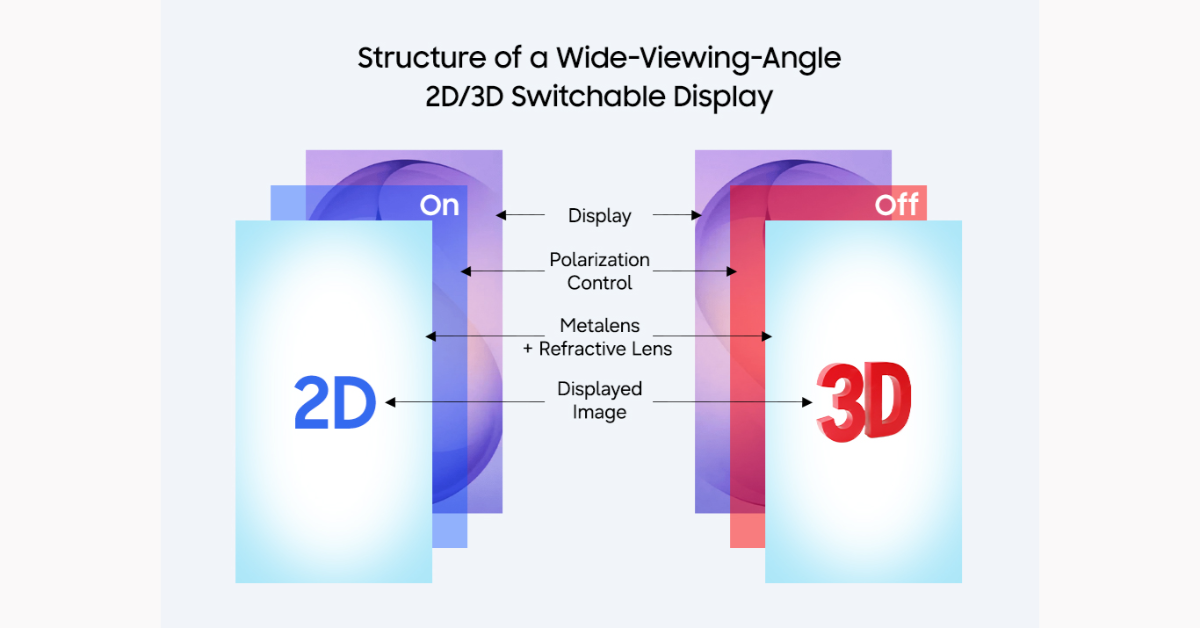
Samsung has released a research paper on a new switchable 2D/3D display technology that can be switched on and off. This technology might be used in future Galaxy smartphones, especially the Samsung Galaxy S28 Ultra, which is slated to be launched in 2028. The Galaxy S26 Ultra was released in late February. It has a 6.9-inch display and is powered by a Snapdragon System on Chip (SoC). The Galaxy S26 Ultra’s privacy display is one of its best features. It stops shoulder surfing using a hardware-based approach.
Samsung Electronics and POSTECH have released a major research paper in the journal Nature on a new “switchable 2D-3D display through a metasurface lenticular lens”. This new kind of display uses a metasurface lenticular lens that makes it easy to switch between 2D and 3D images. Nanoscale features in the centre of these ultra-thin metalens improve the optical functions that are important for today’s displays and camera systems.
Also Read: Apple iPhone Ultra metal dummy surfaced online: Details
This technology has come a long way, and it makes Light Field Display systems much better simply by offering a 3D experience without glasses that is very near to how you would see things in real life. Traditional Light Field Displays have had trouble being sold since they are big, have restricted viewing angles, and need real-time eye tracking to work. The research team has cleverly used polarisation to make a metasurface lenticular lens that can dynamically adjust its focal properties on its own. This solves many problems that come with conventional methods and opens the door to better and more accessible 3D display solutions.
This work introduces an innovative meta-optical system that can toggle between two-dimensional (2D) and three-dimensional (3D) modes via voltage control. This new feature lets users pick high-resolution 2D settings for tasks that need accuracy or 3D settings for video experiences. The switching method is made easier by a metalens that changes between concave and convex configurations for 2D and 3D views, respectively, using a polarisation controller to work.
Also Read: AMD Ryzen 9 9950X3D2 Dual Edition processor with AMD 3D V-Cache announced
In 2D mode, a concave form of the metalens lets light pass straight through, which makes for clean, sharp pictures that are important for intricate work. In 3D mode, on the other hand, the convex shape greatly improves depth perception and widens the viewing angle, presenting both clear images and a rich depth experience at the same time. This dual-mode feature is a big step forward for optical technology since it combines usefulness with immersive visual experiences.
According to Samsung, significant advancements in lens design have been achieved, most notably a decrease in thickness to 1.2 mm and an increased viewing angle of up to 100 degrees. This development increases the viewing angle by more than sixfold when compared to traditional lenses, which only give 15 degrees, allowing for a wider range of viewing angles for 3D entertainment. The practical usefulness of metalens technology is proven, notably for integration with OLED displays widely used in mobile devices.
Also Read: Lava introduced Bold N1 5G in a new RAM and storage model: Pricing and Availability
Also, a partnership between Samsung Research and POSTECH’s Nanoscale Photonics & Integrated Manufacturing Laboratory shows that people are working together to improve optical technology. This novel concept might change how screens work on smartphones, tablets, and commercial systems.


