


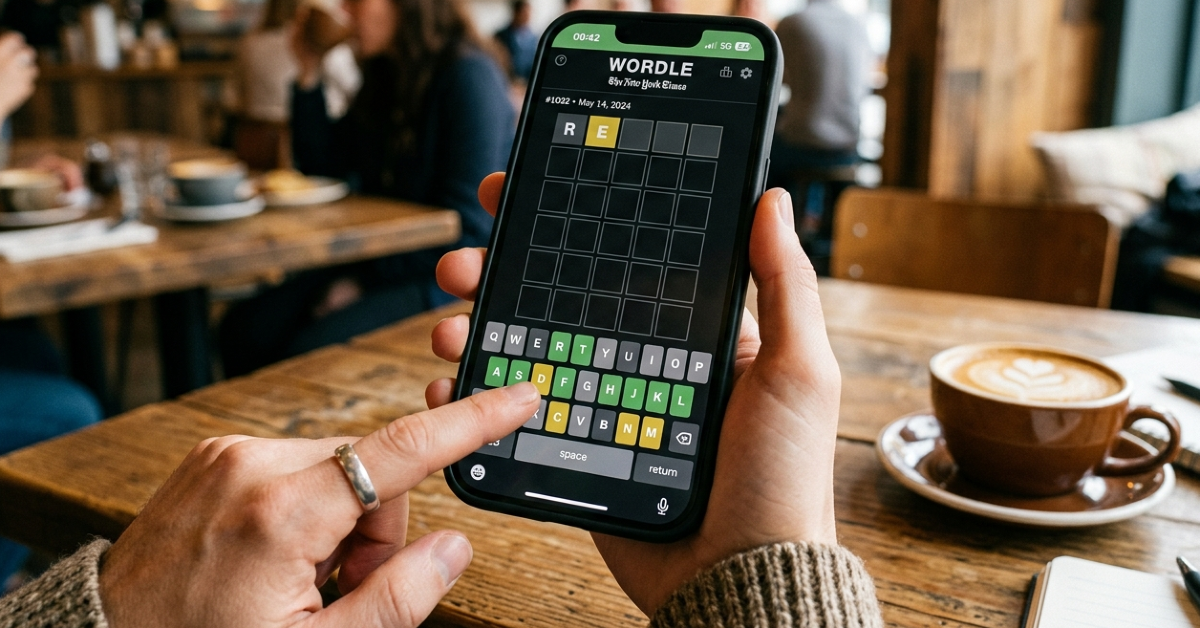
Players are facing the midweek hump on Wednesday. The NYT has introduced Wordle #1817 today, June 10, 2026, and it’s meant to disturb morning routines. This challenge involves a typical strategic and typographical verb that has led to dissatisfaction on global leaderboards. Unlike yesterday’s nautical-themed challenge, WHARF, today’s challenge has a basic-seeming layout but hides a silent consonant at the finish line, adding to the difficulty and attraction of the puzzle. Players are urged to work their way through these little details as they play the puzzle.
The challenge of the Wordle answer June 10, 2026, isn’t because the term is confusing, but because it’s used so often in design and tech. The main problem is the orthographic constitution of the word. It starts with a vowel and ends with a nasal, which makes the penultimate letter unclear. For players who prefer to start with words full of consonants like “STARE” or “CHIPS”, this specific game might be a real struggle, as they will most likely be faced with a string of grey tiles, signalling wrong answers. This in-depth guide gives a systematic way to not waste guesses on random letter combinations and helps players keep their winning streak by giving an efficient roadmap for the day’s Wordle puzzle.
In This Article
Is today’s Wordle #1817 difficult?
Early morning analytics indicate the global average solution count for Puzzle #1817 is reaching 4.3 out of 6 tries, suggesting that casual solvers are finding it difficult. The problem is caused by phonetic omission filtering, in which prevalent patterns cause players to choose voiced consonant pairings, making the silent G in the solution difficult to find. The problem notably snares solvers on row four, where, after finding the first AL- structure and the letter I, players might be led astray into popular word ends such as ALIVE or ALONG. This commonly leads to unsuccessful attempts and may disrupt long-established success streaks. A way to avoid this is to try to test out diagnostic words like REIGN or GHOST in the earlier rows to help validate the less common letters on the board.
Also Read: Blaupunkt QLED Google 5.0 TV range launched in India: Pricing and Availability
Tip for solving today’s Wordle
Today’s Wordle is on grapheme neglect, a cognitive barrier affecting the identification of words in contemporary languages that rely heavily on quick visual decoding. The condition leads people to miss internal letters that do not affect the pronunciation of a word. Cognitive reflexes may get in the way of pairing off neighbouring vowels smoothly, for instance, when a yellow “G” or dispersed “N” shows up on the grid.
Recognising this mental shortcut allows players to evaluate historical silent structures, notably in the challenges of row three. We must maintain performance indicators that are high and above global standards. The puzzle-solving method could favour early vowels but might also lead to greyed-out terminal spaces when targeting typical consonants such as -T, -D, or -S. The effort may be fruitless and cause quick exhaustion.
What is needed is a change of strategy. Players should pay attention to tracking structural frame restrictions. A diagnostic word, such as POUND or BINGOS, uses a combination of less common internal consonants and more common linking letters to quickly prove or disprove large sets of silent phonetic patterns. This methodical way of playing cuts out the distraction of rhyming patterns and lets players approach their final responses with mathematical accuracy.
Today’s Wordle Hints and Answers for June 10, 2026
Wordle Hints 1 Vowel Configuration: 2 Vowels (A and I) occupying the 1st and 4th slots
Wordle Hints 2 Consonants: 3 Unique Consonants (L, G, N)
Wordle Hints 3 Repeat Letters: No repeated letters; all 5 tiles are unique.
Wordle Hints 4 Starting Letter: A
Wordle Hints 5 Ending Letter: N
Wordle Hints 6 Meaning: A platform made of stone or wood at the side of a river where ships and boats can be tied up
Today’s Wordle Answer #1817
Today’s Wordle answer is ALIGN.
ALIGN has a beginning vowel displacement (A) and a smooth liquid transit. It leaves players entirely stranded at the finish line with a quiet, stealthy terminal consonant digraph (-GN). When individuals become agitated, they spell phonetically; therefore, they will fling all I-N combinations at the board and totally ignore the silent G.
Etymology of ALIGN
The history of the word “align” fits well with its current use. It came into English in the late 17th century from the Old French verb ‘aligner’, meaning ‘to lay out in a line’. This comes from the Latin phrase “ad lineam”, with “ad” meaning “to/toward” and “linea” meaning “a thread or string for measurement”. It was originally a technical phrase in military and construction applications. Later it was used for engineering on a world scale, for computer programming, and for daily strategic planning. It is a flexible phrase and has a nice phonetic effect for current use.
Previous Wordle Answers
Also read: WWDC 2026: Everything New in watchOS 27- Siri AI, Menopause Tracking, and Next-Level Gestures
How To Play Wordle:
• Players have six attempts to guess a hidden five-letter word.
• Feedback is provided through colour changes to tiles after each guess:
– Green indicates a correct letter in the correct position.
– Yellow indicates a correct letter in the wrong position.
– Grey indicates a letter that is not in the word.
Tips and tricks to solve the puzzle
• Choose a strong starting word that contains common letters rather than unusual ones.
• Repeating letters are common in words; don’t hesitate to use them in guesses.
• Utilise WordleBot, which analyses guesses and identifies areas for improvement to enhance your skills.


