


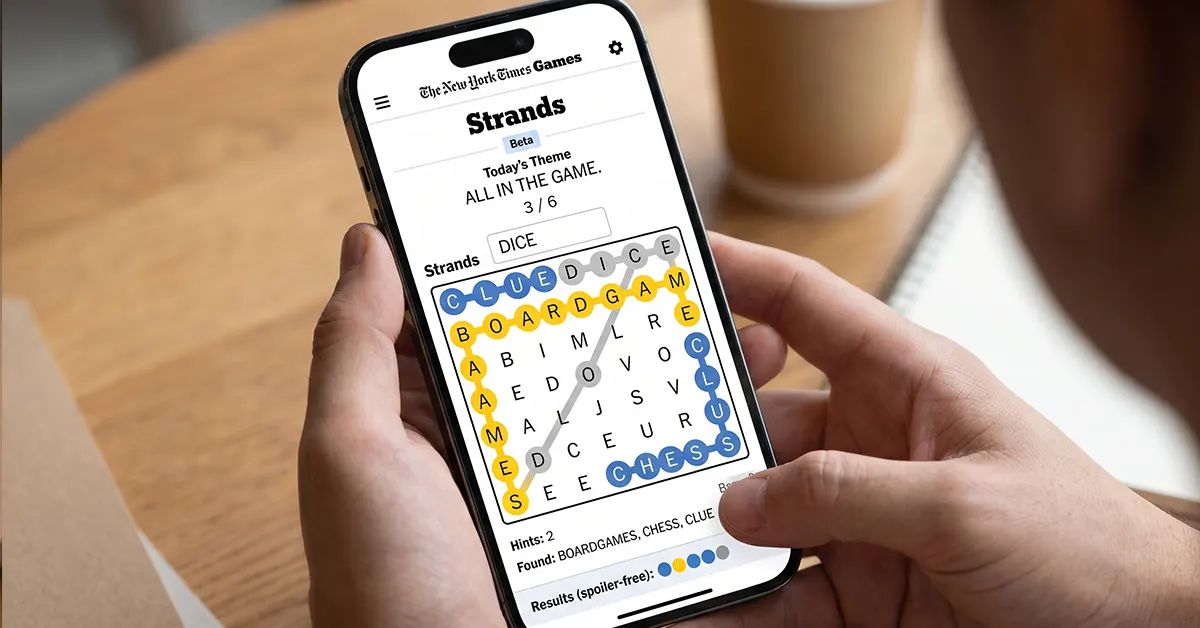

If you’re hunting for NYT Strands answers today, you’ve landed in the right place for puzzle number 914, dated September 3, 2026. The Times’ word search spinoff has quietly become one of the stickiest little games in its stable, mostly because it rewards patience over speed and punishes anyone who thinks they can brute force a grid full of overlapping letters. Today’s edition leans on a theme that will feel familiar to anyone who has spent a Sunday afternoon yelling at a television.
In This Article
What’s today’s Strands theme
The official theme is “Hike,” which is a cute bit of misdirection since this has nothing to do with trails or boots. It’s a football puzzle through and through, built around the language you’d hear from a commentary booth rather than a hiking trail.
Read Also: NYT Strands Today: Hints, Spangram and All Six Answers for September 2
Hints before you peek at the answers
Strands works by letting you find any four-letter-or-longer word hiding in the grid, even ones unrelated to the theme, to earn hint tokens. Words like FOOT, TOOT, BALD, DALE and STALE will get you moving without spoiling anything. Collect three qualifying words and the game reveals one theme answer as a reward, which is honestly a nicer mechanic than most puzzle games bother with.
Full list of answers for Strands puzzle 914
For anyone who wants the complete NYT Strands hints and answers without the guesswork, here’s the rundown for today’s grid:
- DOWN
- KICK
- PASS
- PLAY
- RUSH
- TACKLE
- STADIUM
- UPRIGHT
How to find the spangram
The spangram, the word that stretches from one edge of the board to the other and ties the whole theme together, is FOOTBALL. It runs diagonally across the grid, starting from the F positioned five letters down on the far left side. Once you spot it, the rest of the board tends to click into place a lot faster, since the spangram usually shares letters with several other answers.
Read Also: Wordle #1901 Hints and Answer Today: Wednesday, September 2
A few tips for getting better at Strands
Sports and slang-themed puzzles trip people up more than you’d expect, mostly because your brain wants to search for dictionary words instead of jargon. A couple of things that help. Scan the corners first, since spangrams almost always touch two opposite edges of the board. Don’t ignore short words either, since a four-letter find is just as useful for generating hints as a longer one. And if a puzzle feels unusually hard, there’s a good chance it’s leaning on a niche vocabulary, the same way past Strands puzzles built around old-school slang or deep-sea fish names left a lot of solvers stuck on a single stubborn word.


