



| Category | Score | Notes |
| Cleaning Performance | ★★★★★ | Best-in-class interdental cleaning via cavitation. 97% plaque removal claim holds up in subjective testing. |
| Comfort | ★★★★★ | The most comfortable electric brush I’ve used. Zero bleeding episodes across six weeks. |
| Build & Materials | ★★★★★ | IPX7, Grade 0 anti-mould, stainless steel shaft. Flawless after 6 weeks in a humid bathroom. |
| Battery & Charging | ★★★★★ | 26–39 days real-world. USB-C + wireless wall mount. The wall mount is a killer accessory. |
| Features & Modes | ★★★★☆ | Four genuinely distinct modes. No Bluetooth, no app, no pressure sensor. |
| Value | ★★★★★ | $119.99 with included wall mount. Replacement heads $5–7. Undercuts flagships by $150–210. |
| Overall | ★★★★★ | The best electric toothbrush for most people. Period. |
In This Article
Introduction: What Problem Are We Solving Here?
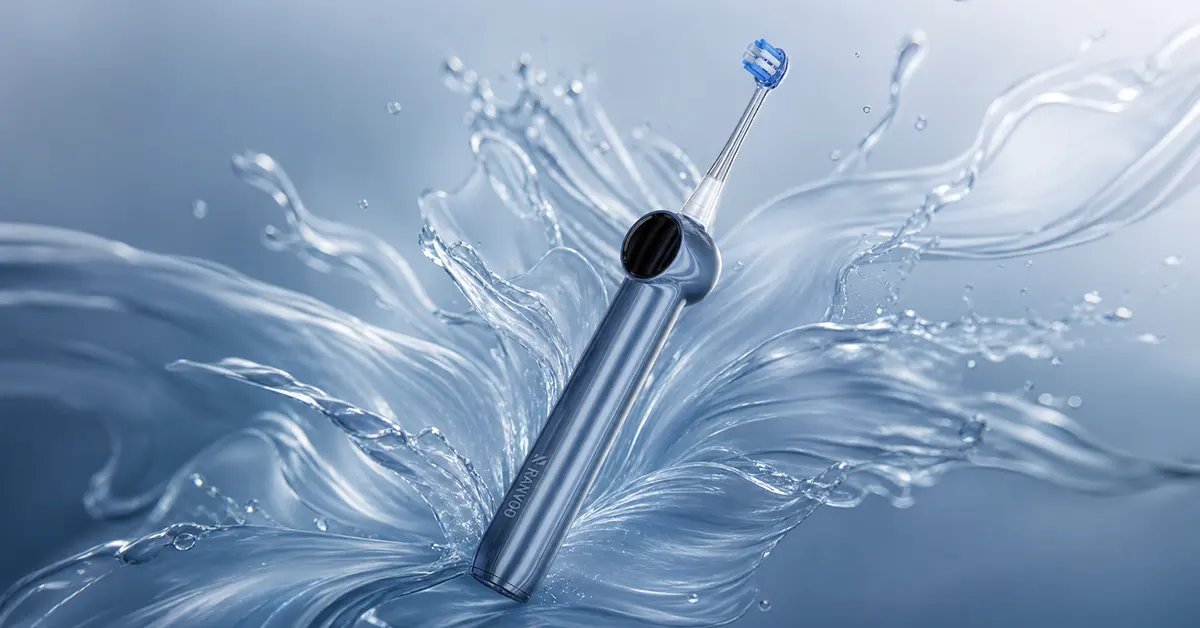
Electric toothbrushes have consistently been the most boring category. Not because oral hygiene doesn’t matter, it does, but because the innovation curve flattened sometime around 2010 and never recovered. Every year, the same two companies ship the same two brushes with slightly different packaging, a new app feature nobody asked for, and a $30 price hike justified by an extra brushing mode that is functionally identical to the other five.
The RANVOO AirJet X5, from a company most people haven’t heard of, is the first toothbrush I’ve tested that made me sit up and pay attention. Not because it has a better app. Not because it vibrates faster than the competition. But because it questions whether the fundamental mechanism of electric toothbrushes, bristles scrubbing teeth really, really fast, was the right approach to begin with.
The answer, after six weeks of testing, is: mostly no. And the AirJet 2.0 bubble-cavitation system that replaces it is the most interesting thing to happen to this category since sonic technology went mainstream.
Design & Build Quality: The Wall Mount Is the Star
What’s in the Box
The AirJet X5 ships with the handle, one bubble brush head, a 0.5 m USB-A to USB-C cable, and the accessory: the magnetic wall mount with integrated wireless charging. Four colour options: Grey, White, Blue, Purple.
Read Also: JC SkySport Smartwatch and JC SLEEPODS Wireless Earbuds launched: Pricing Details
The Handle
At 153 g with the brush head attached and measuring 258 × 34.4 × 30.4 mm, the AirJet X5 sits comfortably in the hand. It’s slightly heavier than an entry-level sonic brush but noticeably lighter than the Oral-B iO series. The ABS body carries a silicon carbide anti-mould coating, more on this later, with a matte finish that resists fingerprints and doesn’t get slippery with wet hands.
The 0.79-inch TFT display (128 × 128 pixels) is small but sharp. It shows the current mode, battery level as a percentage bar, and a quadrant timer that divides your two-minute session into four 30-second segments. The display is colour; modes get their own accent hue, which makes it trivially easy to confirm which mode you’re in at a glance. This is genuinely useful in a way that most toothbrush screens aren’t.
The stainless steel connecting shaft is a detail worth noting because it’s a common failure point on cheaper brushes. Stainless steel resists the crevice corrosion that eventually causes wobble and water ingress. After six weeks in a bathroom that gets properly steamy during showers, there’s zero play in the head attachment and no discolouration on the shaft.
The Wall Mount (Seriously, This Changes Everything)
The magnetic wall mount adheres to tile, glass, or mirror with an adhesive backing. The toothbrush snaps into place with a firm magnetic connection; a nickel-plated iron plate meets a magnet in the mount, and the hold is strong enough that accidental dislodgement requires deliberate force. This isn’t a friction-fit cradle you’ll knock the brush out of while reaching for a towel.
The mount is also a wireless charger. Input is 5V / 0.8A. The brush charges whenever it’s docked. You never think about charging again. This is the kind of design decision that sounds trivial on a spec sheet and proves transformative in daily use. After six weeks, the concept of “plugging in my toothbrush” feels archaic.
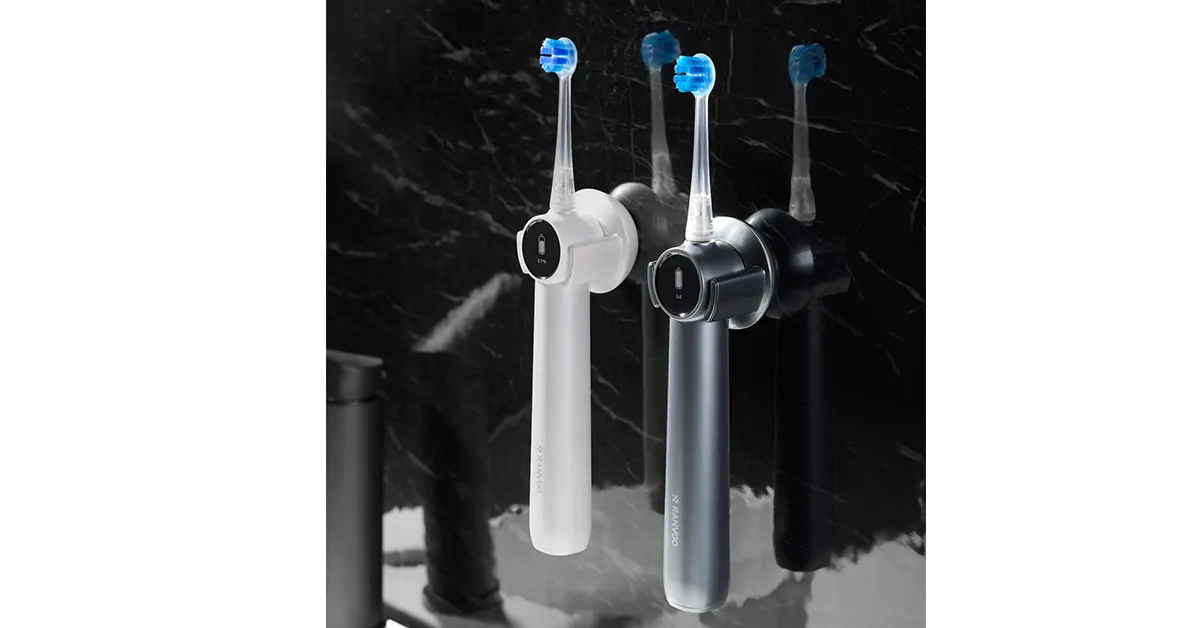
The vertical storage has a hygiene benefit that took me a few weeks to fully appreciate: the brush hangs. Water drips down and away. Air circulates on all sides. The handle dries completely between uses. Contrast this with a traditional charging puck, which creates a standing-water moat around the base and becomes a biofilm farm within months. I’ve thrown away electric toothbrushes because the base got gross. I won’t have that problem with the X5.
Anti-Mold: The Feature Nobody Markets, But Everyone Needs
The SiC anti-mould coating on both the handle and wall mount is certified to Grade 0, the highest classification under mould-resistance testing. After six weeks in a high-humidity bathroom with no special care, the unit shows zero speckling, zero discolouration, and zero of that faint musty smell that eventually develops around the charging contacts on every other electric toothbrush I’ve owned.
This is an engineering solution to a problem the industry has collectively decided to ignore. I appreciate it.
The Core Technology: AirJet 2.0 and Why It’s Different
How Every Other Toothbrush Works
Traditional electric toothbrushes, sonic, oscillating-rotating, magnetic-levitation, whatever, all clean via the same mechanism: bristles contact tooth surface, bristles vibrate or rotate, friction dislodges plaque. The only variables are frequency, amplitude, and head geometry. This works fine on flat, accessible surfaces. It fundamentally fails between teeth, where bristles physically cannot fit.
The industry’s workaround has been to recommend supplementary tools, floss, water flossers, interdental brushes, effectively acknowledging that the primary tool is incomplete. Consumer compliance with these supplementary tools is, charitably, low.
How the AirJet X5 Works
The AirJet 2.0 platform replaces bristle friction with fluid dynamics for the interdental cleaning task. Here’s the mechanism:
- A boosted bubble chamber inside the handle pressurises and aerates the water-toothpaste mixture, producing a continuous stream of high-density microbubbles.
- A Coanda-effect brush head named for the fluid-dynamic principle where a jet adheres to a convex surface directs the bubble-laden fluid along tooth contours and into interproximal spaces. The fluid follows the anatomy automatically.
- When microbubbles reach the tight spaces between teeth, they collapse in a process called acoustic cavitation. Each implosion generates a localised high-pressure microjet that mechanically disrupts plaque biofilm.
Cleaning is achieved without requiring the bristle to physically enter the interproximal space. No technique required. No supplementary tool needed. The fluid does the work.
Does It Actually Work?
Yes. Unequivocally.
I used plaque-disclosing tablets (the purple chewables that stain remaining plaque) after brushing with the AirJet X5 in Bubble mode and, for comparison, after brushing with a $330 flagship sonic brush. The difference in interproximal staining was immediately visible to the naked eye. The AirJet X5 left noticeably less purple between molars, exactly where RANVOO’s claims predict the advantage should be.
RANVOO claims a 97% plaque removal rate and Grade 1 cleaning efficiency. I don’t have a lab to verify those figures independently. What I can verify is that the post-brush “tongue test”, running your tongue across your teeth to feel for smoothness, consistently produced better results than my reference sonic brush, particularly on the lingual surfaces of the lower incisors (a common calculus accumulation site) and in the interproximal spaces of the posterior dentition.
The sensation in Bubble mode is distinctive: a soft effervescence, almost fizzy, combined with a low-frequency hum. It doesn’t feel like a power tool. It feels like a very gentle water flosser crossed with a traditional brush, but neither analogy quite captures it. After six weeks, I prefer it to the high-frequency whine of traditional sonic brushes, and I notice the difference when I switch back.
Modes: Four That Actually Do Different Things
A recurring complaint in toothbrushes: functionally identical modes. The motor runs at the same speed, the bristles feel the same, and you suspect the only thing changing is the label. The AirJet X5 avoids this entirely.
| Mode | Frequency | Flow Rate | Amplitude | Oscillation | What It’s For |
| Bubble | 15,600/min (130 Hz) | 1,000 ml/min | 1.2–2.5 mm | 6.8°–14.0° | Maximum interdental clean. This is the reason to buy this brush. |
| Sensitive | 15,600/min (130 Hz) | 500 ml/min | 3.0–4.5 mm | 16.7°–24.2° | Gum recovery, post-procedure, active sensitivity. |
| Clean | 21,600/min (180 Hz) | 800 ml/min | 0.5–2.2 mm | 2.9°–12.4° | Daily driver. Tightest parameters, minimal tissue engagement. |
| Whitening | 18,500/min (130/180 Hz) | 1,000 ml/min | 2.5–4.5 mm | 14.0°–24.2° | Alternating dual-frequency stain management. |
Each mode has physically distinct frequency, flow rate, amplitude, and oscillation angle parameters. This is the kind of transparency I wish every manufacturer practised. RANVOO published the full spec sheet. Most brands hide behind vague marketing terms.
My daily setup: Bubble mode at night (maximum clean before sleep), Clean mode in the morning. When my gums felt irritated after an overly aggressive flossing session (user error, not the brush’s fault), switching to Sensitive mode for a few days made a noticeable difference. I used Whitening mode for one session daily over two weeks and observed subtle but real brightening, though without a spectrophotometer, I’ll classify this as subjective.
Comfort & Gum Safety: The Frequency Bet Pays Off
The AirJet X5’s maximum frequency of 21,600 strokes per minute is, on paper, a weakness. Premium sonic brushes run at 31,000–62,000 strokes per minute. RANVOO is voluntarily leaving performance on the table, and in any other product category, that would be a red flag.
It’s not a red flag here. It’s the right call.
The AirJet 2.0 cavitation system handles interdental cleaning, the task that most benefits from high energy input, without using bristle strokes at all. The bristle component only needs to handle buccal, lingual, and occlusal surfaces, which are well-served by the 15,600–21,600 range. By decoupling the two cleaning mechanisms, the X5 can run its bristles at a frequency optimised for tissue safety rather than maximum plaque removal.
The 12° micro-oscillating sweep, roughly half the angular displacement of typical premium brushes, further reduces mechanical energy delivered to gingival tissue. The 0.01 mm ultra-fine nylon bristles have a certified 99.99% end-rounding rate, meaning the tips are polished into smooth domes rather than left as abrasive-edged cylinders. The TPE rubber backing on the brush head absorbs residual vibration and eliminates the jarring hard-plastic contact that occurs when the head inadvertently strikes an adjacent tooth.
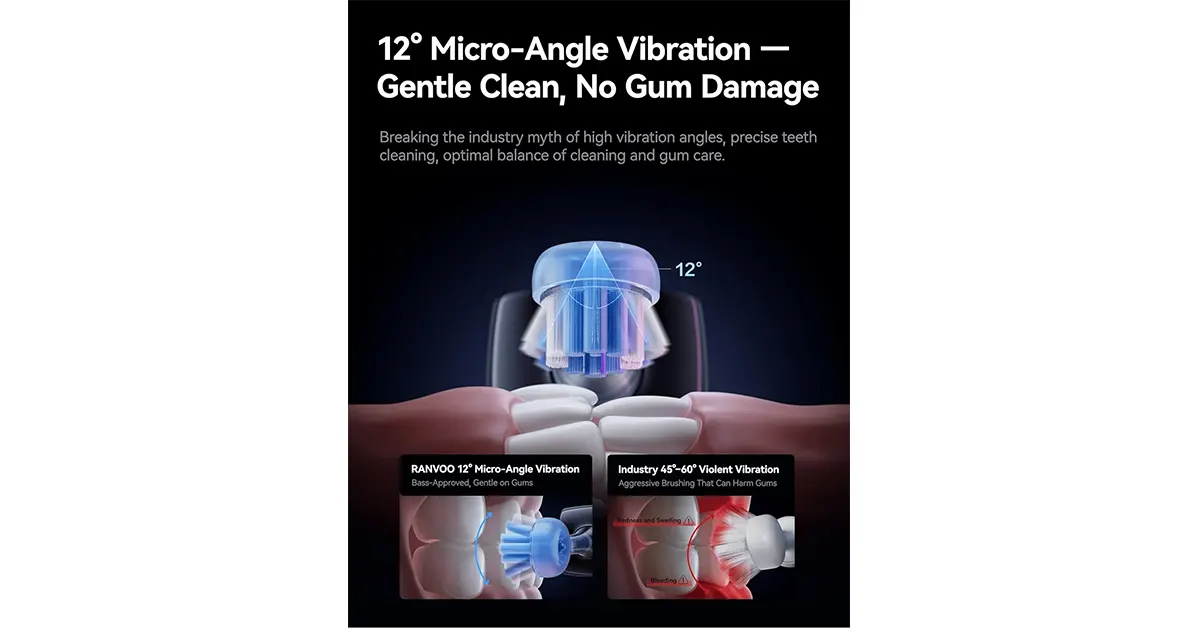
In six weeks of twice-daily use, I experienced zero episodes of gum bleeding. My reference sonic brush typically produced faint pink in the sink once or twice a week, minor enough to ignore, but present. The AirJet X5 eliminated it. For users with sensitive gums, a history of recession, or a thin periodontal biotype, this alone may justify the purchase.
Noise is rated ≤65 dB. In practice, it’s noticeably quieter than the Oral-B iO Series 10 I tested alongside it, and quiet enough that it won’t disturb a sleeping partner in a shared bedroom.
Battery & Charging: Set It and Forget It
The 1,600 mAh / 5.92 Wh battery delivers:
| Mode | Real-World Battery Life |
| Bubble | 29–39 days |
| Sensitive | 30–37 days |
| Clean | 26–30 days |
| Whitening | 28–32 days |
My mixed-use testing (Bubble + Clean, twice daily) averaged 31 days between charges. For context, the Philips Sonicare 9900 Prestige manages roughly 14 days. The Oral-B iO Series 10 does 10–14 days.
A full charge via USB-C or the wall mount takes approximately 6 hours. The USB-C port on the handle accepts any standard cable — a $5 replacement from any electronics store works. This shouldn’t be noteworthy in 2026, but the oral care industry’s stubborn attachment to proprietary chargers makes it a genuine differentiator.
For travellers: a month of battery life means you can leave the charger at home for all but the longest trips. The USB-C port means you can share a cable with your phone or laptop if needed. No proprietary charging case required.
What’s Missing: The Smart Feature Gap
The AirJet X5 does not include Bluetooth, a companion app, AI-powered brushing analysis, or a pressure sensor with visual or haptic feedback. There is no tongue-cleaning mode. There is no travel case in the box.
If you are the kind of user who actively engages with the Philips Sonicare app’s 3D mouth mapping and stays engaged beyond the two-week novelty window, the X5 is not for you. Buy the 9900 Prestige.
For everyone else, and the data consistently suggests that “everyone else” is the vast majority of users, these omissions are a fair trade for the $150–210 saved versus app-equipped flagships. The soft bristles, shock-absorbing head, and conservative frequency profile mitigate over-brushing risk to the point where a pressure sensor is less critical here than on higher-frequency devices. I’d still like to see one in a future revision, but its absence didn’t affect my experience.
Ownership Cost
Replacement heads cost $5–7 each in multi-pack purchases. At the recommended 3-month interval, annual head expenditure is $21–28.
Comparative context:
- Philips Sonicare premium heads: $11–14 each ($43–57/year)
- Oral-B iO heads: $6–9 each ($25–34/year)
The integrated battery is expected to last 3–5 years under normal use. USB-C charging eliminates proprietary charger replacement costs. The anti-mould coating and stainless steel shaft should extend the functional lifespan of the device relative to competitors that accumulate visible mould and shaft corrosion within 12–18 months.
Competition: Where the AirJet X5 Fits
| Product | Price | Best Feature | Trade-Off |
| RANVOO AirJet X5 | $119.99 | Cavitation cleaning + comfort | No smart features |
| Philips Sonicare 9900 Prestige | $329.99 | AI coaching, premium build | Price, 14-day battery |
| Oral-B iO Series 10 | $267.79 | 7 modes, oscillating-rotating | Comfort, proprietary charger |
| Oclean X Pro Elite | $79.99 | 35-day battery, Maglev motor | App quality, touchscreen durability concerns |
| Soocas Neos II | $149.99 | Competent sonic at mid-range | No meaningful differentiation |
| SURI 2.0 | $135.00 | Recyclable, repairable | Limited features, single head variant |
The AirJet X5’s strongest competitors are the Philips at the high end and the Oclean at the low end. Versus the Philips, the X5 sacrifices smart features for a $210 discount, significantly better battery life, and, in my testing, superior interdental cleaning. Versus the Oclean, the X5 costs $40 more but delivers the cavitation mechanism (which the Oclean lacks), a better wall-mount system, and superior anti-mould engineering.
Verdict: The New Benchmark
The RANVOO AirJet X5 is the best electric toothbrush I’ve tested. It is not the most feature-rich, the most expensive, or the most established. It is the one that asked the right question, “what if bristles aren’t the answer?” and answered it with genuine engineering rather than marketing.
The AirJet 2.0 cavitation system delivers interdental cleaning performance that I’ve not experienced from any other brush, at any price. The low-frequency, high-comfort design philosophy produced six weeks of bleeding-free brushing a first in my years of testing electric toothbrushes. The magnetic wall mount and anti-mould system solve the hygiene problems that eventually doom most electric brushes to the trash. The battery lasts a month. The replacement heads are cheap.
At $119.99, the AirJet X5 makes the $270–330 flagships from legacy brands very difficult to justify. Unless you are one of the few users who genuinely rely on app-based brushing coaching, this is the toothbrush to buy.
Recommended for: Anyone with teeth. Especially anyone with gums.
Not recommended for: Users committed to AI coaching and real-time brushing analytics. You know who you are.


