Search Live India is no longer just a test-bed story. Google has now expanded Search Live globally to every market where AI Mode is available, pushing the feature into more than 200 countries and territories. The update also leans on Gemini 3.1 Flash Live, Google’s new audio and voice model, which the company says is built for more natural, lower-latency conversations. For users, that means Search is moving a little further away from typed keywords and a little closer to an actual back-and-forth conversation.
That matters because this is not just another interface refresh. It is part of a broader Google AI Mode push where Search is being reframed as something you can speak to, point at, and continue questioning without starting over every time. AI Mode is now available across a long list of countries, including the US, UK, India, Australia, and many other English-speaking markets, with support for a wide range of languages.
What’s changing
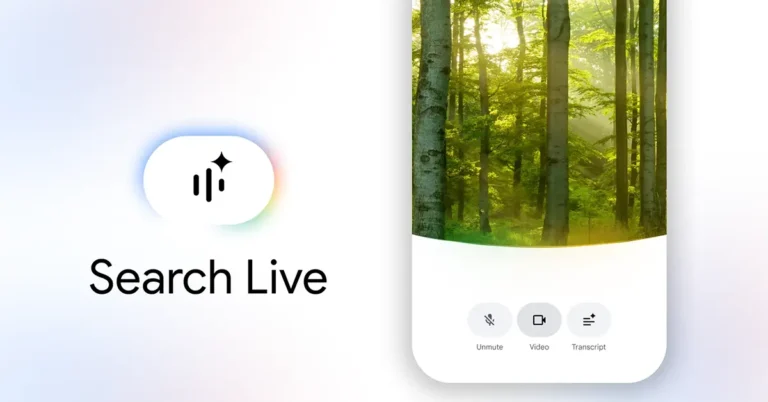
At the centre of this AI search rollout is Search Live, a feature that lets users speak with Search and, when needed, use their phone camera to add context. Google says people can open the Google app on Android or iOS, tap the Live icon under the Search bar, ask a question out loud, and then keep the conversation going with follow-up questions. If the query is about something in front of you, the camera can be turned on so Search can respond to what it sees. There is also a shortcut through Google Lens, where users can tap the Live option while already using the camera.
Read Also: Haier Gravity AI AC Series Review: Smart cooling
In practical terms, this is Google betting that real-world queries are often messy. A user trying to fix a shelf, identify a gadget port, compare two products on a store rack, or troubleshoot a router light is not always looking for a neat ten-word search query. They want camera search help and a faster answer. Search Live is clearly designed for those moments when typing feels like extra work.
Why India is central to this story
India has been an important proving ground for Google’s AI search ambitions. Last year, Google launched Search Live in India in English and Hindi and positioned the market as one of the earliest to receive the experience outside the US. Around the same time, the company also expanded AI Mode in India to more regional languages, underlining how serious it is about multilingual usage rather than treating English as the default gateway to AI tools.
Now, with the latest rollout, Google says Search Live is available in more Indian languages as well, including Bengali, Gujarati, Kannada, Malayalam, Marathi, Odia, Tamil, Telugu and Urdu, among others. That wider Search Live languages push matters more in India than in many markets because language is not a side note here. It is the interface. And when a company gets multilingual voice search right, it does not just make search more convenient. It makes it more usable for millions of people who think, ask, and compare in a language other than English.
The Gemini angle
The engine behind this expansion is Gemini 3.1 Flash Live. Google describes it as a faster, more natural voice model with improved precision, lower latency, and built-in multilingual ability. That technical layer may sound like background plumbing, but it is actually the story. Search Live only works if the conversation feels fluid enough that users forget they are talking to software. If responses are slow, stiff, or bad at switching languages, the feature becomes a demo instead of a habit.
Read Also: Wobble 65-inch K-series review: Big screen on a budget
Why this launch matters
For readers in the US, UK, India, Australia and other English-speaking regions, this rollout is worth watching because it shows where mainstream search is heading next. The classic blue-link era is not disappearing overnight, but Google is clearly building a version of Search that speaks, sees, and remembers the thread of your question a bit better than before.
My short take: this is one of those updates that sounds incremental on paper but could feel quite big in daily life. If Search Live works smoothly across accents, languages, and messy real-world camera inputs, Google may have found a more natural future for search. If not, users will go right back to typing.