


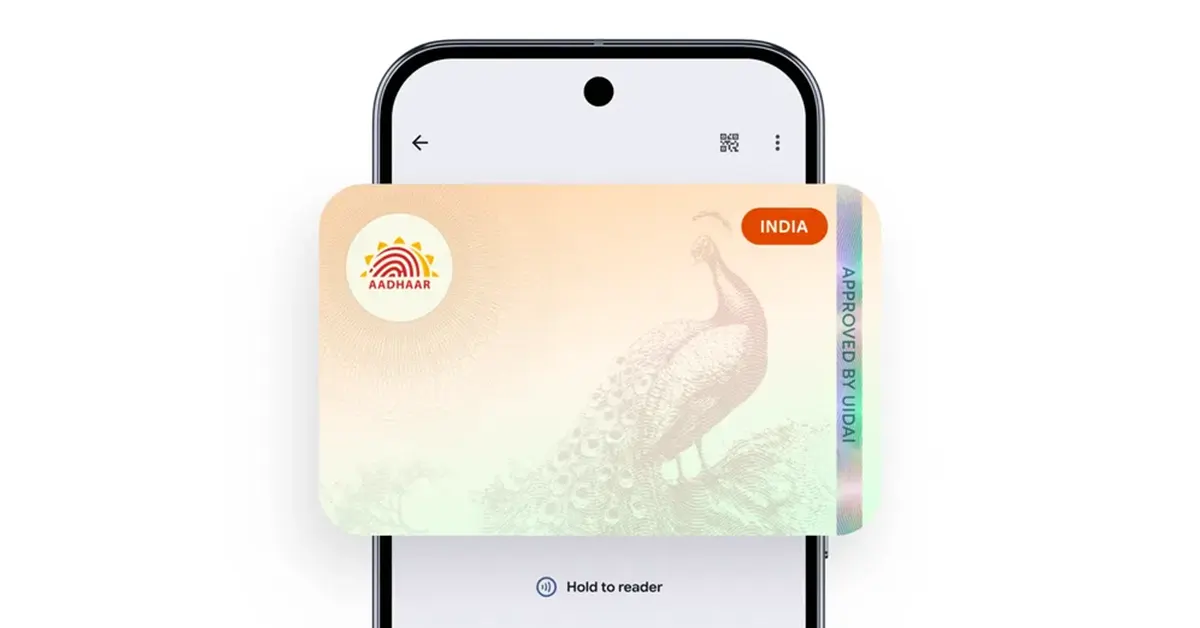
Your physical wallet just got a little less relevant. Google has officially rolled out support for Aadhaar Verifiable Credentials inside Google Wallet for users in India, marking a significant step forward in the country’s digital identity journey. Built in partnership with the Unique Identification Authority of India (UIDAI), this new capability lets you store a secure, device-based version of your Aadhaar ID and use it across a growing list of everyday services. No more digging through your bag at the cinema. No more re-entering your passport details for the fifth time in a visa form.
In This Article
What Exactly Is an Aadhaar Verifiable Credential in Google Wallet?
Think of it as your Aadhaar card, but smarter and far more private. The credential lives on your device inside Google Wallet, and it uses a privacy feature called selective disclosure. This means when a service asks to verify your identity, only the specific details required for that transaction are shared, nothing more. Proving your age at a multiplex? The system shares just that. It does not hand over your full ID profile to every app and service you interact with. That is a meaningful privacy upgrade over handing over a physical card.
Read Also: Haier Spartan AI Tower AC Launch: Wants to Know When You’re Coming Home
Which Services Support It Right Now?
The initial partner lineup in India includes some recognisable names. PVR INOX users can now quickly verify their age for age-restricted movies and also unlock loyalty rewards. BharatMatrimony is using the credentials to power verified “Prime” profiles, so matchmaking can happen with greater confidence in the other person’s identity. Atlys, the popular visa facilitation platform, lets travellers auto-fill international visa applications with a single tap, using the verified credentials directly.
Two more integrations are coming soon. Mygate, widely used by residential communities across Indian cities, will use the system to verify delivery and service personnel entering gated societies. Snabbit, focused on the gig economy, plans to introduce seamless identity checks for service providers. Both integrations are expected to add a layer of trust that the gig and home-services sector genuinely needs.
Built on Global Standards, Not a Quick Fix
Google has been clear that security, privacy, and interoperability are not afterthoughts here. The Aadhaar integration is built on globally recognised digital identity standards, which means it is designed to work across digital and physical environments without creating new vulnerabilities. The focus on interoperability also signals that this is not a closed ecosystem play. It is built to be open, extensible, and ready for the long term.
ID Passes Now Available in Singapore, Taiwan, and Brazil
India is not the only country getting a digital identity upgrade from Google Wallet. Users in Singapore, Taiwan, and Brazil can now create what Google calls an “ID pass.” This is a secure digital ID built on passport information, saved directly in Google Wallet. It can be used to verify identity or confirm age for both in-person situations and online services, such as signing into accounts that require age verification.
The ID pass rollout signals Google’s broader strategy to make digital identity a standard, global capability inside its Wallet product rather than a one-off regional feature. For travellers and globally mobile users, a consistent identity layer across countries is an increasingly practical necessity.
Read Also: How to recharge your phone using WhatsApp
Why This Matters Beyond Convenience
Digital IDs done right represent something more than a shortcut. When identity systems respect privacy by design, they reduce the risk of data over-collection, a problem that has plagued the digital economy for years. Selective disclosure, in particular, is a principle that regulators, privacy advocates, and users alike have been pushing for a long time. Seeing it implemented at scale, across a country the size of India, is genuinely noteworthy.
The ripple effect could be significant. As more services integrate with verified digital credentials, the incentive to build proper, standards-based identity systems grows for developers, businesses, and governments alike. Countries watching India’s rollout may well accelerate their own digital ID programmes.
The world is moving toward digital-first identity management, whether we are ready or not. If Google’s expanding ecosystem is any indication, the future of proving who you are might just live in your pocket rather than your wallet.


