


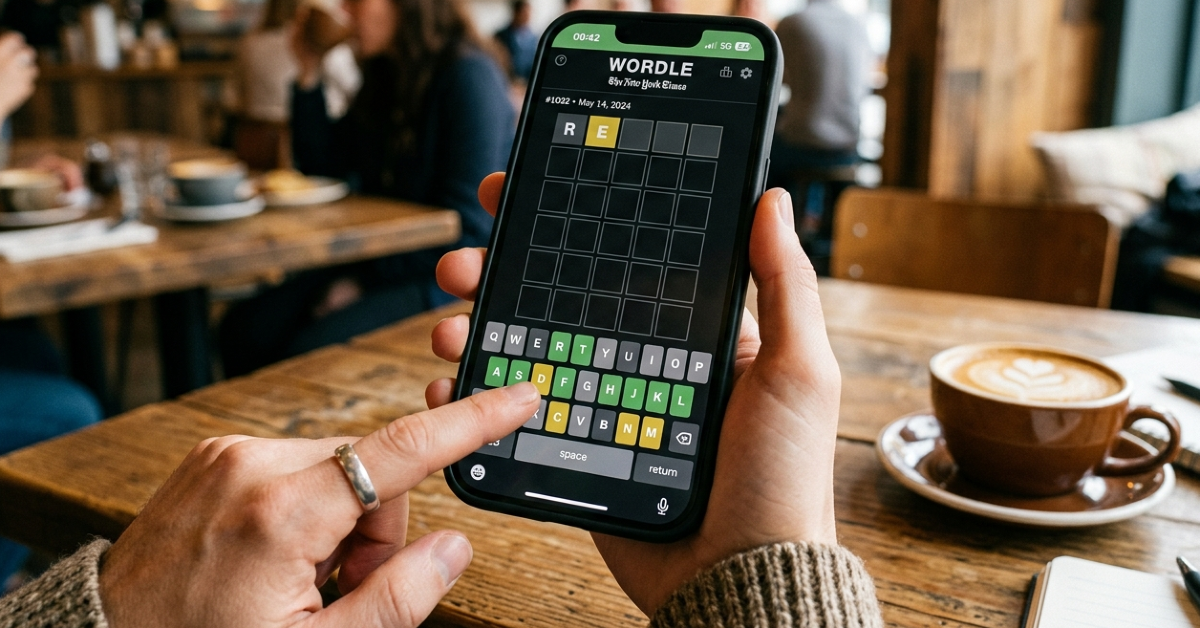

The structural difficulty of Wordle Puzzle #1796 (May 20) has been raised thanks to The New York Times’ digital gaming staff. Today’s puzzle is going back to being very morphologically misleading after Tuesday’s stabilising hint, “DUSTY.” The challenge with this word puzzle isn’t some mysterious word but the phonetic assumptions we make in our everyday morning routines.
Today’s grid layout makes it very challenging for the usual vowel-rich starters like AUDIO, ADIEU, or RAISE. Players have to watch out for a difficult double-consonant boundary instead of vowels. The change in structure causes a special kind of cognitive friction and so requires the use of advanced deductive reasoning techniques. By the third row, players are expected to move from easy elimination tactics to a specialised manner of isolating consonants, highlighting the necessity for a more strategic approach to problem-solving in the game.
Our complete analysis breaks down the specific structural challenges in boards, focusing on historical spelling shifts and innovative consonant-clearing techniques.
Also Read: Voice-powered Docs Live: Google’s major update to brain-dump whatever is on your mind
In This Article
Is today’s Wordle #1796 difficult?
Difficulty Rating: 3/5
The tactical difficulty of Wordle #1796 is mostly due to orthographic deception rather than semantic complexities. In particular, the silent first letter ‘W’ in five-letter words accompanied by ‘R’ might trip up phonetics-focused players. This phonetic method may take them astray from the actual starting point of the answer, consuming guesses while looking for vowels.
From the community stats, we see that the average number of tries to solve is 4.3 out of 6, meaning the terminal digraph ‘-CK’ usually makes the game challenging for players. After they find the core vowel, players often begin looking for frequent suffixes, like “-ED,” “-ER,” or “-ET.” Hard-stop blends at the end of words break this logical flow, requiring players to abandon vowel-heavy strategies by the second row.
Players are recommended to use sacrificial words to isolate last consonant pairs to correctly approach the challenge, which could encourage a more successful solving technique.
Hints and Answers for Today’s Wordle May 20
- Wordle Hints 1 Vowel Configuration: 1 vowel (E) sitting exactly in the centre of the word
- Wordle Hints 2 Consonant Clusters: 4 Consonants ( silent -WR blens paired with a terminal -CK hard diagraph cluster.
- Wordle Hints 3 Repeat Letters: None
- Wordle Hints 4 Starting Letter: W
- Wordle Hints 5 Ending Letter: K
- Wordle Hints 6 Meaning: The word is a noun and a verb describing to ruin or to destroy.
Today’s Wordle Answer #1796
Today’s Wordle Answer is WRECK
Yesterday’s Wordle #1794 answer May 19 was DUSTY.
Origin and Etymology of WRECK
“Wreck” has a deep and maritime history, originating in the Old Norse word “reka”, meaning “to drive, drift, or push”. This etymology emphasises the act of movement associated with seafaring activities. The term “wreck” was an Anglo-Norman word that was used to particularly denote goods washed ashore from abandoned ships, pointing to an early legal link to marine accidents. The legal interpretation of “seadrift” grew to include a wider sense of grave damage or physical obliteration, not necessarily confined to shipwrecks.
Moreover, the linguistic foundations of these words show special features typical of maritime terminology, in particular the existence of hard-consonant ends. This phonetic quality is not only relevant in the context of marine language but also has a practical use in deciphering complicated puzzle grids in later applications. The connection between historical linguistics and legal definitions demonstrates the dynamic and evolving nature of language as it responds to the changing conditions of maritime contexts.
Also Read: Google IO 2026: Here is everything about the Intelligent AI Search box and new features
Tips and tricks to solve the puzzle
• If you have a puzzle with a centre “E” and grey squares around it, don’t chase following vowels like “A” or “I”.
• Test a number of consonant pairs using a focused consonant test (e.g., FLACK, TRUCK, or CHIPS).
• Even when these strategic guesses become grey, they serve to narrow down the remaining letters.
• This strategy separates the core frame, which is a more definite way to get the answer.
Previous Wordle Answers
- May 19 #1795: DUSTY
- May 18 #1794: LOATH
- May 17 #1793: BYLAW
- May 16 #1792: MOVER
- May 15 #1791: CREED
- May 14 #1790: WAVER
- May 12 #1789: DOWDY
- May 11 #1788: CLOCK
- May 10 #1787: NEWLY
How To Play Wordle:
• Players have six attempts to guess a hidden five-letter word.
• Feedback is provided through colour changes to tiles after each guess:
– Green indicates a correct letter in the correct position.
– Yellow indicates a correct letter in the wrong position.
– Grey indicates a letter that is not in the word.


