In This Article
Design and Display
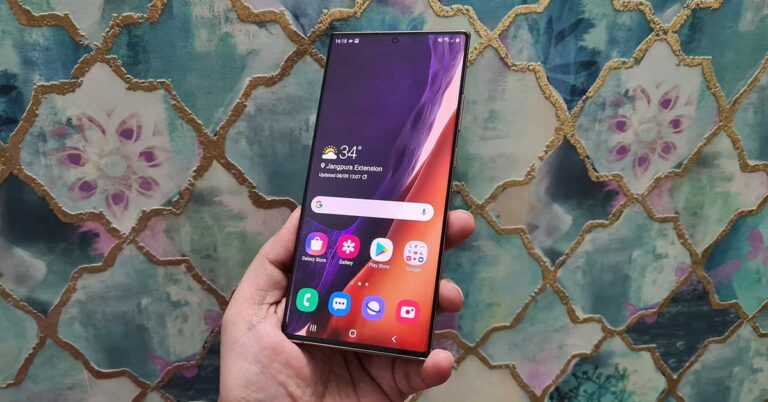
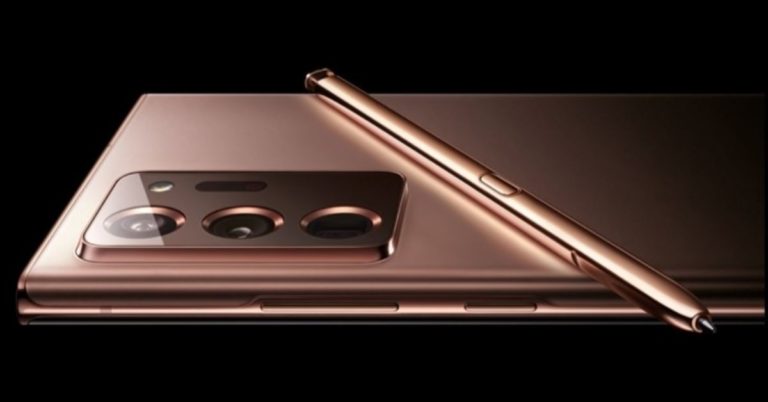
Well, with the opening para you would have already guessed that we are by now a fanboy of the looks of this smartphone. This smartphone just kept pulling us deeper in love with it. The front of the Samsung Galaxy Note 20 Ultra is conquered by a large curved touchscreen that measures 6.9-inches. This is protected by a layer of Corning’s, first-ever on a smartphone, Gorilla Glass Victus. The same can be found on the back, which has a very matte-like finish. Corning says that this Gorilla Glass can withstand a drop of up to 2 meters. Which is great if you are a Chandler (butterfingers from the popular TV show Friends). Moving on, Samsung Galaxy Note 20 Ultra is available in two colours – Mystic Black and Mystic Bronze. We got the latter one to play around with and if we must sum up its looks in one word, it is breath-taking. Samsung’s designers did everything they could for a jaw-dropping experience. Right from the camera bump, which is bigger than usual, but has an identity of its own that does grow on you. The bump also gets these bronze accents around it, so does each of the camera lenses. At the back, you will find Samsung’s branding too, which again can be found in a very premium bronze-ish chrome.
The sides of the Samsung Galaxy Note 20 Ultra are made up of metal and look good too. On the right one can find the power and volume rocker keys. While the speaker grille, USB Type-C charging port, primary microphone and the S-pen can be found at the bottom. The top has a dual SIM tray and a secondary microphone. The left side is plain and has just the fine thin metal band running across.
Coming back to its display, we enjoyed every bit of it. Samsung Galaxy Note 20 Ultra comes with 120Hz refresh rate, which still does not work on with QHD (like the Note 10 series), but with FHD+. It is not a deal-breaker, but we would have not minded the upgrade. Everything on the screen runs smoothly and rarely come across as ghosted. The screen responds well to each touch and tap, and one would love the experience with the S-pen. All the cool features of the S-pen do come back from the previous series to the Samsung Galaxy Note 20 Ultra, like air control and air gestures. These still work well. Some might find them gimmicky, but for creators/photographers/vloggers they are handy.
Moving on, Samsung Galaxy Note 20 Ultra is available in two colours – Mystic Black and Mystic Bronze. We got the latter one to play around with and if we must sum up its looks in one word, it is breath-taking. Samsung’s designers did everything they could for a jaw-dropping experience. Right from the camera bump, which is bigger than usual, but has an identity of its own that does grow on you. The bump also gets these bronze accents around it, so does each of the camera lenses. At the back, you will find Samsung’s branding too, which again can be found in a very premium bronze-ish chrome.
The sides of the Samsung Galaxy Note 20 Ultra are made up of metal and look good too. On the right one can find the power and volume rocker keys. While the speaker grille, USB Type-C charging port, primary microphone and the S-pen can be found at the bottom. The top has a dual SIM tray and a secondary microphone. The left side is plain and has just the fine thin metal band running across.
Coming back to its display, we enjoyed every bit of it. Samsung Galaxy Note 20 Ultra comes with 120Hz refresh rate, which still does not work on with QHD (like the Note 10 series), but with FHD+. It is not a deal-breaker, but we would have not minded the upgrade. Everything on the screen runs smoothly and rarely come across as ghosted. The screen responds well to each touch and tap, and one would love the experience with the S-pen. All the cool features of the S-pen do come back from the previous series to the Samsung Galaxy Note 20 Ultra, like air control and air gestures. These still work well. Some might find them gimmicky, but for creators/photographers/vloggers they are handy.
 Also, now there is a nice chalkboard sound attached to the S-pen when you are writing something on the screen, it gives it a nice touch. And yes, it can be turned off from the settings menu. The movie and gaming experience on the Samsung Galaxy Note 20 Ultra is superb. Barring the occasional heat up after an extended session of gaming, we found games like Call of Duty Mobile or Asphalt 9 working well on high settings. Since this is an infinity-O display, which means you get a single selfie camera on top of the screen. It does not hinder much while playing a game or watching a movie.
Talking about which, we loved the movie experience on the Samsung Galaxy Note 20 Ultra. The colour reproduction is great, the blacks are deep and combined with the enhanced stereo speaker system the experience becomes better. All in all, the screen is one of the best aspects of the Samsung Galaxy Note 20 Ultra. Before we forget, since the display supports 1,500 nits of brightness, it is very legible in direct sunlight too.
Also, now there is a nice chalkboard sound attached to the S-pen when you are writing something on the screen, it gives it a nice touch. And yes, it can be turned off from the settings menu. The movie and gaming experience on the Samsung Galaxy Note 20 Ultra is superb. Barring the occasional heat up after an extended session of gaming, we found games like Call of Duty Mobile or Asphalt 9 working well on high settings. Since this is an infinity-O display, which means you get a single selfie camera on top of the screen. It does not hinder much while playing a game or watching a movie.
Talking about which, we loved the movie experience on the Samsung Galaxy Note 20 Ultra. The colour reproduction is great, the blacks are deep and combined with the enhanced stereo speaker system the experience becomes better. All in all, the screen is one of the best aspects of the Samsung Galaxy Note 20 Ultra. Before we forget, since the display supports 1,500 nits of brightness, it is very legible in direct sunlight too.
Samsung Galaxy Note 20 Ultra Performance and Cameras
Now here is the part which some might love, and some might hate. Us? We are right in the middle leaning towards the liking part. As most of you know, Samsung pushes out the latest Snapdragon chipsets in countries like USA and China. While the rest of the world gets its proprietary Exynos chipsets. With the Samsung Galaxy Note 20 Ultra, the case is the same. While the above two countries get Qualcomm Snapdragon 865+ chipsets, India and rest are stuck with Exynos 990. We will talk about that in the coming paras, first, let us introduce you to the rest of the tech specs of Samsung Galaxy Note 20 Ultra. Samsung Galaxy Note 20 Ultra comes with 12GB RAM and 256GB storage. Storage is expandable using a microSD card. 5G is supported by the device but that does not make much sense in India (at the moment). The GPU used here is Mali-G77 MP11, which is good but not great. There is no 3.5mm audio port here, so you would need to make home with the USB Type-C port for audio connectivity, or better go wireless. 25W fast charging is supported with 10W wireless charging as well as reverse charging options. Now that we have the tech specs out of the way, let us come back to the Exynos 990. Why Samsung why? Why the disparity. We were strongly hoping we will get a taste of the latest Qualcomm CPU in this version of the Note, perhaps next year? When compared to QC SD 865+ the Exynos 990 is a step behind. But does that really matter? Well if you are regular binge-watcher who would want to use the smartphone for daily doings and basic internet activities, it does not matter much. But if you are a super creator and want extreme performance from each buck spent, then every extra power point does matter. Nonetheless, we did try to do all those heavy-duty activities like multi-app usage, creating art etc and to our amazement, the Samsung Galaxy Note 20 Ultra with its Exynos CPU did deliver quite well. Switching gears, the smartphone is built on Android 10 OS with Samsung One V2 UI on top. Now, this is an aspect where the device excels and is leaps and bounds ahead of the rest of the competition. Frankly, we can write a thesis on how good these OS enhancements and features are, as there are many. These include 8K video recording, S-Pen air gestures and integration, excellent screen notification system, gaming enhancements with Microsoft Xbox games and DEX. For the lesser-known, DEX is Samsung’s attempt at turning the smartphone into a PC. Where previous generation (of DEX) needed the user to connect an HDMI cable to make it work like a desktop, this time Samsung has gone wireless. We did try it with a competitor’s TV with Miracast as the latest Samsung TV was not available. The results were not that great. We found it to be gimmicky, the device heats up easily and Samsung has some way to go before they find perfection. Coming over to the cameras, the Samsung Galaxy Note 20 Ultra comes with three cameras at the back. The array includes a 12MP ultra-wide camera, 108MP wide-angle camera and 12 MP telephoto camera. There is a fourth sensor here, which is laser-driven for autofocus. A rather bright LED flash has also been thrown in the mix. Like its sibling this one can also capture videos in 8K, however, we liked the stability when capturing in 4K resolution. But what really takes the cake away is the 50X zoom capability of the rear cameras. It is now much better than before and captures the subject with more stability and accuracy.
The cameras amazed us at various levels. The shots during the day, including portraits and landscape, came out very close to life and vibrant. Edges were clear and sharp. The night mode has also become much better and with the latest update, rolled out a few days ago, it has become even better. On the other side, users get a 10MP selfie camera. Here we got mixed results. While most of the time the portrait shots came out to be good indoors and outdoors, the quality went down a bit when there was less light in the room or at night when compared to the Galaxy S20 series. Nonetheless, you will still enjoy the photo experience with the front shooter.
Coming over to the cameras, the Samsung Galaxy Note 20 Ultra comes with three cameras at the back. The array includes a 12MP ultra-wide camera, 108MP wide-angle camera and 12 MP telephoto camera. There is a fourth sensor here, which is laser-driven for autofocus. A rather bright LED flash has also been thrown in the mix. Like its sibling this one can also capture videos in 8K, however, we liked the stability when capturing in 4K resolution. But what really takes the cake away is the 50X zoom capability of the rear cameras. It is now much better than before and captures the subject with more stability and accuracy.
The cameras amazed us at various levels. The shots during the day, including portraits and landscape, came out very close to life and vibrant. Edges were clear and sharp. The night mode has also become much better and with the latest update, rolled out a few days ago, it has become even better. On the other side, users get a 10MP selfie camera. Here we got mixed results. While most of the time the portrait shots came out to be good indoors and outdoors, the quality went down a bit when there was less light in the room or at night when compared to the Galaxy S20 series. Nonetheless, you will still enjoy the photo experience with the front shooter.
 Over that, users also get an in-display fingerprint reader that is very swift. We were able to open the smartphone even with moist fingers. On the battery front, Samsung has put in a 4,500 mAh battery inside the Samsung Galaxy Note 20 Ultra. While its sibling launched this year has higher mAh battery, this one still manages to post a usage time of over a day (under nominal use). If you play a lot of games and keep the Wi-Fi on all the time, then you would need to put it to charge before going to bed. Since there is only support for 25W fast charger, we were able to charge the phone fully from zero to hundred in a little over 1 hour. On Geekbench 5 we got a score of 924 in single-core and 2796 in the multi-core test. While the Geekbench 5 compute test fetched a score of 5343.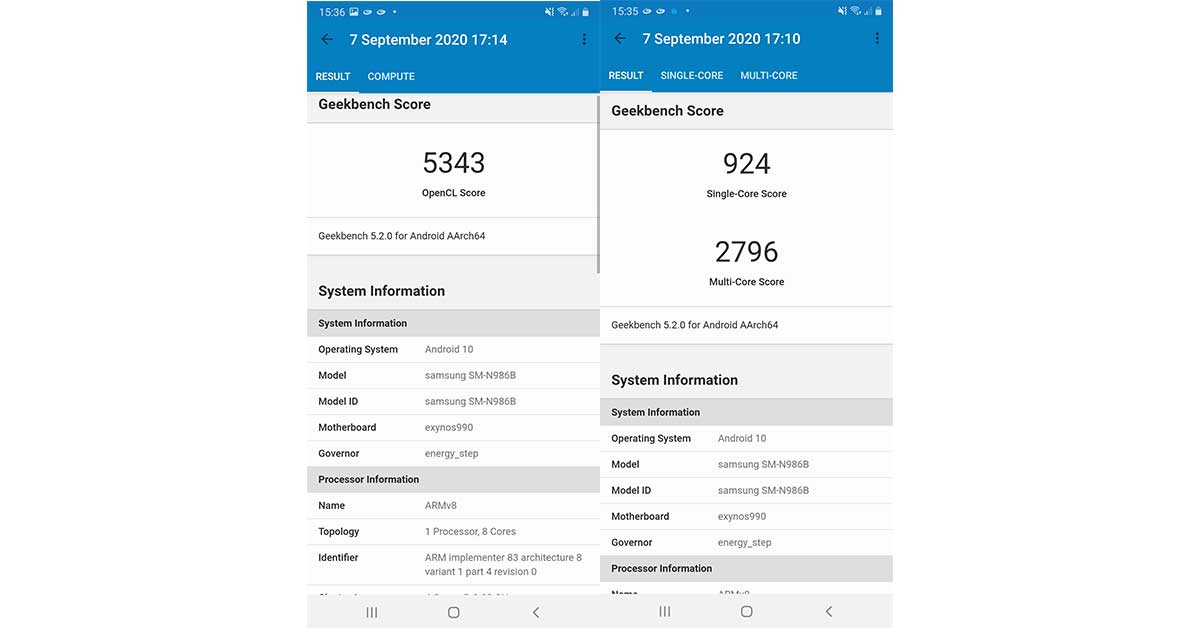


 Huawei Y9a specifications


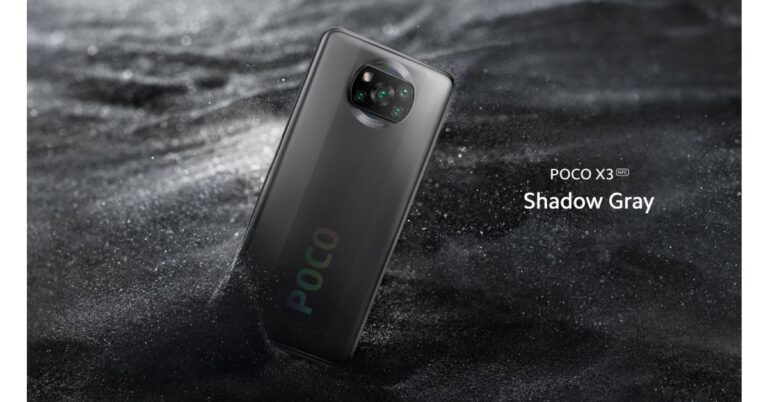
 Poco X3 NFC specifications and features





 Realme 55-inch Smart TV
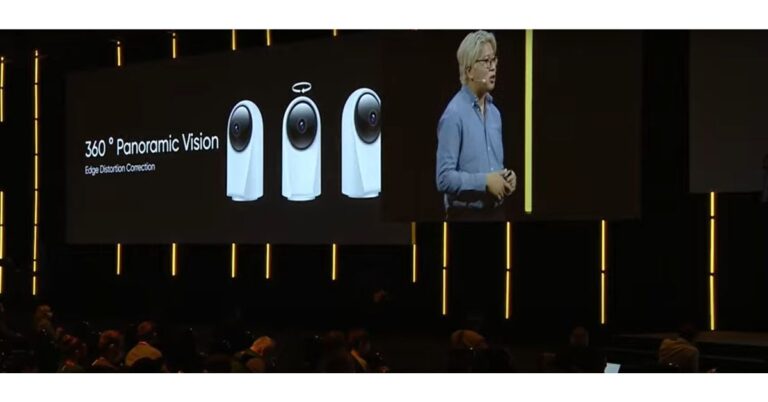
 Realme Smart Cam 360 and Realme Smart Bulb





 The Mi 10 is the new smartphone for 5G era. The 108MP quad-camera set up comes with 8K video recording capability for a truly cinematic experience. It comprises of a 16.94cm (6.67-inch) 3D Curved E3 AMOLED Display. The user will never have to stop thanks to the Qualcomm Snapdragon 865 powering this smartphone.
It is available for Rs 49,999 on
The Mi 10 is the new smartphone for 5G era. The 108MP quad-camera set up comes with 8K video recording capability for a truly cinematic experience. It comprises of a 16.94cm (6.67-inch) 3D Curved E3 AMOLED Display. The user will never have to stop thanks to the Qualcomm Snapdragon 865 powering this smartphone.
It is available for Rs 49,999 on  The ROG Phone 3 runs on the latest Qualcomm Snapdragon 865 Plus 5G Mobile Platform with advanced 5G mobile communications and Qualcomm Snapdragon Elite Gaming capabilities. Featuring the uprated GameCool 3 cooling system, the ROG Phone 3 is engineered to deliver non-stop, ultra-smooth performance for the ultimate mobile gaming experience.
A 144 Hz/1 ms AMOLED 6.59-inch display provides Delta-E colour accuracy of less than one to ensure vivid and accurate imagery, and an industry-leading 25-millisecond touch latency allows a near-instant touch response. It sports a 6000 mAh battery that will enable gamers to go truly mobile while gaming, and sports a 30W ROG HyperCharge system to top-up charge quickly. With ASUS PowerMaster, the company claims that this smartphone features superb levels of power-saving options, and also has options that help extend the battery life-span.
It is available for Rs 49,999 on Flipkart.
OnePlus 8 Pro
The ROG Phone 3 runs on the latest Qualcomm Snapdragon 865 Plus 5G Mobile Platform with advanced 5G mobile communications and Qualcomm Snapdragon Elite Gaming capabilities. Featuring the uprated GameCool 3 cooling system, the ROG Phone 3 is engineered to deliver non-stop, ultra-smooth performance for the ultimate mobile gaming experience.
A 144 Hz/1 ms AMOLED 6.59-inch display provides Delta-E colour accuracy of less than one to ensure vivid and accurate imagery, and an industry-leading 25-millisecond touch latency allows a near-instant touch response. It sports a 6000 mAh battery that will enable gamers to go truly mobile while gaming, and sports a 30W ROG HyperCharge system to top-up charge quickly. With ASUS PowerMaster, the company claims that this smartphone features superb levels of power-saving options, and also has options that help extend the battery life-span.
It is available for Rs 49,999 on Flipkart.
OnePlus 8 Pro
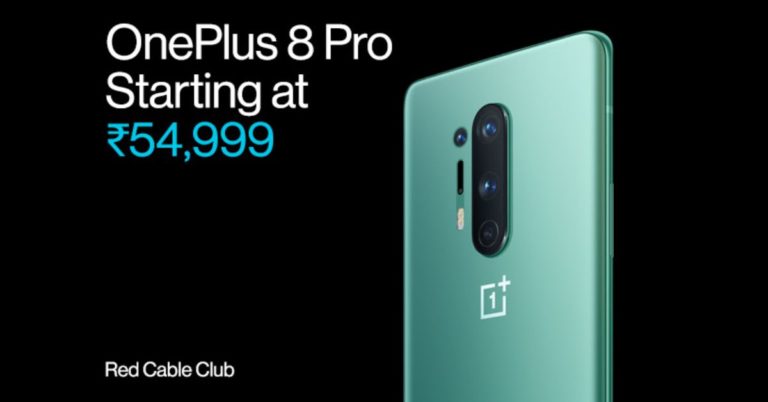
 With over 280 software optimizations, the OnePlus 8 Pro runs seamlessly at 120 Hz, so swiping and scrolling feels smooth and effortless. Capture the moment with a powerful 48 MP Quad Camera. A 48MP ultra-wide-angle camera expands your view while Dynamic Video lets you shoot more vibrant and detailed videos. Besides this, there is a 48MP main camera, 8MP Hybrid Zoom Camera along with 5MP colour filter camera. On the front, the user gets a 16MP front camera.
Running on Qualcomm Snapdragon 865, the OnePlus 8 Pro automatically switches between 5G and non-5G networks, extending the battery life so the user can stay connected for longer. A user can also choose how they charge with Warp Charge 30T and Warp Charge 30 Wireless. Improved charging technology ensures that the phone charges up fast enough to keep up with the user.
It is available in three variants Onyx Black, Glacial Green and Ultramarine Blue for Rs 54,999.
Oppo Find X2
With over 280 software optimizations, the OnePlus 8 Pro runs seamlessly at 120 Hz, so swiping and scrolling feels smooth and effortless. Capture the moment with a powerful 48 MP Quad Camera. A 48MP ultra-wide-angle camera expands your view while Dynamic Video lets you shoot more vibrant and detailed videos. Besides this, there is a 48MP main camera, 8MP Hybrid Zoom Camera along with 5MP colour filter camera. On the front, the user gets a 16MP front camera.
Running on Qualcomm Snapdragon 865, the OnePlus 8 Pro automatically switches between 5G and non-5G networks, extending the battery life so the user can stay connected for longer. A user can also choose how they charge with Warp Charge 30T and Warp Charge 30 Wireless. Improved charging technology ensures that the phone charges up fast enough to keep up with the user.
It is available in three variants Onyx Black, Glacial Green and Ultramarine Blue for Rs 54,999.
Oppo Find X2
 Powered by Qualcomm Snapdragon 865 processor for 5G connectivity, Oppo Find X2 runs on ColorOS 7.1 based on Android 10. It features a 6.7-inch QHD+ with 1440×3168 pixels of resolution Ultra Vision display with 120Hz refresh rate and up to 240Hz touch sampling rate. The display is protected with Corning Gorilla Glass 6. The connectivity options on the phone include 5G, 4G LTE, Wi-Fi 6, Bluetooth v5.1, GPS/ A-GPS, NFC, and USB Type-C. On the connectivity front, there is an accelerometer, ambient light sensor, barometer, magnetometer, colour temperature sensor, and proximity sensor. The Oppo smartphone packs a 4,200mAh battery supported by 65W SuperVOOC 2.0 Flash Charge technology.
It is available on
Powered by Qualcomm Snapdragon 865 processor for 5G connectivity, Oppo Find X2 runs on ColorOS 7.1 based on Android 10. It features a 6.7-inch QHD+ with 1440×3168 pixels of resolution Ultra Vision display with 120Hz refresh rate and up to 240Hz touch sampling rate. The display is protected with Corning Gorilla Glass 6. The connectivity options on the phone include 5G, 4G LTE, Wi-Fi 6, Bluetooth v5.1, GPS/ A-GPS, NFC, and USB Type-C. On the connectivity front, there is an accelerometer, ambient light sensor, barometer, magnetometer, colour temperature sensor, and proximity sensor. The Oppo smartphone packs a 4,200mAh battery supported by 65W SuperVOOC 2.0 Flash Charge technology.
It is available on  This smartphone runs on Android 10 out-of-the-box. It features a curved display with a punch-hole cutout for a selfie camera. It comes with a 6.7-inch full-HD+ OLED display with 90Hz refresh rate and HDR10+ support as well as an in-display fingerprint sensor. It derives its power from Qualcomm’s flagship Snapdragon 865 processor paired with 12GB of RAM and 256GB of non-expandable UFS 3.0 storage. For connectivity it includes 5G, Bluetooth 5.1, Wi-Fi 802.11 a/b/g/n/ac/ax (Wi-Fi 6), GPS, A-GPS, GLONASS, Galileo, and BDS.
In terms of camera capability, Motorola Edge+ features a triple rear camera set up with a high-resolution 108-megapixel primary camera sensor with /1.8 aperture and 0.8-micron pixel size. The other two camera sensors are a 16-megapixel ultra-wide-angle camera with 117-degree field of view with f/2.2 aperture along with an 8-megapixel telephoto lens with 3X optical zoom and OIS support. The camera set also supports a ToF sensor. For taking selfies it comes with a 25-megapixel selfie camera with f/2.0 aperture.
It is available for Rs 73,000 on
This smartphone runs on Android 10 out-of-the-box. It features a curved display with a punch-hole cutout for a selfie camera. It comes with a 6.7-inch full-HD+ OLED display with 90Hz refresh rate and HDR10+ support as well as an in-display fingerprint sensor. It derives its power from Qualcomm’s flagship Snapdragon 865 processor paired with 12GB of RAM and 256GB of non-expandable UFS 3.0 storage. For connectivity it includes 5G, Bluetooth 5.1, Wi-Fi 802.11 a/b/g/n/ac/ax (Wi-Fi 6), GPS, A-GPS, GLONASS, Galileo, and BDS.
In terms of camera capability, Motorola Edge+ features a triple rear camera set up with a high-resolution 108-megapixel primary camera sensor with /1.8 aperture and 0.8-micron pixel size. The other two camera sensors are a 16-megapixel ultra-wide-angle camera with 117-degree field of view with f/2.2 aperture along with an 8-megapixel telephoto lens with 3X optical zoom and OIS support. The camera set also supports a ToF sensor. For taking selfies it comes with a 25-megapixel selfie camera with f/2.0 aperture.
It is available for Rs 73,000 on  This smartphone by