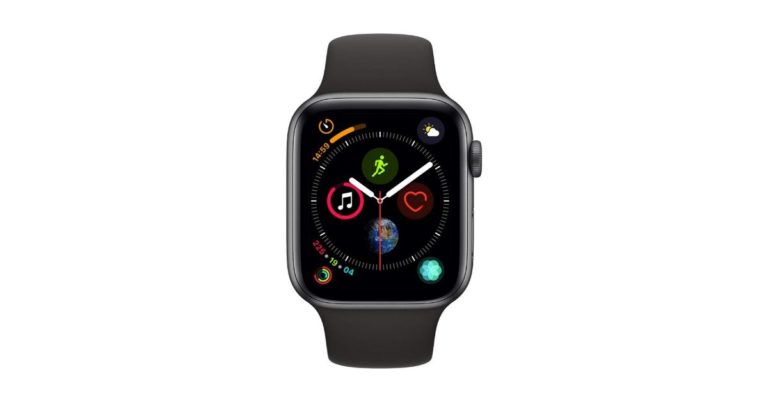
As the launch of Apple’s iPhone11 is coming near more and more reports are emerging on the internet around the event. Like always this time also the smartphone company is planning to launch Apple Watch alongside its most awaited smartphone. Now a report suggests that the company is working on a sleep tracking feature for its Apple Watch series. The new feature is called “Time in Bed tracking.” It is internally codenamed as Burrito and will allow the users to track the quality of sleep, movement, heart rate, and noises. And as usual, it will be accessible via Health app and a new Sleep app.
As the name suggests with the use of ‘Time in Bed’ tracking feature the user will be able to wear the Apple watch while sleeping. Wearing the Apple Watch to bed will allow it to track the user’s quality of sleep with the use of multiple sensors and inputs on it. The data then can be accessed in the Health app as well as on a new dedicated Sleep app for the Apple watch.
When wearing the Watch during bedtime, if the user wakes up and starts their day before their alarm goes off, it will automatically turn off the alarm. The alarm will also play only on Apple Watch, using the iPhone as a backup. There will also be an option to use a silent alarm that only vibrates the Apple Watch. The new bedtime system will enable Do Not Disturb automatically when the user goes to bed.
While many users have a habit to charge their device at night Apple Watch will come with a feature that will strike a chord to charge their watch before they go to bed so that they can wear it during sleep.
However, it is not confirmed whether Apple Watch sleep tracking feature will be available on all Apple Watch models or it will only be made available to the new Watches that are expected to be unveiled on September 10 when the iPhone 11 gets launched.
Previous reports suggest that the upcoming Apple watch will be launched in two casings, titanium as well as ceramic. The upgraded version of the watch will arrive in 40mm along with 44mm sizes similar to the Apple Watch Series 4. However, the company only offered the ceramic casing for Series 2 and Series 3 watches, but now the new Apple Watch Series will be arriving in both titanium and ceramic casings.
Google-owned YouTube is the largest video streaming platform in the world and every day millions of videos are uploaded on it. You can find videos related to any topic and Millions of people stream videos on it every day. Sometimes, even if the videos uploaded by content creators are positive and not even remotely controversial, the comments below them can be hateful. In order to stop this, the video streaming platform has now set new rules around community contributions when it found its feature was misused.
The new rules say contributed translations would only be published on its platform after the channel’s owner approval. This would circumvent the abusive translation being posted on a channel.
First reported by The Verge that said, “Under the old system, creators could review individual contributions and had the option of disabling community contributions for specific videos or groups of videos, but most saw little downside to simply leaving the option enabled and letting translations populate without review.”
From now on the users will be able to translate YouTuber’s titles and descriptions into their local language while making it more accessible globally.
In a Creator Academy post from 2017, YouTube warned “While most community contributors are there to help, abuse can happen,” the post warns. “Regular review can keep things like spam links and offensive language out of your translated content.”
The new rules will make harder for trolls and harassment sneak into a channel. Recently a YouTuber named JT was targeted by a harassment campaign that was based on the translations for PewDiePie’s videos this resulted in the spreading of harassing titles to other channels also.
Then JT reported to YouTube’s @teamyoutube account on Twitter that recommended, “the team that works on translations is aware that this is an issue and they’re working on a fix. In the meantime, you can turn off Community Captions & remove translations that have already been published”
“So you want us to report every title of every video?” JT replied. “Why not just roll out an actual fix… like having to approve them first?”
A few days later YouTube gave it a thought and came with a permanent fix to this problem, “Thanks for your patience – Based on the feedback we’ve heard, we are introducing some changes to Community Contributions. Moving forward, creators that have turned on this feature will need to manually review their Community Contributions and check for spam before publishing.”
This seems to be a good move by YouTube to curb trolling and hate in the community. The feature will be rolled out the world over.
As we all are now aware that Android Q will now be known as Android 10 as the software company Google has decided to discontinue the naming of the Android version based on desserts for its new operating systems. Many smartphone companies have already announced that their phones will be getting the new update. Companies such as Nokia, Google, OnePlus and Huawei have already confirmed that their set of smartphones will get the updates first. The latest is that Google is planning to roll out Android 10 to all of its pixel phones from today. The list includes all the Pixel phones from the first generation to the latest ones that is Google Pixel 3a.
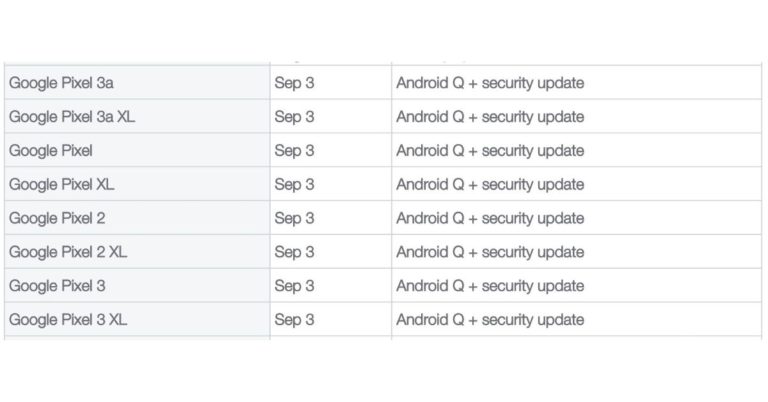
Previously the Canadian carrier Rogers revealed that Google will be releasing Android 10 for all of its smartphones starting from September 3 and now another Canadian network Telus has also revealed the same launch date. Rogers has also shared a list of Pixel devices that will receive the Android 10 on its customer support page.
According to the list Pixel and Pixel XL, Pixel 2 and Pixel 2 XL, Pixel 3 and Pixel 3 XL and last but not the least latest Pixel 3a and Pixel 3a XL were mentioned with Q OS that point towards Android Q.
While on the other hand another Canadian carrier Telus also reported the expected launch date of the Android 10 on its support website. Additionally, it also posted a list of all the Pixel phones that will receive the Android Q + security update first. It is interesting to see that Google is quickly pushing the latest updates on its own smartphones first. However, rumour was that OnePlus 7 and 7 Pro will be the first to receive the new OS. Nevertheless, they are still slated to receive the new OS in the coming weeks.
Chinese smartphone company Huawei is gearing up to launch another smartphone. The company has announced that it will be launching Huawei Enjoy Plus 10 on September 5. The smartphone company has also shared a video teaser giving us the first glimpse of the upcoming smartphone. Recently the company also announced that it will be launching a new Huawei Mate30 series on September 19 in Munich. At the launch event, the company will be launching three new devices.
As per the video teaser shared by Huawei on its Weibo page the phone will be launched on September 5. The Huawei Enjoy Plus 10 will be introduced in four colour variants black, jade green, flame red, and a gradient white colour. In addition to this, the device will come with a pop-up selfie camera along with a triple rear camera setup aligned vertically.
However, the short video did not reveal much about the upcoming smartphone but it is tipped to feature a 48-megapixel primary camera. The reports suggest that Enjoy Plus 10 will be powered by the company’s own Kirin 710 SoC. According to a report by Gizchina Huawei Enjoy Plus, 10 is expected to come with a 6.59-inch full-screen display with a resolution of 1,080 x 2,340 pixels. The triple rear camera set up will include a 48-megapixel primary camera, along with an 8-megapixel secondary sensor and a 2-megapixel tertiary sensor. While on the front it will sport a 16-megapixel pop-up selfie camera. As for the processor it is suggested to be powered by company’s own Kirin 710 SoC that might be offered in four storage variant 4GB + 64GB, 4GB + 128GB, 6GB + 128GB, and 8GB + 128GB. It is reportedly to come with a 4000mAh battery and it doesn’t support NFC. It has a USB Type-C interface as well as a 3.5mm headphone jack. All the leaked specifications are similar to the TENAA listing.
As we mentioned earlier the smartphone company will also be launching three new smartphones under Huawei Mate 30 series on September 19 in Munich. It will be launching Huawei Mate 30, Huawei Mate 30 Pro, and the Huawei Mate 30 Lite smartphones. The trio will be featuring a quad rear camera set up placed in a circular module. It is rumored that the company will be launching the renamed version of the Huawei Mate 30 Lite in European markets as Nova 5i Pro.
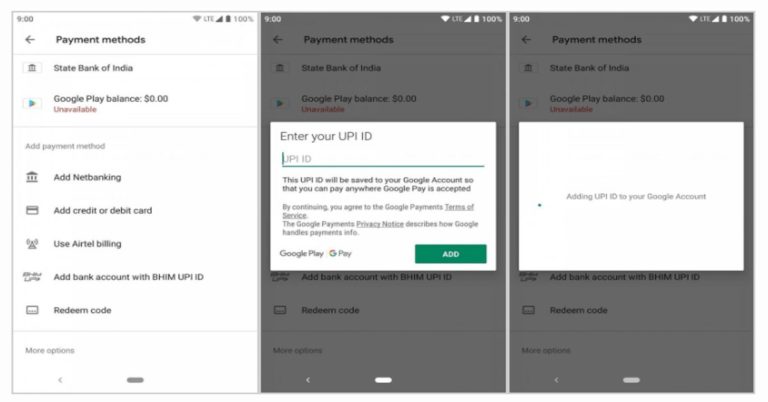
Google Play Store has launched Unified Payments Interface (UPI) for its users in India. As per a report, the new payment option has now been added by the software tech giant in its Play Store payment alternative. At the moment Google Play Store supports credit cards, debit cards, net banking, carrier billing via Airtel and Vodafone, Google Play Gift Cards and Google Play Balance in the country.
Unified Payments Interface (UPI) is a facility provided by the Government of India in order to promote digital payments in the country. The users in India can transfer a restricted amount of cash immediately between bank accounts via UPI transfer. The software company has already launched the Google Pay app supported by UPI in the country and now Google has brought UPI payment options in its Google Play Store, too. As per a report Google Play Store v16.3.37, users have begun spotting UPI as an option. However, currently, even with its most recent version of Google Play v16.4.15 the UPI payment option was not found. So chances are with the next update users might see the option.
For the unknown, the Unified Payments Interface (UPI) is regulated by the Reserve Bank of India and works by instantly transferring funds between two bank accounts on a mobile platform. As of March 2019, there are 142 banks live on UPI and this method is being approved by most of the apps as well as the services. Google’s own Google Pay also approves the payment method in the country. Currently, the users need to share their card details with Google from now on the users can use their UPI ID in order to make payments to purchase an app from the Google Play Store.
However, UPI still requires a PIN to complete the transaction, but the smaller limits allowed by the service lessens the quantum of abuse if there is any chance of it. Since most transactions on the Google Play Store fall within this limit, users should have no problem purchasing apps and other content, while still retaining their peace of mind, a report in XDA said.
The South Korean tech giant has officially revealed the launch date of the Samsung Galaxy M30s. The upcoming smartphone is the upgraded variant of the Galaxy M30 smartphone. The latest smartphone has now been listed on the Amazon India website. The dedicated product page revealed that the handset will launch on September 18 in the country. The listing also reveals few specifications. The M30s has also been spotted on the Android Enterprise that too reveals the specifications of the device.
Samsung Galaxy M30s launch date and expected price
Samsung Galaxy M30s will come to India on September 18 at 12noon IST. The launch event of the Galaxy M30s will also be live-streamed on the dedicated microsite on Amazon as well as the company’s official Samsung India Newsroom.
To recollect, Samsung launched Galaxy M30 earlier this year in the month of February. The company launched the smartphone at a starting price of Rs 14,990 for its 4GB RAM with 64GB inbuilt storage variant while the upper variant that is 6GB RAM with 128GB was priced at Rs 17,990 in the country. So we can expect that the upgraded variant to fall between the Rs 15,000 and Rs 20,000 price segment.
Samsung Galaxy M30s specifications
The dedicated microsite reveals that the Samsung Galaxy M30s will pack a 6,000mAh battery along with fast charging support. The product page also reveals that the phone will be featuring a triple rear camera setup that will include a 8-megapixel sensor. Sadly the listing did not reveal the other two camera sensors. But if we go by reports and rumours that surfaced on the web we can expect it will be sporting a 48-megapixel camera. As per the Amazon listing, the handset will arrive with a new powerful processor. The rumours suggest that the device will be powered by Exynos 9610 SoC processor.
On the front, the Samsung Galaxy M30s has an Infinity-U Display along with a U-shaped notch. While on the rear panel it sports triple cameras aligned vertically on the rear panel (as said) along with a rear fingerprint sensor. Over that, the smartphone is displayed donning a greenish-blue colour gradient finish on the back panel.
Another listing suggests that the handset will be sporting a 6.4-inch display. It will be offering4GB RAM along with 64GB and 128GB internal storage variants. The handset will run on Android 9.0 Pie with Samsung One UI.
The Galaxy M30s will come with model number SM-M307F has also been spotted. It also suggests that it will come with Wi-Fi 802.11ac connectivity with 2.4GHz and 5GHz dual-band support.
Telecommunications services provider Bharti Airtel announced the launch of Airtel Xstream that includes Xstream Box and Xstream Stick along with App and web access. The telecom company has rebranded the name of its Airtel TV platform to Airtel Xstream. Airtel Xstream Box and Xstream Stick pricing, specifications and plans have been detailed below:
Airtel Xstream Box
the Airtel Xstream 4K Hybrid Box is powered by Android 9.0. The device comes with the option to select from more than 500 TV channels along with preinstalled Airtel Xstream app that offers Netflix, Amazon Prime Video, YouTube, over 10.000 movies and shows as well as Airtel Store. The Box comes with Wi-Fi and Bluetooth connectivity and in-built Chromecast. The device also comes with a universal remote that features a Google voice assistant on it.
Airtel Xstream Box can be purchased at Rs 3,999 while all the existing Digital TV customers can upgrade to Airtel Xstream Box at Rs 2249. The Xstream Box is available at Airtel retail stores, airtel.in and across all the top e-commerce websites. the Airtel Xstream Box comes with a complimentary one-year subscription (worth Rs 999) to all Airtel Xstream app content in addition to a one-month subscription to an HD DTH pack.
Airtel Xstream Stick
Airtel Xstream Stick is designed for plug & play experience on any TV screen. It comes with a single subscription plan that provides access to more than 10,000 movies and shows from top OTT content partners like ZEE5, Hooq, Hoi Choi, Eros Now, HungamaPlay, ShemarooMe, Ultra and Curiosity Stream, in addition to over 6 million songs from Wynk Music’s library. Apart from that it also provides access to Netflix, Amazon Prime Video and other Google Playstore applications.
is powered 1.6 GHz processor that runs on Android 8.0. The Airtel stick comes with Bluetooth 4.2 connectivity. The Airtel Xstream Stick is priced at Rs 3999 in the country. While the Airtel Thanks Platinum and Gold customers get complimentary access to the content subscription plan on Airtel Xstream Stick whereas other customers can access content free for the first 30 days after which they have to subscribe to a Rs 999/- annual plan.
The Airtel Xstream Stick is exclusively available at Flipkart along with Airtel retail stores, airtel.in, like Croma and Vijay Sales as well
Airtel Xstream app and Web interface
Airtel Xstream app that is a refreshed version of the Airtel TV app is a new User Interface and much sharper content discovery and recommendation engine. Using the app the users get access to over 400 live TV channels along with more than 10,000 movies and shows from ZEE5, Hooq, Eros Now, HungamaPlay and many more. Besides this Airtel customers can also access Airtel Xstream content on the web by logging onto www.airtelxstream.in, which offers a convenient way to watch LIVE TV, movies and shows.
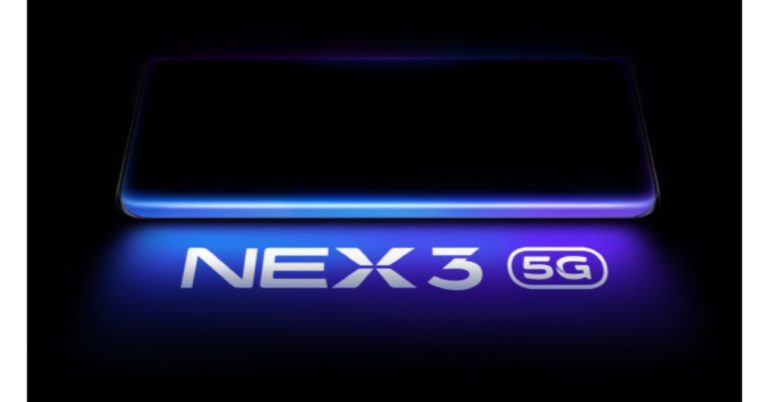
Last week Chinese smartphone company Vivo officially revealed that its upcoming device Vivo Nex 3 5G will be launched this month while sharing an image on its Weibo page. However, it did not revealed the exact date of the launch event nor it disclosed the specifications and the pricing details. And now the phone has been discovered on the TENAA listings revealing its specifications details. The key details of the handset include a 6.89-inch display, 4,410mAh battery, up to 12GB RAM with 512GB internal storage, and a 64MP primary sensor on the rear panel.
As per the TENAA listing, Vivo NEX 3 will come with a 6.89-inch AMOLED screen with Full-HD+ (1,080 x 2,256 pixels) resolution along with an in-display fingerprint sensor. The upcoming phone by Vivo will be powered by an octa-core processor with 2.96GHz clock speed. It will run on Android 9 Pie and will be offered in two variants 8GB and 12GB RAM offering 128GB, 256GB, and 512GB internal storage options.
While on the part of the imaging capabilities the listing reveals that Vivo NEX 3 will have a triple rear camera setup consisting of a 64MP sensor and 13MP sensors. While on the front it will sport a 16MP selfie sensor. The TENAA listing suggests that the handset will pack a 4,410mAh battery. The mobile phone measures 167.44 x 76.18 x 9.4mm and it weighs 218.5 grams.
The company’s Manager also shared the sketches of Vivo Nex 3 that disclosed that the phone’s front panel will come with a 100% screen-to-body ratio along with waterfall-like edges. The phone will arrive with a triple rear camera setup placed in a circular module. The phone will have a waterfall screen along with a 3.5mm headphone jack. The handset will come with a pop-up selfie camera and will be sporting a buttonless design in fact it will feature a pressure-sensitive button along as well as a textured Power key.
The Company has only announced that Vivo Nex 3 5G will be launched in the month of September but it did not reveal the launch date. The mobile phone will be launched in China first and is expected to arrive in India either by the end of September or October.
Lenovo owned company Motorola recently launched the new Motorola One Action in India. The phone is powered by Samsung Exynos 9605 SoC and it packs a 3,500mAh battery. It comes with 128GB of onboard storage and features 21:9 CinemaVision display along with a hole-punch front camera design. Prior to its launch in the country, the smartphone was launched in Brazil. The smartphone went on its first sale on July 30 and now be available via open sale on Flipkart.
In This Article
Motorola One Action pricing, sale offers
The smartphone company has now put the Motorola One Action on Open sale on Flipkart. The device comes in single GB RAM and 128GB of internal storage and it is priced at Rs 13,999 in the country.
On the purchase of the latest handset by Motorola Jio subscribers can avail an instant cashback of Rs 2,000 along with an additional 125 GB of 4G data. The buyers are also being offered no-cost EMI on the purchase of the smartphone. Besides this, the e-commerce website Flipkart is also offering a 5% cashback to the buyers using Axis Bank Credit Card whereas the Axis Bank Buzz Credit card users can avail a 10% cashback on the purchase of Motorola One Action.
Motorola One Action specifications
Motorola One Action runs Android 9 Pie and is powered by octa-core Samsung Exynos 9609SoC along with Mali G72 MP3 GPU and 4GB of RAM. One Action features a 6.3-inch full-HD+ (1,080×2,520 pixels) IPS CinemaVision display with 21:9 aspect ratio. The device offers 128GB of internal storage expandable up to 512GB via a microSD card.
On the part of camera capabilities One Action features a triple rear camera setup. The setup includes a 12-megapixel primary sensor along with an f/1.8 lens, an action camera sensor with a 2-micron pixel size and an f/2.2 lens and a 5-megapixel depth sensor with an f/2.2 lens. Additionally, the camera setup comes with the support of Enhanced Video Stabilisation that offers stabled video recording. The handset is also capable of recording a landscape video while holding the phone vertically. On the front, it comes with a 12-megapixel camera sensor with 1.25-micron pixel size and an f/2.0 lens.
On the connectivity front, it has 4G LTE, Wi-Fi 802.11ac, Bluetooth v5.0, GPS/ A-GPS, NFC, USB Type-C and a 3.5mm headphone jack. The sensors on the phone include accelerometer, ambient light, gyroscope, fingerprint reader, magnetometer, and a proximity sensor. Motorola One Action houses a 3,500 mAh battery supported by a 10W rapid charger.
The Chinese smartphone company Huawei is all geared up to launch its new series of smartphones in the market. For the past couple of months, the internet is flooded with leaks and rumours with regard to Huawei Mate 30 series. And now the company has finally revealed the official launch date for the upcoming series of smartphones by Huawei. The company has officially announced that it will be launching three devices under the Huawei Mate line up on September 19 in Munich. It was earlier reported that all the three upcoming smartphones will be launched at an event and the Huawei Mate 30 Lite as Huawei Nova 5i Pro in some of the markets.
Huawei took to the Twitter and officially announced that Huawei Mate 30, Huawei Mate 30 Pro, and the Huawei Mate 30 Lite on September 19. In addition to this, the company also shared a short teaser video on its official Twitter account. All the phones are expected to come with a quad rear camera set up placed in a circular module.
As per a promotional image Huawei Mate 30 series of smartphones are expected to be powered by the company’s own Kirin 990 SoC. The rumours and reports suggest that Huawei Mote 30 Pro will be housing the latest Sony IMX600 series sensors that include 40-megapixel primary camera along with a variable aperture of f/1.6 – f/1.4, a 1/1.5-inch sensor, an RYYB pixel layout, and Cine Lens feature. Along with another 40-megapixel secondary camera with a 1/1.8-inch aperture and a 120-degree ultra-wide lens will also come with Cine Lens support, an 8-megapixel telephoto sensor that will come with 5X zoom capabilities, and the while the fourth one is expected to come with periscope lens.
The leaked renders suggest that Huawei Mate 30 Pro will be sporting a curved display along with a wide notch housing 3D face unlock sensors. It is rumoured to come with an OLED display with a 90Hz refresh rate while on the other hand, Huawei Mate 30 will come with a flat display panel. Instead of featuring a Corning Gorilla Glass it will come equipped with AirGlass along with a SuperSensing camera.
Previously the case renders of the Huawei Mate 30 also surface on the web. The leaked case renders suggest that the upcoming phone will be featuring triple rear cameras positioned in a spherical module along with a wide notch.
On the other hand, the Lite variant of the Mate 30 has also received the certification from the Chinese regulatory TENAA. As per the TENAA listing, Huawei Mate 30 Lite will be featuring a quad-camera setup at its rear panel and a fingerprint sensor placed beneath the camera setup. The quad-camera setup comes fitted in a square module. It is rumored that the company will be launching the renamed version of the smartphone in European markets as Nova 5i Pro.
The South Korean tech giant Samsung is all set to launch its most awaited foldable device in the market- Samsung Galaxy Fold in September. According to the company, in the beginning, the phone will be launched in a few markets and India is among the list where the foldable smartphone will arrive first. Ahead of its launch, the company has also listed the Samsung Galaxy Fold on its official Samsung India website. Now according to a report, the company has also started working on the cheaper variant of the foldable device to make it accessible to bigger population.
After postponing the launch of Samsung Galaxy Fold for several months, the company will be re-launching the phone in September. The company has also listed the mobile phone on its official website revealing its design and a few specifications. However, the product page did not reveal the pricing of the phone. Few reports suggest that the current Galaxy Fold is expected to arrive with a price tag of USD 1,980 (approximately Rs 1,40,000) now it planning to launch the cheaper Galaxy Fold device for $1,000 (approximately Rs. 71,600). In order to bring down its price, the company will bring the cheaper variant of the device with 256GB of internal storage along with cheaper design. The upcoming device currently comes with 512GB of internal storage. The cheaper Samsung Galaxy Fold will arrive with a model number SM-F700F.
As per the SamMobile report “Whether it’s going to have a clamshell or outfolding form factor and whether it will have support for the S Pen.” It further adds, “Samsung may also choose to go with a different moniker but that’s beside the point. However, it’s the first sign that the company is working on a more affordable foldable smartphone. It will make a significant difference if Samsung is able to bring the price down by a few hundred dollars.”
Samsung Galaxy Fold specifications
Samsung Galaxy Fold will arrive with a 7.3-inch primary AMOLED Infinity Flex Display and a secondary 4.6-inch screen. The foldable device will be powered by 7nm Qualcomm Snapdragon 855 octa-core SoC, paired with 12GB of RAM and 512GB internal storage. The smartphone will come with six cameras. The triple rear camera setup includes a 16MP ultra-wide camera, a 12MP wide-angle camera, and a 12MP telephoto camera. On the inside, it has a 10MP selfie camera and an 8MP RGB depth camera, lastly, a 10MP selfie camera on the cover will be seen. It will be housing a 4,380mAh battery along with a face and fingerprint scanner. The company will be launching the Galaxy Fold in four colour options Space Silver, Cosmos Astro Blue, and Martian Green Black colour.
The Chinese smartphone company Vivo has slashed the price of two of its smartphones in India. Vivo Y15 (2019) and Vivo Y17 has received a price cut of Rs 1,000 in India. While it’s earlier price was Rs 13,990 and Rs 17,990 respectively. Vivo Y15 (2019) was launched by the company in May whereas the Vivo Y17 was introduced in April this year. The key highlights of both the smartphones include a like triple rear camera setup and it comes with a waterdrop-style notch display. Both the devices pack a 5,000mAh battery.
Vivo Y15 (2019) and Vivo Y17 price in India, availability
After the price cut of Rs, 1,000 Vivo Y15 (2019) will be selling for Rs 12,990 for the 4GB RAM/64GB storage variant. The device is available in two colour options Aqua Blue and Burgundy Red colours. The new price of the smartphone is available on Flipkart, Amazon.in, Paytm, Tata Cliq, Vivo India’s e-store.
Coming on the Vivo Y17 will now be sold at Rs 14,990. To recall the device also received a price cut in May that was launched at Rs 17,990 in India. After the price cut, the smartphone can be purchased at Flipkart, Amazon.in, Paytm, Tata Cliq, Vivo India’s e-store.
Vivo Y15(2019) features and specifications
Vivo Y15 (2019) features a 6.35-inch HD+ (720×1544 pixels) display with a waterdrop notch at the top. It is by a MediaTek Helio P22 SoC along with 4GB of RAM and 64GB of internal storage that can be expanded via microSD card. Y15 runs on Funtouch OS 9 on top of Android 9 Pie and houses a 5000mAh battery.
On the imaging front, Vivo Y15 (2019) comes with a triple camera rear setup that includes a 13-megapixel primary camera with an f/2.2 aperture, 8-megapixel super-wide-angle lens with f/2.2 aperture and a 120-degree field-of-view and a 2-megapixel depth sensor with an f/2.4 aperture. On the front, it sports a 16-megapixel selfie camera with an f/2.0 aperture.
The connectivity options include 4G VoLTE, dual-band Wi-Fi, Bluetooth 5, Micro-USB port, and GPS/ A-GPS. Vivo Y15 comes with a fingerprint scanner at the rear panel
Vivo Y17 features and specifications
Vivo Y17 features a 6.35-inch HD+ (720×1544 pixels) Halo FullView display with a 19.3:9 aspect ratio along with a waterdrop notch at the top. It is powered by the octa-core MediaTek Helio P35 SoC clocked at 2.3GHz with 4GB of RAM that offers 128GB of internal storage. Y17 runs Funtouch OS 9, based on Android Pie and houses a 5000mAh battery.
On the part of the camera, Vivo Y17 also comes with a triple rear camera setup that consists of a 13-megapixel main camera with f/2.2 aperture, along with an 8-megapixel Super Wide Angle camera with f/2.2 aperture and a 2-megapixel depth sensor with f/2.4 aperture. While for the selfies and video chats it features a 20-megapixel camera with an f/2.0 aperture.
The connectivity options include 4G, Bluetooth 5.0, Wi-Fi, GPS, FM radio, and a Micro-USB port.
The e-retail website Amazon has launched OnePlus Flagship Phenomenon sale in India. In the said sale the company is offering its latest flagship smartphones at a discounted price. The company is offering both OnePlus 7 and OnePlus 7 Pro at a discounted of to Rs. 2,000 to Axis Bank customers. The OnePlus Flagship Phenomenon sale is open till September 6. Both OnePlus 7 and OnePlus 7 Pro are currently being sold at Rs 32,999 and Rs 48,999 respectively.
During OnePlus Flagship Phenomenon sale Axis Bank card users can avail a discount of Rs 2,000 on the purchase of OnePlus 7 and OnePlus 7 Pro that was launched by the company a few months ago in the country. Both the devices are up for sale on the e-commerce website Amazon. According to the Amazon listing, the Oneplus 7 and Pro buyer are eligible to avail an instant discount on both EMI and non-EMI transactions. On the purchase of OnePlus 7, the buyers will receive a discount of Rs 1000 while the Oneplus 7 Pro buyers will get an instant discount of Rs 2,000.
The OnePlus 7 has been launched in two storage variants. The 6GB RAM with 128GB storage variant is priced at Rs 32,999 whereas the 8GB RAM with 256GB storage variant costs Rs 37,999.
The smartphone runs on Android 9.0 Pie skinned with OxygenOS and comes with a 6.41-inch full-HD+ (1080×2340 pixels) Optic AMOLED display. It is powered by Qualcomm Snapdragon 855 SoC, One Plus 7 along with Adreno 640 that is offered in 6GB of RAM and 128GB of internal storage.
On the camera front, OnePlus 7 has a dual rear camera setup that includes a 48MP Sony IMX sensor and a 5MP secondary sensor. On the front, there is a 16MP Sony IMX471 sensor.
The OnePlus 7 houses a 3,700mAh battery that has support for 20W (5V/ 4A) fast charging. For connectivity, there is 4G VoLTE, Wi-Fi, Bluetooth v5.0, NFC, GPS, and a USB Type-C (v3.1 Gen 1) port that can also be used as a headphone port.
The OnePlus 7 Pro comes in three storage variants. The device is available at Rs 48,999 for the 6GB RAM with128GB storage variant while the 8GB RAM with 256GB storage variant costs Rs 52,999 and lastly the high end 12GB RAM with 256GB variant is currently available at Rs 57,999.
The OnePlus 7 Pro smartphone comes with a 6.67-inch curved Quad HD+ Fluid AMOLED display that comes with an in-display fingerprint sensor. It is powered by the Qualcomm Snapdragon 855 SoC and it comes with up to 8GB RAM and runs Android 9 Pie with OxygenOS baked on top. The handset houses a 4,000mAh battery.
OnePlus 7 Pro has a triple rear camera setup that consists of a 48MP primary Sony IMX586 sensor, an 8MP telephoto sensor that has 3X zoom, and a 16MP wide-angle sensor. For selfies and video calls, OnePlus’ flagship device has a 16MP pop-up selfie camera.
The Chinese smartphone company Xiaomi has announced the launch of MIUI 10 Beta Program for the alpha flagship Redmi K20 Pro. Xiaomi India has announced that it is in a search of smartphone users to test the Android 10-based MIUI 10 operating system. For this Xiaomi has started accepting registration from the interested candidates. The registration has started and will end on September 8 while the results will be declared on September 11.
Only Indian nationals are eligible to apply for this programme and are required to fill a Google form. The shortlisted candidates should own a Redmi K20 Pro smartphone in order to participate in the Android 10-based MIUI 10 operating system.
Apart from that, the participant must be an active member of the Mi Community. The users must follow the rules of the Mi Community and not leak the ROM provided to him/her during the testing. The user’s Mi Community ranking should be ‘Semi Pro Bunny’ or higher. He or she should not post anything related to the ROM or team on Social Media, in other sections of the forum or anywhere else.
The selected candidates should have a thorough knowledge of MIUI and Android in and out. In addition to this being a special team member includes a few major responsibilities which he/she needs to follow. Other than that Moderator, other special team members, Mi FC presidents can also apply for the Android 10-based MIUI 10 operating system programme.
The company has also started taking registration from the candidates and the registrations will close on 8th Sept 23:59:59 hrs (IST). Xiaomi will be announcing the successfully shortlisted candidates on or before 11th Sept 2019 09:00 PM IST. Privileges such as Special OTA update access, Special user group – ‘Android 10 Tester’, Exclusive Android 10 tester medal and lastly a chance to attend official launches for top performers
Redmi K20 Pro specifications
Redmi K20 Pro features a 6.39-inch Full-HD+ (1080 x 2340 pixels) AMOLED display that has a 19.5:9 aspect ratio and comes with a fingerprint scanner. The device is powered by the octa-core Qualcomm Snapdragon 855 SoC and comes with Adreno 640 GPU and it has up to 8GB of RAM and 256GB of internal storage. The device can hold a microSD card of up to 512GB and it houses a 4,000mAh battery that has support for 27W fast charging.
On the part of camera capabilities, the Redmi K20 Pro comes with a triple rear camera setup that includes a 48MP Sony IMX586 sensor, a 13MP wide-angle lens, and an 8MP telephoto sensor. While on the front it has a 20MP pop-up front camera selfies and video calls.
The Chinese smartphone company Vivo is all set to launch its new smartphone Vivo Z1x in the market. Recently we got to know that the smartphone will be launched in India on September 6 through a product listing on Flipkart. However, the product page did not reveal the specifications but now as the launch date is coming closer more and more leaks are pouring. Now ahead of its official launch Vivo Z1x full specifications have been leaked on the web. The key specifications include a 4500mAh battery that will come with the support of VOOC Flash Charge. The phone will be featuring a triple rear cameras setup along with waterdrop-style notch display and in-display fingerprint scanner already as well.
Vivo Z1x leaked specifications
According to a report by GSMArena Vivo Z1x is expected to feature a 6.38-inch full-HD Super AMOLED display. The upcoming phone is suggested to be powered by Snapdragon 712 SoC coupled with 6GB RAM that will be offering 64GB and 128GB of internal storage options. The handset will run on Android Pie.
On the part of camera capabilities, Vivo Z1x is rumoured to come with a triple rear camera setup that will include a 48-megapixel main Sony IMX582 sensor, ultra-wide-angle sensor and a depth-sensing camera. For selfies and video calling it will be sporting a 32-megapixel front camera.
The handset will house a 4,500mAh battery with 22.5W Flash Charge support. As per the report the device will be offered in two colours Blue and Purple.
Right now the phone has been put on pre-registrations on the e-commerce website Flipkart. Apart from that recently the company also shared a video teaser of the upcoming smartphone on Twitter. As per the teaser, the phone is being displayed in two colour pearl blue and purple on the back panel. The rear panel will come with a triple rear camera set up aligned vertically along with an LED flashlight. While on the front it will come with an in-display fingerprint sensor. The video also confirmed that Vivo Z1x will be launched on September 6 at 12 pm IST and will be available on both Flipkart as well as the company’s official website vivo.com.
Garmin has launched a series of new smartwatches. Garmin has introduced three smartwatches Fenix 6, Fenix 6S, and Fenix 6X. All three smartwatches by Garmin will be available in 42mm, 47mm, and 51mm sizes. Alongside the buyers can also choose from between Pro and Sapphire edition. Fenix 6X Pro comes equipped with a “Power Glass” solar lens that helps the device in boosting its battery life. The new smartwatch offers an extensive range of improved and amplified features.
The new Garmin Fenix 6S sports a 1.2-inch (240 x 240 pixels) display along with the latest 20mm QuickFit watch bands. The display screen has been protected by Gorilla Glass 6 while the casing has been topped with a Sapphire Crystal coating that makes it scratch resistance. The device comes with a heart rate and Pulse Ox sensors that monitor the heart rate of the user while running, cycling, indoor track, treadmill, etc. The sensors make use of the PacePro feature that comes with grade-adjusted guidance. The company has launched the Fenix 6S smartwatch with a starting price of $599.99 (approximately Rs. 43,000).
The Garmin Fenix 6 comes with a 1.3-inch (260 x 260 pixels) display that will be offered in two cases to choose from Steel and Titanium casing.
The Garmin Fenix 6 will be available in 32GB of internal storage and is rated to work under 10ATM of liquid pressure. It also comes with preinstalled terrain maps similar to the Fenix 6 series other than that it comes with PacePro and Power Manager feature for better power management. Garmin Fenix 6 smartwatch comes with a starting price of $599.99 (approximately Rs. 43,000).
The Garmin Fenix 6X Pro features a 1.4-inch (240 x 240 pixels) display. For the first time, the company is offering a device that comes with the support for the solar charging feature. It sports a transparent Power Glass that makes use of Solar energy to charge the battery. It comes with a starting price of $749.99 (approximately Rs. 54,000). It is offered with a PacePro feature and comes pre-loaded features with topographic maps, ski maps for more than 2,000 ski resorts along with 41,000 golf courses globally.
Chinese Technology Company Honor is all set to launch its upcoming mobile phone Honor 20S on September 4. The company will be introducing the smartphone first in China. Prior to its launch, the Honor 20S has now been listed on the JD.com. The latest smartphone is now up for pre-order on the website. The listing on the website reveals the design as well as the display along with key specifications.
As per the official listing Honor 20S is now available for pre-booking. As per the listing, the handset will come with a triple rear camera setup with a 48-megapixel sensor on the back panel. While the front the smartphone will be featuring a hole-punch display. The website also reveals the pricing of the device. Honor 20S will be available for purchase at CNY 9,998 (approximately Rs. 99,900) from 9 PM onwards
The smartphone will come in three colour options Butterfly Feather White, Butterfly Feather Black, and Butterfly Feather Blue colour. The company will be offering Honor 20S in two storage variants 6GB RAM with 128GB internal storage and 8GB RAM with 128GB internal storage.
On the part of the design, the upcoming phone will be featuring a bezel-less as well as notch-less hole-punch display integrated with a selfie camera on the top left corner of the screen. On the rear panel, it sports a triple rear camera setup aligned vertically in a module along with a side-mounted fingerprint scanner.
Previously the smartphone also got listed on the Chinese regulatory website TENAA. As per the listing, the smartphone will be featuring a 6.26-inch full-HD+ (1080×2340 pixels) display. The device will be powered by, a 2.6GHz octa-core SoC that will be offering 12GB RAM along with up to 256GB storage. Honor 20S runs on Android Pie. On the part of the camera, it comes with a triple rear camera setup included with the 48-megapixel main camera, 8-megapixel sensor, and a 2-megapixel sensor. While on the front Honor 20S will include a 32-megapixel sensor. The device will house a 3,650mAh battery with 20W fast charging support. It measures 154.25×73.97×7.87mm and weighs 172 grams.
Taiwanese technology company Asus, expanding its gaming laptop range, announced the launch of ultra-slim gaming laptop ROG Zephyrus G (GA502) in India. It not only covers all the gaming essentials but also extends an ultra-slim and compact experience at an affordable price bracket, as stated by the company. The gaming laptop will be available for purchase via e-retailer Flipkart at a price tag of Rs 99,990.
The ultra-slim Asus ROG Zephyrus G GA502 is 20mm slim and it weighs 2.1kg. The gaming laptop features a 15.6-inch IPS anti-glare display along with a Full HD resolution as well as a 120Hz refresh rate panel. The laptop is powered by third-generation AMD Ryzen 7 3750 processor supported by Intelligent Cooling, the Nvidia GeForce GTX 1660 Ti clocks up to 1,335MHz at 60W in Turbo mode with ROG Boost. The device comes with up to 32GB DDR4 RAM along with 512GB internal storage.
Zephyrus G GA502 offers a White-backlit chiclet keyboard. Asus ROG Zephyrus G GA502 comes with a 76Whr lithium-ion battery along with a 180W power adapter allowing gamers 8.8 hours of battery life, ample to support everyday productivity. The connectivity options include Wi-Fi, Bluetooth v5.0, one USB 3.1 Gen 2 Type-C port, three USB 3.1 Gen 1 Type-A ports, an HDMI port, 3.5mm headphone jack, and a Kensington lock as well.
“Ensuring the long life of the laptop is the intelligent cooling system, powered by self-cleaning thermal module, anti-dust tunnel fans, 33% thinner blades for up to 17% improved airflow, fan scenario profiles and modes. The laptop is completely flexible and versatile, with smart amplifier and HRA certification”, said the company.
To recall last month Asus launched a new range of gaming laptop range in India with the launch of six new ROG laptops. The newly launched Asus ROG laptops include – ROG Strix G531/G731, ROG Strix Scar III, ROG Zephyrus M GU502, ROG Zephyrus S GX531, ROG Zephyrus GX701, and ROG G703. Asus ROG G703 can be purchased at Rs 4,00,000. The Zephyrus GX701 and GX531 cost Rs 3,00,000 and Rs 2,50,000 respectively. The Asus ROG Strix III Scar comes at a starting price of Rs 1,65,000 and the Zephyrs GUS502 is available at Rs 1,50,000. Lastly, Asus ROG Strix III comes at a starting price of Rs 80,000.
Creating a checklist or To-Do list on Microsoft Excel for keeping a track of day to day work is very easy. Most of us use To-Do apps to list down the day to day tasks on a particular day. Here are the simple steps that you can follow through the end to create a checklist:
In This Article
Turn on Developer Tab
At the outset activate the ‘Developer’ tab in Excel. First, you need to head to File and choose Options now you will see Excel Options in the dialog box. Then select the Customize Ribbon option, after this check the box beside ‘Developer’ and click Ok. Now on the Excel ribbon, you will spot the Developer tab.
Prepare Tasks in Excel
Now set up a column ‘To Do’ and start adding the tasks that you want to do.
Enter Checkboxes in Excel
Apart from the to-do column you now need to add Checkboxes. In order to do that all you have to do is click on the Developer tab next click on the Insert tab that you will find under ‘Form Controls’. After that click on the Excel cell and then insert the checkbox.
Now you will notice a default text to the right of the checkbox. In order to remove that right click on the checkbox then select the ‘Edit Text’ option and erase the text.
Allocate a cell to each Checkbox
Now you are required to allocate a cell to all the checkboxes. While doing this we need to tick and un-tick to the right of the checkboxes where you will see TRUE and FALSE values. This process will allow us to make use of those values to check whether all the boxes are checked or not. To do so right-click on the checkbox and opt for Format Control.
After this, you will get an option of the control tab you will spot a cell link box. Now click on the button on the right side of the Cell link box that you would like to allocate to the checkbox then click ok.
Repeat the step to select the cell for the remaining checkboxes
Apply Conditional Formatting
To select the task click on ‘Conditional Formatting’ under the ‘Home’ tab and select ‘New Rule’. To do so ‘Use a formula to determine which cells to format’, now click on ‘Format’ button, select ‘Strikethrough’ under ‘Effects’ and go for a red color from ‘Color’ dropdown and click ‘Ok’. Do again for each task you entered.
Now the column gets hidden every time you tick the column that gets updated and unticks the checkbox, so you can only view the tasks that are undone in the Excel sheet. To do so tick the checkbox beside the task that will turn red as well as striking off the text for completing the task
Microsoft announced a new Windows 10 Insider Preview Build 18970(20H1) to Windows Insiders that intends to bring back desktop design for the tablet mode. Releasing the new Windows 10 Insider Preview the company aims to bring tablet experience for 2 -in-1 convertible PCs.
“We are beginning to roll out a new tablet experience for 2-in-1 convertible PCs as a Beta to Windows Insiders. This new experience allows users entering tablet posture to stay in the familiar desktop experience without interruption” said the company.
The search box on the taskbar collapsed into an icon.
File Explorer switches to touch an optimized layout.
Touch keyboard auto invokes when you tap text fields.
The software company has also made a few more changes to the tablet section in Settings. According to the company, the new rollout is only available for a small number of Insiders first.
Use your convertible PC as a laptop as you normally would–opening apps and interacting with them.
When you’re ready to pick it up and go or simply lean back on the couch, you can fold back the keyboard or remove it altogether, and it should switch to this new mode shown above.
Now use your device as a tablet with touch.
Apart from that, the company now also brings new reset this PC option that will now allow the user to select between download Windows or use local reinstall. Before this change, the PC only came with the option to do a local reinstall and would build a new Windows installation from existing Windows files.
“When this feature was introduced in Windows 10 version 1507, it provided the advantage of enabling Windows to be recoverable without requiring extra disk space to store a compressed, backup copy of Windows in a hidden partition. We’ve heard feedback that some of you would prefer to use your high-speed internet connection to speed up this process by just downloading Windows.”
Now this will remove all the apps that the user has installed on their PC. Additionally, if the user selects the option of “Remove everything” user data on their PC will get automatically deleted. While on the other hand the on the Windows 10 devices they will now have a cloud download option that is different from the Recover from the cloud that will reinstall the same build, version and edition, which is currently installed on the user’s device.
Last year the software technology giant Microsoft introduced the dark mode theme for Outlook.com. And now the company has announced that it will bring the dark mode feature on Outlook for iOS and Android, as well as Office.com. Dark mode themes reduce eye strain and improve battery life. After the launch of iOS 13, the software company will roll out the new feature to Word, Excel, OneNote, PowerPoint, SharePoint, OneDrive, Planner and To-Do on mobile.
In its official blog post announcing the launch of Dark mode on Outlook for iOS and Android, Microsoft explained that for iOS, Outlook will automatically switch to Dark Mode depending on the preference while Outlook for Android automatically switches to Dark Mode when you choose Battery Saver. Dark Mode will also save battery life when the user is traveling or on the go for long stretches of time. It will be best suited for viewing email, calendars or files in places where the default white mode may be less suitable, like darkened airplanes, movie theaters or in bed at night.
“Our design research specifically focused on these contexts where folks would want to use Dark Mode, and the response was very positive. While some Dark Mode experiences can be neon or overly bright, people felt that Outlook mobile kept the kind of relaxed feeling you might want in a dimly lit living room or bedroom. They described the experience as comfortable, crisp, clear, and aesthetically pleasing, a nod to how Dark Mode can reduce eye strain.” said the blog post.
Microsoft first brought a darker UI theme to desktop apps in Office 2010. The company further explained that “using the new gray palette for Fluent, our app teams began by aligning to the single palette. This included increasing contrast, brand color saturation, and consistency among details like how and when we use shadows when in Dark Mode.”
In the future, the company is also planning to bring Dark Mode to even more of the Microsoft 365 product suite. Dark Mode comes to Word, Excel and PowerPoint for mobile with the launch of iOS 13, as well as iPad. Along with this, the company will also bring Dark Mode to SharePoint, OneDrive, OneNote, Planner, and To-Do on mobile.
“There will be more experiences to follow — Dark Mode for all Outlook clients, Planner and OneDrive on the web are coming down the pipe — so stay tuned for those rollout dates.”
Super Plastronics Pvt. Ltd. (SPPL), on the completion of its association with Kodak today announced the launch of a series of new 4K smart TV in India. The three new Kodak smart TVs have been launched under the XPRO series that includes Kodak 43 4KXPRO, Kodak 50 4KXPRO and Kodak 55 4KXPRO. All the three XPRO series of smart TVs offers 1GB of RAM and up to 8GB of internal storage.
Speaking at the launch, Super Plastronics Director and CEO, Avneet Singh Marwah said “We are delighted to announce the expansion of Kodak XPRO HD LED TV series. We have always marked our efforts proactively to support the demands of our customers. Thus, we have come up with these 4K models and recently we have started a new production line at our Noida facility with a production capacity of 3000 units in a day and we will be offering 2-3 variants in every quarter”.
As the name suggests Kodak 43 4KXPRO comes with a 43-inch display, Kodak 50 4KXPROwill be available with a 50-inch screen and last of all
Kodak 55 4KXPRO will be available in a 55-inch screen size. The Kodak XPRO lineup of smart TVs display comes with IPS panels along with 4K resolution of 3,840 x 2,160 pixels, a 5,00,000:1 contrast ratio, 500 nits brightness and are supported by HDR 10.
All the new LED TVs will be powered by a quad-core A53 CPU coupled with Mali-450MP multi-core GPU. The Kodak XPRO smart TVs come with 1GB of RAM along with 8GB of internal memory. The smart TVs run on the Android 7.1 operating system that comes integrated with apps like Netflix, Hotstar, Amazon Prime, YouTube, Voot and Zee5, YUOO TV, Sony LIV and Eros Now.
Kodak XPRO TVs will be offering a 24W Audio Output supported by Digital surround sound, Total volume, Dynamic surround and feather sound support. The connectivity options include three HDMI ports, two USB ports, WiFi and an RJ45 ethernet port.
Pricing and Availability
The latest Smart TVs Kodak 43 4KXPRO, Kodak 50 4KXPRO and Kodak 55 4KXPRO can be purchased at Rs 22,499, Rs 27,999 and Rs 31,999 respectively. All three TVs will be available on the e-commerce website Flipkart from September 1.
After postponing the launch of Samsung Galaxy Fold for several months, last month the South Korean company confirmed to launch its foldable smartphone sometime in September. However, the company did not confirm the exact launch date of the device. Now in the latest development, the company has confirmed that initially, the Galaxy Fold will arrive in few markets. And on that list, India is among them where the most awaited phone will debut. The upcoming phone is now also listed on the Samsung India website.
Earlier this year, Samsung was ready to launch its first foldable smartphone. But before it did that, it sent the device to some reviewers in the US, who reported about the issues in the screen and the hinge design of the Galaxy Fold. Now the company assures that it has fixed all the issues of the Galaxy Fold handset and that it is ready to be launched for the general public in September. Some of the reports suggest that the company will be launching the Galaxy Fold between September 18 to September 20.
Other reports suggest that Samsung, in the beginning, will roll out 100,000 units in the Korean market and its entire production of the Galaxy Fold will arrive at a number of 1 million units worldwide. Therefore, we can guess that the company is in no mood to launch the phone at cheaper prices. Galaxy Fold is priced at USD 1,980 (approximately Rs 1,40,000).
Now according to the Samsung India website’s listing, the company will be launching the phone in four colour options Space Silver, Cosmos Astro Blue, and Martian Green Black colour here.
In total the smartphone will come with six cameras a triple camera set up on the rear panel, dual camera set up within the foldable screen and a selfie camera on the cover. The triple rear camera setup consists of a 16MP ultra-wide camera, a 12MP wide-angle camera and a 12MP telephoto camera. On the inside, it has a 10MP selfie camera and an 8MP RGB depth camera, lastly, a 10MP selfie camera on the cover will be seen. The screen comes with a flexible 7.3-inch Dynamic AMOLED Infinity Flex Display
The Samsung Galaxy Fold will come with 12GB of RAM along with 512GB of internal storage. To give it the life it houses a 4,380mAh battery. The foldable phone will also offer face and fingerprint scanner.
As the launch of the OnePlus 7T is coming closer more and more leaks and rumours are pouring in. The latest is that the key specifications of the OnePlus 7T smartphone have been leaked on the web. The rumours suggest that the phone will be powered by Qualcomm Snapdragon 855+ SoC, and it will pack a 3,800mAh battery.
Additionally, the device will be featuring a 6.55-inch Super AMOLED display and will come with some improvements over OnePlus 7 that the company launched a few months ago, globally. Apart from that, the company is also expected to launch its first-ever OnePlus TV alongside the said smartphone. According to some other rumours the smartphone company likely to launch the high-end variant of the OnePlus 7T that is OnePlus 7T next month on September 26th.
Tipster Ishan Agarwal on Twitter shared that the upcoming phone will come in two storage variants 8GB of RAM along with 128GB and 256GB of internal storage. Additionally OnePlus 7T will be offered in two colour options Frosted Silver and Haze Blue colours.
On the part of technical specifications, the phone is expected to be powered by Qualcomm Snapdragon 855+ SoC. It will come with a 6.55-inch 2K Super AMOLED 90hz Display with Smaller Notch. The OnePlus 7T will be housing a 3,800mAh battery.
Coming on the camera capabilities the tweet suggests that OnePlus 7T will arrive with the triple rear camera setup. The camera setup will consist of a 48-megapixel primary camera sensor, a 16-megapixel secondary camera sensor and lastly a 12-megapixel tertiary camera on the back panel of the phone. While on the front, it will feature a 16-megapixel camera for selfies and video calling. The front camera will have support for the 960fps 10-second SlowMo videos, Wide-angle-video as well as Nightscape mode.
However, as of now the smartphone company has not revealed the launch date of the OnePlus 7T but the tweet shared by tipster Ishan Agarwal claims that the handset will be launched on September 26. In addition to this, he also says that the launch event will be held in Delhi
As per other reports, the upcoming OnePlus phone will be housing a 4,080 mAh battery and will be powered by Snapdragon 855 SoC. OnePlus 7T will measure 161.2×74.5×8.3mm.
Lastly, we would like to say that all the mentioned details are speculative and we therefore also suggest you take it with a grain of salt.
The Chinese smartphone company recently launched Vivo S1 in India. It comes with a 32-megapixel front-facing camera and is powered by MediaTek Helio P65 SoC. The device has a 4,500mAh battery along with an in-display fingerprint sensor. Vivo sent us the Diamond Black colour variant of the S1 for review that we used for over 10 days now. Read our review to know if it is worth purchasing.
In This Article
Vivo S1 Design and display
Vivo S1 comes with a 6.38-inch Full-HD+ Super AMOLED display that includes a waterdrop design to house the selfie camera. The design of the smartphone has a 90 per cent screen to body ratio and offers an aspect ratio of 19.5:9 that provides great multimedia experience. The display comes with an in-display fingerprint sensor along with face unlock as security features. If we look at the design it carries a slim look that makes it easy to handle and the bezels are thin on the sides and on contrast the chin is wider.
The company has launched the smartphone in two colour variants Skyline Blue and Diamond Black. So, for this review, we got Diamond Black colour version. The very first time when we unpacked the device we found it to be sleek as well as well designed. It comes with a plastic-coated rear panel, under it some diamond patterns that make it look stunning.
However, the back, as well as the front panel, catches fingerprints as well as scratches very easily. And while reviewing this stylish unit the front caught few minor scratches on the display. Here we would like to suggest that at Rs 20,000 price point the company should have taken care of such details and rather than giving more attention to the design. We would have appreciated the use of Corning Gorilla Glass because no one likes a trendy phone with a scratched front.
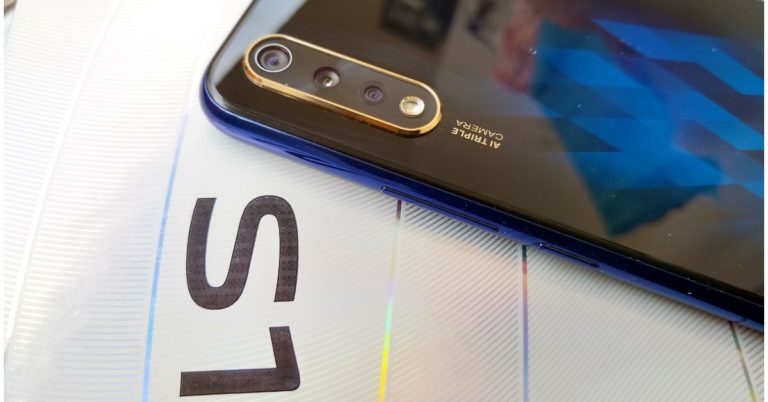
On the brighter side, the company has chosen plastic material that gives it a glass-like finish. The rear panel comes with a triple rear camera set up aligned vertically along with golden border all along the metal rim placed on the top left corner with LED Flashlight. On the right edge, Vivo S1 comes with Volume and power buttons that are easy to get to. On the left, the phone comes with a Dual SIM (NANO) card slots along with a dedicated Google Assistant button that activates the Assistant on a single press, identical to the Vivo Z1 Pro. While at the bottom user gets a 3.5mm headphone jack as well as a Micro-USB port along with a speaker grille.
Not only the back panel looks stylish, but the front also looks pretty good. Vivo S1 has a bright display screen that offers vivid colours as well as crisp text characters when used indoors. The brightness of the screen is not superb when used under direct sunlight. We suggest using the auto screen brightness mode if you go out a lot. On the whole, the display is pretty much decent as we thoroughly enjoyed watching movies, surfing the internet as well as browsing social media apps like Instagram and Facebook. The overall experience was good because the touch response is quick.
Here we would also like to mention that at this price point the Vivo S1 offers in-display fingerprint sensor along with face unlock feature. And we were surprised to note that both the sensor were swift at unlocking the phone, but the face unlocks feature excellent for our liking as it was way faster than the fingerprint sensor.
Vivo S1 Performance and Camera
Vivo S1 is powered by an octa-core MediaTek Helio P65 SoC. The Helio P65 is paired with two cores Cortex A75 cores clocked at 2GHz along with six Cortex A55 cores clocked at 1.7 GHz. The handset comes integrated with Mali-G52 intended for graphics.
The handset is available in three storage options 4GB RAM/128 GB storage and 6GB RAM/64 GB storage and 6GB RAM with 128GB storage that is expandable up to 256GB via microSD card. The 4GB RAM along with 128GB of internal storage will come at a price tag of Rs 17,999 the other 6GB RAM with 64GB of onboard storage variant can be purchased at Rs 18,990 while the 6GB RAM with 128GB storage variant can be bought for Rs 19,990.
The handset runs on Android 9.0 based on Funtouch OS 9 that offers Jovi Smart Screen, Customisable Icons, Dark Mode, new shortcut centre and so on, which offers smoother and faster user experience.
Unlike Vivo Z1 Pro, the Vivo S1 smartphone comes with a 4500mAh battery supported by 18W fast charger that is included in the box. It takes 2.5 hours to get fully charged. Despite the large battery inside the device is light in weight.
Vivo S1 Performance and Camera
Coming to the user interface and Android 9 with Funtouch OS experience, if truth to be told the home screen is a bit chaotic as there is no app drawer. It comes pre-installed with lots of apps like V-Appstore, Vivo Browser, Vivocloud data backup service, Easyshare file sharing tool, I Manager for general security and maintenance tasks and I Theme for UI customisation. Third-party apps include Gaana, Amazon, Facebook, WhatsApp, PhonePe, Paytm and more. The device could have done without them, however, Vivo does give its users the options to quickly remove most of the above apps in two taps.
A good-looking phone with great design is not the only requirement while buying a smartphone. Today in the era of Instagram and Facebook people love clicking pictures as well as posting them instantly. So if you are also one of them and love taking pictures as well as expect them to be Instagram worthy then the S1’s selfie camera comes into play. On the front, the 32MP camera (with f/2.0 aperture) has been included within a waterdrop design. The camera sensors of the device are supported by Artificial Intelligence. It offers enhanced beautification features like AI Face Beauty, AI Portrait Lighting, AR Stickers, etc. We must say it is a good quality selfie phone that let us capture great selfies in low light conditions also. So that means the front camera sensor is capable of taking a picture in all light conditions.
Now coming on the rear camera capabilities, first things first, Vivo S1 features a triple rear camera set up that includes a 16MP (f/1.78), 8MP AI Super Wide Angle (f/2.2) secondary sensor along with 2MP Bokeh Camera (f/2.4). The rear camera sensors of the device are supported by Artificial Intelligence, too. It comes with several modes like HDR Mode, Live Photo, PDAF, AI Super Wide-Angle, Portrait Mode, AI Portrait Framing, AI Face Beauty, Time-Lapse, Slo-Mo among others. At this price point, we did not expect Vivo to be providing a phone with just a 16-megapixel camera. Its competitors in the market launched their devices with a 48-megapixel camera set up. Well, maybe in the next one then.
However, we managed to click a good picture with the Vivo S1 but we missed the sharpness in the pictures, which a 48 MP camera will fetch. And here we would like to mention like many other smartphones it also failed to capture pictures where red, magenta and white colours were prominent, we clicked few pictures in the portrait mode and the results were not up to mark as we noticed a change in the colours.
The low light pictures were great we have also attached a few samples of photos captured in low light conditions. The pictures were less noisy when compared to some of its competition and we were able to capture the photos with great details.
Verdict
Where other Chinese brands like Xiaomi and Realme are constantly coming up with great design and performance Vivo’s S1 did leave us with a mixed bag of feelings. On one hand, we loved the day and night shots of the front camera, but day shots of the rear sensors were a bit outdated. Nevertheless, if you are looking for a phone that looks good as well as captures great selfies then go for Vivo S1 because it delivers good selfies in almost all light conditions.
Over that, to give it life, Vivo S1 houses a 4500 mAh battery that is supported by 18W Dual-Engine Fast Charging. It lasts more than a day on a single charge if you are not a heavy gamer or power user.